Author: tugela
-
Superfortress Europe
[FR] [NL] plus bas / hieronder
[ENG] On the significance ot the Valletta-treaty for Niger – Money, knowledge and technology in exchange for shifting Europe’s borders:
excellent documentary Superfortress Europe (46 min; 19/02/17)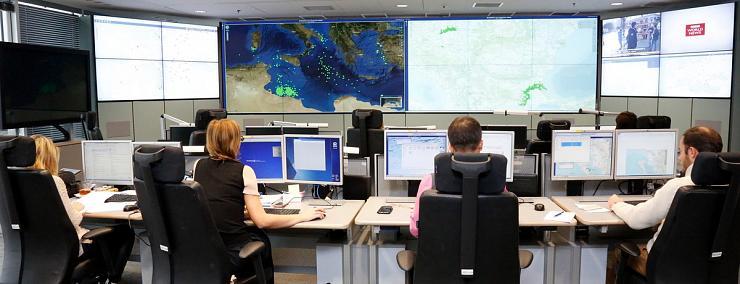 VPRO Backlight is participating in the research project Security for Sale, an initiative of dutch internet Correspondent. Journalists from Sweden, Denmark, Germany, France, Netherlands, Belgium and Italy explore the expanding European security industry: https://thecorrespondent.com/10221/security-for-sale-the-price-we-pay-to-protect-europeans
[NL]
Over de betekenis van de Valetta-overeenkomst voor Niger kijk naar
Superfort Europa (46 min; VPRO Tegenlicht 19 febr 2017)VPRO Tegenlicht doet mee aan het onderzoeksproject Security for Sale, een initiatief van De Correspondent. Journalisten uit Zweden, Denemarken, Duitsland, Frankrijk, Nederland, België en Italië onderzoeken de uitdijende Europese veiligheidsindustrie:
http://www.vpro.nl/programmas/tegenlicht/lees/bijlagen/2016-2017/superfort-europa/gidsartikel.html
https://thecorrespondent.com/10221/security-for-sale-the-price-we-pay-to-protect-europeansEuropa’s zuidgrens ligt niet meer aan de Middellandse Zee, maar midden in Afrika (Correspondent)
Niger en de buitengrens van Europa (VPRO Tegenlicht)[FR]
Bientot aussi en francais le documentaire Super Fortresse Europe (fait parti du projet de recherche Security for Sale, une initiative du journal digital Neérlandais Correspondant: des journalistes de la Suède, du Danemark, de l’Allemagne, de la France, des Pays-Bas, de la Belgique et de l’Italie explorent l’industrie de la sécurité européenne en expansion: https://thecorrespondent.com/10221/security-for-sale-the-price-we-pay-to-protect-europeans).
Enquête de Basta! (aussi Security for Sale):
Migrants, Schengen, terrorisme : comment le complexe militaro-industriel européen prospère sur la peur -
The European travel document. Yet another step to deport by all means
[eng. below]
http://www.migreurop.org/IMG/pdf/cp-valettelpe-final_fr.pdf
Le Laissez-passer européen, un pas supplémentaire
vers l’expulsion à tout prixAlors que des hauts fonctionnaires africains et européens se réunissent à Malte les 8/9 février 2017 à mi-parcours du processus de la Valette, l’Union européenne fait un pas de plus pour restreindre la mobilité des personnes migrantes et imposer sa loi aux pays d’où viennent la majorité d’entre elles, sous la forme du « laissez-passer européen », adopté sans bruit en octobre 2016.
Le plan d’action lancé à La Valette en novembre 2015 par l’UE, ses Etats membres et 35 Etats africains vise à « lutter contre l’immigration irrégulière, le trafic d’êtres humains et les causes profondes de la migration forcée ». Actuellement en cours d’évaluation, il s’appuie sur la « coopération extérieure » pour obtenir la signature, par des Etats « tiers », d’accords de réadmission destinés à expulser plus facilement les personnes migrantes.
Avec le laissez-passer européen (LPE), l’UE marque une étape supplémentaire de la stratégie d’externalisation de sa politique migratoire depuis vingt ans. Ce document de voyage, délivré par les Etats membres de l’UE – et eux seuls -, permet d’expulser une personne sans qu’elle ait été identifiée par le pays « tiers » dont elle est supposée être originaire, et donc sans laissez-passer consulaire, au mépris de ses droits et du principe d’égalité entre Etats souverains (garanti par la Convention de Vienne).
En dépit de l’opposition exprimée dès novembre 2015 par les responsables africains présents au Sommet de La Valette et réitérée début 2017 par la société civile et le gouvernement maliens, le LPE – malgré ses défauts majeurs de forme et de fond – est bel et bien déjà utilisé.Au-delà des effets négatifs immédiats d’une mesure d’éloignement sur les personnes, le flou total qui caractérise la mise en œuvre du LPE laisse craindre un nombre important de violation des droits, en atteste le nombre de questions sans réponse que pose l’utilisation de ce document (voir liste ci-jointe).
A l’heure où la machine à expulser gagne en puissance (coopération avec la Turquie, l’Afghanistan, la Libye, nouvelles prérogatives octroyées à Frontex), les droits fondamentaux ne sont même pas évoqués dans le texte paru au Journal Officiel de l’UE sur le LPE.
Les réseaux africains et européens d’organisations de la société civile signataires du présent communiqué réclament que les Etats membres de l’UE suspendent immédiatement l’utilisation du LPE et que l es autorités européennes fournissent et publient sans délai les informations complémentaires et indispensables concernant sa mise en œuvre (voir liste des informations ci-jointe).
La mobilité est un droit, et non un outil de chantage diplomatique.
7 février 2017________________________________________________________
[eng]
http://www.migreurop.org/IMG/pdf/pr-valettaeutd-final_en.pdf
The European travel document
Yet another step to deport by all meansMid-way in the Valletta processes, and as African and European high officials are meeting in Malta on 8/9 February 2017, the European Union is crossing a step further in its attempts to limit mobility of migrants and imposes its rule on countries where most of migrants originate from through the use of the “European travel document”, a document adopted last October 2016 and almost unnoticed.
The action plan established in Valletta in November 2015 by the EU, its Member States as well as 35 African states aims to “address irregular migration, human trafficking as well as the root causes of forced migration”. Currently under mid-term review, the action plan bases upon “external cooperation” in order to get “third” states’ signature on readmission agreements. Those agreements should facilitate the removal of migrants.
The European travel document (EUTD) marks yet another step in the EU’s strategy to externalise its migration policy or over twenty years. This travel document is issued exclusively by EU Member States and enables the deportation of a person without s/he has been identified by the “third” country h/she suspected of coming from, i.e. without the person being issued a consular travel document regardless of the person’s rights and of the principle of equality between sovereign states (guaranteed in the Vienna Convention).
Despite the strong opposition of African leaders against the European travel document as soon as November 2015, a position reasserted in early 2017 by civil society and the Malian government, the EUTD is already in use, irrespective of substantial shortcomings both in the format and in the content.
Beyond the negative and immediate impact of a removal order on people, it should be stressed that the complete vagueness on the use of the EUTD may lead to serious human rights violations, as illustrated by the number of interrogations and uncertainties (see attached list).
As the deportation apparatus is gaining in strength (cooperation with Turkey, Afghanistan, Libya, as well as Frontex’s new prerogatives), it is worth noting that fundamental rights are not even mentioned once in the related regulation published in the EU Official Journal.
The undersigned European and African networks of civil society organisations hereby call on the EU Member States to immediately suspend the use of the EUTD, and call on the EU authorities to provide publicly and with no delay complementary and indispensable information on its use (see attached list of required information).
Mobility is a right, not a tool for diplomacy bargain.
February, 7 th , 2017 -
Le Mali refuse le Paissez-passer européen et appele les compagnies aériennes à ne pas les accepter / Mali refuses EU-Laissez-passers and calls airline companies not to accept them
[EN] below
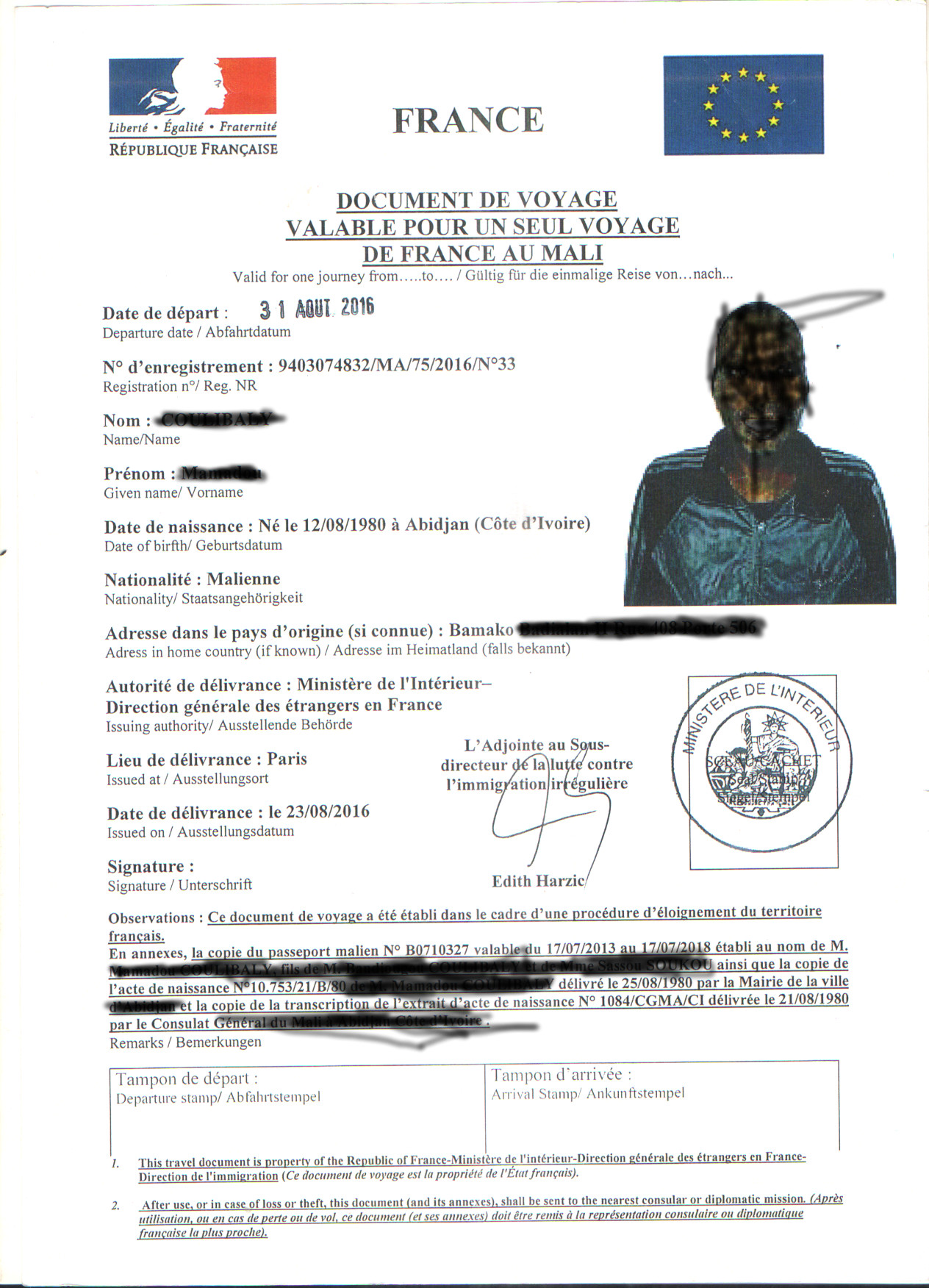
Voici le refus de Laissez-passer européen de l’Etat Malien 29 dec. 2016 avec lequel deux migrants en provenance de France ont été renvoyés par le mème vol à l’aéroport international de Bamako.
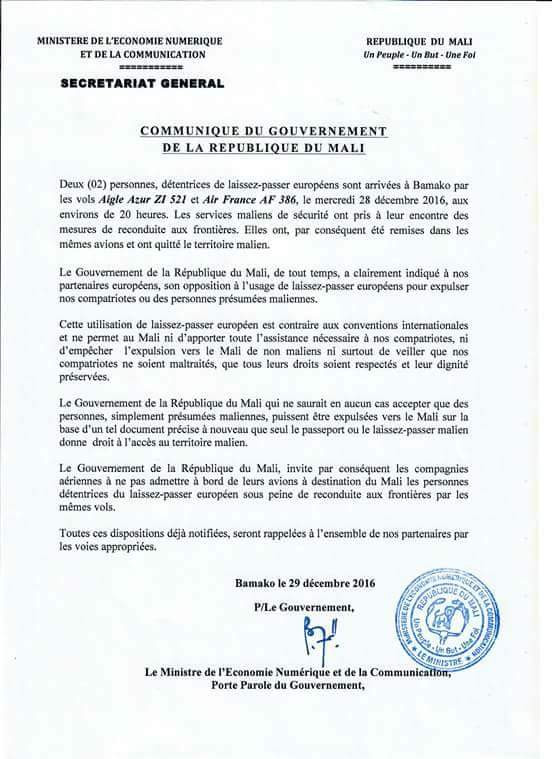
(en-dessous copie du Laissez-passer Européen)
Communiqué Association Malienne des Expulsés
vendredi 6 janvier 2017
Le mercredi 28 décembre 2016 les services de sécurité maliennes (Police des Airs et des Frontières) ont procédé au refoulement de deux personnes arrivées au Mali le même jour par les vols Aigle Azur ZI 521 et Air France AF 386. Ces deux personnes supposées être des maliens étaient détentrices de laissez-passer européens comme document de voyage alors que ces documents n’ont aucune base juridique et légale.
L’utilisation du laissez-passer européen par certains pays européens constitue une violation de la Convention de Vienne du 24 avril 1963 sur les relations consulaires dans la mesure où ces migrants expulsés vers le Mali n’étaient pas accompagnés par des documents délivrés par les services consulaires de la République du Mali.
Pour rappel, le gouvernement du Mali à travers le Ministère des Affaires Etrangères, de l’Intégration Africaine et de la Coopération Internationale avait déjà mis en garde les autorités françaises contre l’utilisation des laissez-passer européens. Une note verbale a été émise dans ce sens le 27 juin 2015 et prévoyait le renvoi systématique par les mêmes vols des personnes expulsées au Mali et ne possédant pas de documents délivrés par le Consulat du Mali.
L’Association Malienne des Expulsés (AME) se réjouit et félicite le gouvernement de la République du Mali pour le refoulement vers la France des deux personnes expulsées au Mali. L’AME exhorte le gouvernement et l’encourage de continuer à œuvrer pour le respect des droits des migrants et pour une relation franche entre les deux Etats.
L’AME invite les Etats membres de l’Union Européenne à renoncer à l’utilisation des laissez-passer européens et le gouvernement Malien à mettre fin sans délais aux opérations d’identification de nos compatriotes en Europe.
Enfin, l’AME s’interroge sur le sort des migrants expulsés sur la base du laissez-passer européen et qui vivent actuellement au Mali.
Le Président
Ousmane DIARRAL’Association Malienne des Expulsés et All Included sont membres de Afrique-Europe Interact
Afrique-Europe-Interact est un petit réseau, constitué début 2010, organisé au niveau transnational. Participent à ce réseau des activistes de base, venant pour la plupart du Mali, du Togo, de l’Allemagne, de l’Autriche et de la Hollande ; parmi eux, de nombreux réfugiés, migrants et expulsés organisés de façon autonome.
Observatoire de la Société Civile Ouest Africaine sur le Plan d’Action de la Valette: Déclaration de dix ONGs de dix pays de l’Afrique de l’Ouest
[EN]
Mali/EU: Two returnees sent back to France as Mali rejects EU laissez-passer document
On 29 December 2016, the Malian government produced a statement announcing its refusal to recognise the validity of the EU laissez-passer document used to return two of its citizens, who were sent back to France following their arrival in Bamako on 28 December 2016. The Malian authorities also invited air carriers to refrain from transporting its citizens on the basis of recognition of the validity of such documents, noting that they will be made to fly them back to Europe.Statement by the Government of the Republic of Mali (29 December 2016)
Two (02) people, holders of European laissez-passer documents arrived in Bamako on Wednesday 28 December 2016 at around 8:00 p.m. on flights Aigle Azur ZI 521 and Air France AF 386. The Malian security services adopted measures to return them to the border. Consequently, they were placed on board of the same aeroplanes again and left the Malian territory.
For a long time, the Government of the Republic of Mali has clearly indicated to its European partners that it opposes the use of European laissez-passer documents to expel our compatriots or people who are presumed to be Malians.This use of the European laissez-passer documents contravenes international conventions and does not enable Mali to lend the assistance which is required to our compatriots, nor to prevent the expulsion of non-Malians to Mali nor, especially, to ascertain that our compatriots are not mistreated, that all their rights are respected and their dignity is safeguarded.
In any case, the Government of the Republic of Mali could not accept that some people, who are merely presumed to be Malians, may be expelled to Mali on the basis of such a document, and clarifies again that only a passport or a Malian laissez-passer may provide a right of access to Malian territory.
Consequently, the Government of the Republic of Mali invites all air carriers not to allow people who are holders of European laissez-passer documents on board of their flights travelling to Mali, as they will returned to the border on the same flights.
All our partners will be reminded through the appropriate channels of all these provisions, about which they have already been notified.
Bamako, 29 December 2016
For the Government,
The Minister of Statistical Economy and Communications,
and Government SpokesmanUse of the European laissez-passer by certain European countries constitutes a violation of the Vienna Convention
Statement by the Association Malienne des Expulsés, 6 January 2017
On Wednesday 28 December 2016 the Malian security services (Air and Border Police) enacted the refoulement of two people who arrived in Mali on the same day in flights Aigle Azur ZI 521 and Air France AF 386. These two people who were presumed to be Malians were holders of European laissez-passer documents as travel documents although such documents do not have any legal and judicial basis.The use of European laissez-passer documents by certain EU countries constitutes a violation of the Vienna Convention of 24 April 1963 on consular relations, insofar as these migrants expelled to Mali were not in possession of documents issued by the consular services of the Republic of Mali.
We recall that the Malian government, through the Ministry for Foreign Affairs, for African Integration and for International Cooperation, had already warned the French authorities against using European laissez-passer documents. A verbal note was issued to announce this on 27 june 2015, envisaging the systematic return using the same aeroplanes of people expelled to Mali without being in possession of documents produced by the Consulate of Mali.The Association Malienne des Expulsés (AME, Malian Association of Expellees) welcomes this and congratulates the government of the Republic of Mali for these returns to France of the two people who were expelled to Mali. AME exhorts the government and encourages it to continue to act for the sake of respect for the rights of migrants and for a frank relationship between the two States.
AME invites the Member States of the European Union to give up on the use of of European laissez-passer documents and for the Malian government to immediately put an end to its operations to identify our compatriots in Europe.
Finally, AME is concerned about the fate of migrants who have been expelled on the basis of European laissez-passer documents and who currently live in Mali.
The President
Ousmane DIARRATranslations by Statewatch
The original versions of both statements (in French) are available on the Dutch website All Included, which also includes a copy of the European laissez-passer document issued by the French authorities, at: http://www.allincluded.nl/posts/le-mali-appele-compagnies-aeriennes-barrer-acces-aux-personnes-avec-laissez-passer-europeen/
The website of the Association Malienne des Expulsés, http://www.expulsesmaliens.info/
and the 6 January 2017 statement,
L’utilisation du laissez-passer européen par certains pays européens constitue une violation de la Convention de Vienne: http://www.expulsesmaliens.info/L-utilisation-du-laissez-passer.htmlL’Association Malienne des Expulsés and All Included are members of Afrique-Europe Interact
Afrique-Europe-Interact is a small, transnationally organised network that was founded in early 2010. It consists of grassroots activists mainly from Mali, Togo, Germany, Austria and the Netherlands – many of them self-organised refugees, migrants and people who were deported.
Déclaration de la Société Civile d’Afrique de l’Ouest sur le Plan d’action Valletta
Observatory of the West African Civil Society on the La Valletta Action Plan: Declaration of ten NGO’s from ten West-African countries
-
Mali ontkent’ leugenachtige informatie’ over Koenders EU-akkoord met Mali over terugkeer migranten en eist rectificatie
De Malinese minister van Buitenlandse Zaken, Internationale Samenwerking en Afrikaanse Integratie, S.E.M. Abdoulaye DIOP, heeft in een persbericht 12 december 2016 een ‘démenti formel’ – een formele ontkenning – uitgevaardigd. Hierin wordt een EU akkoord met Mali over terugkeer van migranten ten stelligste ontkend. Een dag eerder – de dag van het bezoek van minister Koenders aan Mali 11 december – verspreidde het Nederlandse Ministerie van Buitenlandse Zaken het nieuwsbericht van een terugkeerovereenkomst onder de titel ‘Koenders sluit namens EU akkoord met Mali over terugkeer migranten’. Naar aanleiding van de mediaberichten (o.a. “EU, Mali sign deal to return refugees”) ontstond een heuse rel in Bamako.
De Malinese minister Diop (die zelf Koenders had uitgenodigd) verklaarde in een persbericht:
“Het ministerie van Buitenlandse Zaken, Internationale Samenwerking en Afrikaanse Integratie ontkent deze leugenachtige informatie ten zeerste waarvan zij de ware intenties niet kent. De verspreiding van valse informatie is een overtreding bestaande uit het verspreiden van desinformatie voor manipulatie doeleinden (….). Om de controverse te beëindigen wijst het ministerie van Buitenlandse Zaken van Mali erop dat er nergens sprake is geweest van een ondertekening van welk overeenkomst dan ook die het mogelijk zou maken onze landgenoten die irregulier in Europa verblijven uit te zetten.” (volledige tekst onderaan of hier)
„Van de kant van de regering van Mali verwerpen wij deze verklaring volledig”, zegt Diop. „Want er is geen akkoord getekend over de terugkeer van migranten. De verklaring weerspiegelt niet de punten die zijn besproken.” Hij noemt het belangrijk dat Nederland het bericht corrigeert.
Europarlementariër Sargentini zei in VPRO Bureau Buitenland dat ze over de kwestie vragen gaat stellen aan Eurocommissaris Mogherini.De Association Malienne des Expulsés (AME) heeft sinds jaren in Bamako succesvol actie gevoerd tegen een terugkeer-overeenkomst. Migratie is een belangrijke bron van inkomsten voor een arm land als Mali. De AME heeft na bezoek aan het ministerie van Buitenlandse Zaken in Bamako maandag j.l. verzekerd dat er geen sprake is geweest van ‘verraad van de kant van Mali’ en dat ‘de beslissing van categorische weigering om een terugname-overeenkomst te ondertekenen nog steeds geldig is’. Sinds het Valetta-akkoord tussen Afrikaanse staten en de Europese Unie uit nov. 2015 oefent de Europese Unie grote druk uit op Afrikaanse landen om de onderlinge Afrikaanse grenzen te sluiten voor migranten en om migranten uit Europa terug te nemen. In febr. 2016 zetten tien West-Afrikaanse NGO’s waaronder de AME de ‘Observatoire de la Société Civile Ouest Africaine sur le Plan d’Action de la Valette’ op om op te komen voor migrantenrechten als vrijheid van beweging en om te ijveren voor veilige legale migratie. De AME bereidt zich momenteel voor met een grote mobilisatie tegen een mogelijke terugname-overeenkomst.
Amsterdam, 16 december 2016
All IncludedDe AME maakt deel uit van het Afrique-Europe Interact netwerk waar ondergetekende All Included ook deel van uitmaakt
Meer informatie:
– Déclaration de la Société Civile Ouest Africaine a l’issue de la réunion sur la mise en oeuvre du plan d’action de la Valette par les etats membres de la Cedeao
– Afrique-Europe Interact:”do not sign any readmission agreement or contracts concerning the acknowledgement of EU-laisser passer”
– De Association Malienne des Expulsés (AME) keert zicht tegen een ondertekening van een “overnameovereenkomst” die het mogelijk maakt Malinesen zonder papieren van Europa te verdrijven zonder instemming van een Malinese consulaat: http://news.abamako.com/h/145434.htmlCOMMINIQUE DU MINISTERE DES AFFAIRES ETRANGAIRES, DE LA COOPERATION INTERNATIONALE ET DE L’INTEGRATION AFRICAINE (DEMENTI FORMEL)
Le 12 décembre 2016, le journal L’Orient LE JOUR a révélé dans sa parution que le Mali a signé un Accord avec l’Union Européenne sur la Migration. Selon ce journal, l’UE signe le premier accord avec un pays africain sur le retour de demandeurs d’asile, en faisant allusion au Mali.
Le Ministère des Affaires étrangères, de la Coopération internationale et de l’Intégration africaine dément fermement ces informations mensongères du journal dont il ignore leurs vraies intentions. Le délit de diffusion de fausse information est une infraction consistant à répandre des informations erronées aux fins de manipulation.
La visite au Mali de SEM Bert Koenders, Ministre des Affaires étrangères des Pays-Bas s’inscrit dans le cadre du dialogue de Haut niveau sur toutes les questions de coopération notamment la migration, initié entre le Mali et l’Union européenne depuis le Sommet de La Valette tenu les 11 et 12 novembre 2015.
Dans la pratique diplomatique, il est courant que des visites de cette nature soient sanctionnées par un communiqué commun, conjoint ou de presse. Celui-ci fait ressortir les sujets discutés et fixe les échéances. Aussitôt après la rencontre, le communiqué a été diffusé immédiatement et nulle part, il n’a été question de signature d’un quelconque accord qui permettrait d’expulser nos compatriotes en situation irrégulière en Europe.
Un communiqué conjoint n’a pas la valeur juridique d’un accord en droit international.
Il importe de signaler que ces “journalistes” de L’Orient LE JOUR n’ont pas agi en professionnel car toute information avant sa diffusion doit obéir à des règles de vérification.
Par conséquent, le Ministère des Affaires étrangères, de la Coopération internationale et de l’Intégration africaine invite tout un chacun à lire le texte de communiqué commun qui a été largement diffusé. (voir le site web du Ministère des Affaires Étrangères www.diplomatie.ml).
Bamako, le 12 décembre 2016 -
JOIN US IN ‘THE FLOWERS CAMPAIGN’
In October 2016, the United Nations announced that 3800 people had died in the Mediterranean Sea since the beginning of the year. With more boats sinking off the Libyan coast recently, this number has unfortunately increased, setting a tragic new record in 2016. More than ten thousand men, women and children have thus died over the last two years. According to the International Organization for Migration (IOM), 22000 migrants have perished since the year 2000, their crafts having sunk in the waters of this sea-cemetery. Although this tragedy leaves us with a heavy conscience and a heavy heart, no viable solutions have been found to end this situation.
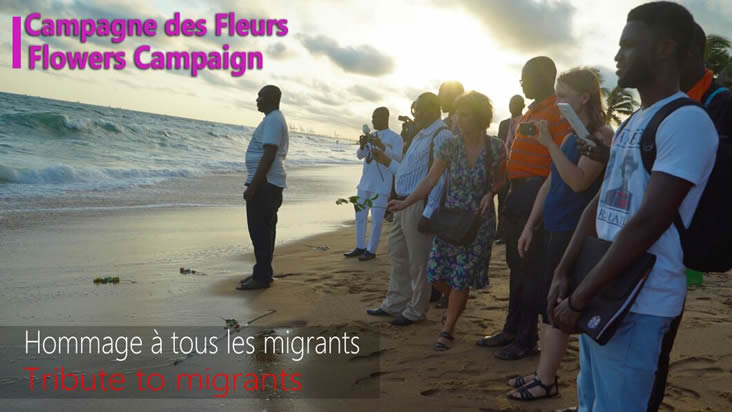
Migration has become a dangerous undertaking for an entire swathe of humanity:
For those human beings who are considered second-class citizens and no longer have the right to freedom of movement; who are unable to flee the conflicts, bullets and bombs decimating their families; to whom exodus is denied even after seeing their cattle succumb to drought, their harvests decimated, their fishing and agricultural activities prohibited following occupation of their land and waterways; for populations living under the oppression of corrupt leaders that are supported by an economic system that ensures they remain in power against the will of the people.Migrants arriving to settle in certain countries are victims of collective expulsion. They are more and more arrested; Suffer physical and moral abuse and in the worst cases are killed to the detriment of international rights and under the watchful eye of African leaders and the international community.
This desperate situation should have incited the international community to renew its commitment to the values of solidarity and sharing rather than egocentricity, selfishness and the pursuit of profits. Alas, the governments in both the North and South have responded to this tragedy by introducing xenophobic policies that infringe human rights and by proclaiming assistance to migrants an offense. Laws are continually being adopted to facilitate free-trade and the transfer of money, encouraging tax evasion, yet, at the same time, the mobility of human beings is being restricted through tighter visa requirements. Human life now has less value than a bottle of Coca Cola.
Convinced that securitarian, xenophobic and repressive policies are totally ineffective in solving the existential crisis undermining our societies and in celebration of International Migrants Day on the 18th December, the member organisations of the West African Observatory on Migrations are launching “the Flowers Campaign”.
On the 18th December, the Flowers Campaign aims to pay homage to all the migrants that have died on the borders and in the seas, oceans and deserts of the world. On this occasion, the West African Observatory on Migrations invites all citizens that support solidarity and justice to join us in paying homage to the migrants that have perished by throwing a flower into a stream, lagoon, river, sea or ocean. To also honour the migrants that live near our homes, we invite you to participate by offering them a flower or the drawing of a flower as a token of your esteem.
Together, let’s unite forces to oppose xenophobic laws and promote global diversity.
West African Observatory on Migrations
Observatoire Ouest Africain des Migrations
Observatório Oeste Africano das Migrações
www.obsmigration.org
Tél / Whatsapp:(+228) 90794412 <+228%2090%2079%2044%2012>
14BP173 Lomé-TOGO -
bijeenkomst met Alassane Dicko uit Mali
[english underneath]
debat over het La Valletta migratieakkoord tussen de EU en Afrika en de betekenis voor West-Afrikaanse bevolking
met gast Alassane Dicko uit Bamako/Malidinsdag 13 sept. 20 uur
Dokhuis Galerie | Plantage Doklaan 8 te Amsterdameten vooraf: 19 uur (5 euro; graag reserveren op antwoordapparaat 020-3795236 maandag uiterlijk)

Alassane Dicko is een activist uit Bamako die zich inzet voor de sociale beweging in Mali (migratie, externalisatie van grensbewaking, gentrification, landroof). Na jarenlang secretaris te zijn geweest van de Association Malienne des Expulsés (AME) is Alassane nu actief binnen de Malinese sectie van Afrique-Europe Interact (AEI) onder de leus Vrije Migratie en Duurzame Ontwikkeling. All Included is vanuit Nederland actief lid van AEI. AEI is actief in Mali, maar ook in Togo. Meer over Togo en AEI.
Onder het mom van de vele doden in de Middellandse Zee sluiten de Europese Unie en Afrikaanse regeringen in nov. 2015 een migratie-akkoord in La Valletta/Malta. De Afrikaanse landen zeggen onder zware druk toe hun grenzen te gaan sluiten voor migranten met als beloning een noodfonds van twee miljard euro voor ontwikkelingsprojecten. Tijdens de top roept Afrique-Europe Interact middels een persconferentie in Bamako de Afrikaanse leiders in een open brief op niet mee te werken aan een plan die onvoorwaardelijk uitgaat van de belangen van het westen zoals het terugnemen van uit te zetten migranten en sluiten van de grenzen tussen de Afrikaanse staten. Een duurzame ontwikkeling ten bate van de gehele bevolking en respect voor de rechten van migranten en vluchtelingen dient voorop te staan, stelt AEI.
Tijdens een regeringsbijeenkomst van de Economische Gemeenschap van West-Afrikaanse Staten (ECOWAS) begin 2016 nemen tien NGO’s uit West-Afrika het gezamelijk initiatief tot het opzetten van de ‘Observatoire Ouest Africain des Migrations’, een monitoring van het La Valletta Actie Plan. Zij ondersteunen als civil society het zoeken van oplossingen voor het aanhoudende drama aan de Europese kusten, in de Sahara woestijn en in de Golf van Guinee. Maar zij stellen eveneens dat de eis van migratie management de ECOWAS enorme schade zou toebrengen. 84% van de West Afrikaanse migranten leven immers in een ander ECOWAS land. De Observatoire beschuldigt de EU tevens van het uitoefenen van zware druk aangaande het ondertekenen van de Economische Partnerschapsakkoorden die de kleine lokale productie-units laat concurreren met de grote Europese bedrijven.
Daar Nederland in de eerste helft van 2016 voorzitter van de Raad van de Europese Unie is, deelt Minister Koenders in april 2016 in verscheidene Afrikaanse landen La Valletta-ontwikkelingsgelden uit in ruil voor toezeggingen en een handtekening onder een akkoord. Door druk van de sociale beweging heeft de regering in Bamako nooit een terugnameoveereenkomst getekend waarmee het zich verplicht irreguliere migranten terug te nemen. Inkomsten uit migratie is voor de Afrikaanse bevolking te essentieel. Nu wist Koenders een handtekening van de Malinese premier los te krijgen. Mali zou het sturen van immigratiemissies naar Europese detentiecentra hebben toegezegd ter identificatie van uit te zetten ongedocumententeerde migranten. Tevens zullen de EU en Mali grenscontroles versterken en mensensmokkel tegengaan.
Wat zal met het La Valletta akkoord veranderen voor de bevolking in Mali? En hoe heeft de sociale beweging hierop gereageerd?
Wat zijn de andere belangrijke thema’s die spelen in Mali?
Wat kunnen we hier in Nederland doen om de sociale beweging in West-Afrika te ondersteunen?
Welkom op deze bijeenkomst!
dinsdag 13 sept. 20u, Dok Gallery, Plantage Doklaan 8 Amsterdam.
Eten vooraf: 19u (5 euro; graag reserveren op antwoordapparaat 020-3795236 maandag uiterlijk).Meer informatie
All Included: http://www.allincluded.nl/posts/category/actie/acties-tegen-eu-afrika-afspraken-valletta/
Afrique-Europe Interact: http://afrique-europe-interact.net/113-1-Home.html>>>>>>>>>>>>>>>>>>>>>>>>>>>>>>>>>>>>>>>>>>>>>>>>>>>>>>>>>>>&
Andere All Included-evenementen:“Harragas”, Algerijnse speelfilm van Merzak Allouache (2010)
vr. 23 sept. 20u
Cineclub in de Meevaart
Balistraat 48A Amsterdam
https://www.facebook.com/Cineclub-in-de-Meevaart-Balistraat-48-A-Amsterdam-665047870201773/
trailer: https://www.youtube.com/watch?v=997zobbtT8kFerdous Buffet
zo. 25 sept. 12-16u
at Budapest, Pesthuislaan 2 (WG-terrein) Amsterdam
Food is vegetarian starter, vegetarian curry, drink, soup, fruit, salad.
Nutritious meals, fruity desserts and more art.[english]
debate on the Valletta summit on migration between the EU and Africa and its meaning for West African population
with guest Alassane Dicko from Bamako/MaliTuesday 13 September. 8 pm
Dok Gallery | Plantage Doklaan 8 Amsterdammeal at 7pm (5 euros, please book by leaving a message on 020-3795236 monday at the latest)
Alassane Dicko is an activist in Bamako dedicated to the social movement in Mali (migration, externalization of border control, gentrification, land grabbing). After years of secretary of the Association Malienne des Expulsés (=deportees; AME) Alassane is now active in the Malian section of Afrique-Europe Interact (AEI) under the slogan Freedom of movement and Sustainable development. All Included is from the Netherlands an active member of AEI.
Under the guise of the many deaths in the Mediterranean the European Union and African governments close a migration deal in Valletta/Malta in Nov. 2015. African countries agree under heavy pressure to close their borders for migrants with an emergency fund of two billion euros for development projects as a reward. During the summit Afrique-Europe Interact calls in an open letter at a press conference in Bamako on the African leaders not to contribute to a plan unconditionally based on the interests of the West such as the readmission of irregular immigrants and the closing of the borders among African states. Sustainable development for the benefit of the entire population and respect for the rights of migrants and refugees must be to the forefront, says AEI.
During a government meeting of the Economic Community of West African States (ECOWAS) early 2016 ten NGOs from West Africa take the joint initiative to set up the “Observatoire Ouest Africain des Migrations”, a monitoring of the Valletta Action Plan. As civil society they support looking for solutions to the ongoing drama at Europe’s coasts, in the Sahara Desert and the Gulf of Guinea. But they also argue that the requirement for migration management would cause enormous damage to the ECOWAS. 84% of West African migrants are living in another ECOWAS country. The Observatoire also accuses the EU of exerting heavy pressure on the signing of the Economic Partnership Agreements which forces small local production units to compete with large European firms.
With the Netherlands as President of the Council of the European Union in the first half of 2016 foreign minister Koenders distributes Valletta development funds in several African countries in exchange for promisses and a signature under an agreement. By pressure of the social movement, the government in Bamako never signed a readmission agreement forcing Mali to take back irregular migrants. Remittances are essential for the African population. Now Koenders was able to extract a signature of the Malian prime minister. Mali would have promissed to send immigration missions to European detention centers to identify undocumented migrants. The EU also will help strengthening Malian border controls and combating human trafficking.
Will the Valletta agreement change the situation for the population in Mali? How has the social movement responded?
What are the other important themes playing in Mali?
What can we do here in the Netherlands to support the social movement in West Africa?Welcome to this meeting!
Tuesday 13 September. 8 pm, Dok Gallery, Plantage Doklaan 8 Amsterdam.
meal at 7pm (5 euros, please book by leaving a message on 020-3795236 monday at the latest)More information:
All Included: http://www.allincluded.nl/posts/category/actie/acties-tegen-eu-afrika-afspraken-valletta/
Afrique-Europe Interact: http://afrique-europe-interact.net/113-1-Home.html>>>>>>>>>>>>>>>>>>>>>>>>>>>>>>>>>>>>>>>>>>>>>>>>>>
Other All Included events:“Harragas” Algerian film by Merzak Allouache (2010)
vr. 23 Sept. 8:00 pm
Cineclub at the Meevaart
Balistraat 48A Amsterdam
https://www.facebook.com/Cineclub-in-de-Meevaart-Balistraat-48-A-Amsterdam-665047870201773/
Trailer: https://www.youtube.com/watch?v=997zobbtT8kFerdous Buffet
sunday Sept. 25. 12 am – 4 pm
at Budapest, Pesthuislaan 2 (WG-premises) Amsterdam
Food is vegetarian starter, vegetarian curry, drink, soup, fruit, salad.
Nutritious meals, fruity desserts and more art. -
Rapport de la manifestation du Jeudi 9 Juin 2016 à Sokodé (Togo)
RESEAU AFRIQUE-EUROPE INTERACT SECTION TOGO (AEI-TOGO)
Le jeudi 9 Juin 2016, l’Association Togolaise des Expulsés a organisé une manifestation à Sokodé (Togo). L’objectif de la manifestation était de dénoncer la politique migratoire de l’union européenne en Afrique et surtout le plan d’action de la valette au sommet Afrique Europe en novembre 2015. La population de Sokodé a été sensibilisée sur quatre points :
-
Visa et tracasseries aux frontières
-
Déportations et la politique migratoire européenne
-
Situation de migrants en mer et dans le désert
-
Approches de solutions à la question migratoire en Afrique et en Europe.
Le facilitateur de cette sensibilisation, le Coordinateur du Réseau Afrique-Europe InternAct section-Togo a expliqué les quatre points sus-indiqués.
Dans son explication, il a apporté la lumière de la complicité des chefs d’Etat africains de refuser aux ambassades européens de donner des visa à leur concitoyen désireux de voyager.
Le facilitateur a ensuite dénoncer la politique de l’union européenne aux participants. En effet, l’UE a crée une agence européenne dénommée le FRONTEX pour empêcher les migrations vers l’Europe. L’UE a donc signé des accords avec les pays africains membre de FRONTEX.
Abordant la situation des migrants dans la mer méditerranée et dans le désert, le facilitateur a fait comprendre à la population d’importants dégâts en vies humines dans la mer et dans le désert. Il a souligné le décès de deux (02) jeunes gens de Sokodé dont l’un est coiffeur l’autre un photographe. Selon l’OIM, on compte plus de 5 000 morts en 2015.
Que faut-il faire face à cette situation de départ des jeunes africains vers l’Europe ?
Selon les participants à la manifestation, il faut : (voir la déclaration en annexe)
Fait à Sokodé, le 14 Juin 2016
Le Rapporteur
Razakou ABOUBAKARI
Thème : « Sauvons la vie des migrants »
DECLARATION
Le Jeudi 9 Juin 2016, le Réseau Afrique Europe Interact Section Togo à organisé une manifestation sur le thème « Sauvons la vie des migrants » dans la ville de Sokodé (Togo). En effet, Sokodé est l’une des principales villes togolaises de départ de migrants et compte au sein de sa population actuelle beaucoup d’anciens migrants expulsés d’Europe et de divers pays d’Afrique vers le Togo.
Etaient présents à la manifestation les membres de l’Association Togolaises des expulsés (ATE), les migrants de transit (Nigérien, Malien, Peuls nomades…) le groupement des femmes migrantes de l’Afrique Subsaharienne et de l’Europe et une centaine d’habitants de la ville de Sokodé.
L’objectif de la manifestation était de dénoncer le plan d’action de la valette sur les nouvelles politiques migratoires adoptées par l’Union Européennes. Les participants à la manifestation, à la suite des témoignages et exposé débat du thème entendus, déclarent :
-
La migration est un mouvement d’individus dans le temps et dans l’espace.
-
La nécessité de mettre fin aux expulsions des migrants dans tout pays (Afrique ou Europe)
-
L’urgence de soutenir des migrants expulsés ou refugiés.
Ils a appellent à :
-
Ouvrir les frontières et permettre la libre circulation des personnes et des biens.
-
Revoir la p politique de contrôle des frontières par l’agence FRONTEX.
-
Mettre plus de ressources suffisantes sur le plan économique, social et culturel en Afrique pour la réduction de la pauvreté.
-
Organiser des forums à l’échelle internationale pour une résolution définitive de la question de la migration.
Non à l’agence européenne de contrôle des frontières (FRONTEX) !
Non aux accords signés par les Etats africains pour empêcher leur propre population de migrer.
Fait à Sokodé, le 9 Juin 2016
-
-
Joint NGO statement condemning new EU policies to contain migration
At the upcoming European Council, European Union (EU) leaders will discuss the European Commission’s Communication on a new Partnership Framework with third countries. The Communication proposes an approach which aims to leverage existing EU and Member States’ external cooperation instruments and tools in order to stem migration to Europe. The undersigned organisations express their grave concern about the direction the EU is taking by making deterrence and return the main objective of the Union’s relationship with third countries. More broadly, this new Partnership Framework risks cementing a shift towards a foreign policy that serves one single objective, to curb migration, at the expense of European credibility and leverage in defence of fundamental values and human rights.
The proposed approach is inspired by the EU-Turkey deal which although touted as a successful example of cooperation, has actually left thousands people stranded in Greece in inhumane and degrading conditions. This has particularly affected children, with the result that hundreds of unaccompanied children have been held in closed detention facilities on the islands or forced to sleep in police cells on the Greek mainland. The wider repercussions of this should not be underestimated. It is hard to see how Europe can ask partner countries to keep their doors open, to host large-scale refugee populations and prevent further movements while at the same time Member States refuse to shoulder their fair share of responsibility for protecting people who flee
their homes. The right to asylum is being significantly undermined, and it will become more and more challenging for civilians in conflict zones to seek international protection.The Commission’s proposal ignores all the evidence on the ineffectiveness of deterrence strategies aimed at stopping migration. This approach will not only fail to “break the business-model” of smugglers but increase human suffering as people are forced into taking more dangerous routes. Moreover, despite the stated commitment to respect the principle of non-refoulement, there are no safeguards envisaged to ensure that human rights, rule of law standards and protection mechanisms are in place. As a result, people risk being deported to countries where their rights are not safeguarded. Responsibility and liability for human rights violations do not end at Europe’s borders.
We are disappointed to see that once again the emphasis on deterrence leaves no clear commitments to open up safe and regular channels to Europe for those in need of international protection and for other migrants, e.g. through resettlement, humanitarian admission schemes, family reunification, educational visas, labour mobility and visa liberalisation. Resettlement, labour migration and visa liberalisation are only mentioned as possible leverage with partner countries in a quid pro quo approach.
Another major concern is the financing of the proposed Partnership Framework which would represent a wholesale re-orientation of Europe’s development programming towards stopping migration. This is an unacceptable contradiction to the commitment to use development cooperation with the aim to eradicate poverty, as enshrined in the Lisbon Treaty. Aid is for thebenefit of people in need, and should not be used as a leverage for migration control. EU funding should be transparent and adhere to clearly established principles, such as the Busan principles on effectiveness and the Paris principles of ownership by and alignment to partner countries’ strategies. In addition, striking ‘migration management’ agreements with countries where grave human rights violations are committed will be counter-productive in the longer term – undermining
human rights around the globe and perpetuating the cycle of abuse and repression that causes people to flee.Migration has many drivers; people may be on the move in search of new livelihood opportunities, an education or to reunite with family, while conflict and violence, human rights violations, climate change, poverty and unemployment can all trigger migration and forced displacement. Any cooperation to manage migration should take into consideration this complex and multi-faceted reality, be evidence and needs-based, and ensure that the benefits of migration are maximised and the risks are mitigated.
If the EU wants to call for more global solidarity, it needs to set the right example. The EU, a project built on the rubble of a devastating war, is about to embark on a dark chapter of its history. We urge EU leaders to choose a rights-based system to manage migration, based on a viable long-term strategic vision, rather than pursuing an unattainable and inhumane deterrence objective and thereby abandoning its core founding principles.
As human rights, humanitarian, medical, migration and development agencies, and key implementing partners of development programmes in third countries, we call on European leaders to:
1. Reject the current Commission Communication and develop a sustainable long-term and evidence-based strategy for migration management, in consultation with civil society and experts.
2. Facilitate safe mobility by opening and strengthening safe and regular channels to Europe both for those in need of international protection and other migrants including through resettlement, humanitarian admission and humanitarian visas, family reunification, worker mobility across skill levels and student visas. Member States must commit to clear benchmarks and appropriate timelines for implementing a migration framework that meets
the needs of migrants , asylum-seekers and refugees, their families, as well as the needs and obligations of Member States.3. Exclude any conditionality based on migration control indicators in the allocation of development aid to third countries. Development aid is a tool to fight poverty and inequality, not to manage migration. Vulnerable populations should not be punished because of concerns that are largely political.
4. Stop any readmissions or removals of people by the EU to a third country that violate – or risk violating – fundamental rights and rule of law, including the principle of non-refoulement. Ensure access to protection, justice and effective remedy for all people in migration and asylum procedures.
5. Ensure transparency in the development of any instruments to manage migration and accountability for human rights violations resulting from EU migration policies.6. Commit to a foreign policy and action focused on preventing and unlocking protracted crises. While the Communication mentions the need to address root causes of displacement in the long term, it does not include engagement to prevent and manage crises.
Signatories
ACT Alliance EU
ActionAid
aditus foundation
Afrique Culture Maroc
Agir Ensemble pour les Droits de l’Homme
Aid Services
Amnesty International
Amycos
Andalucía Acoge
Asamblea de Cooperacion Por la Paz ACPP
Asgi – Associazione per gli Studi Giuridici sull’Immigrazione
Asociacion por ti mujer
Asociacion Salud y Familia – Spain
Association for action against violence and trafficking in human beings-Open Gate
La Strada Macedonia.
Association for the Social Support of Youth
Ayuda en Acción
British Refugee Council
CAFOD
Care International
CCOO de Andalucia
Centre for Youths Integrated Development.
Centro de Investigaciones en Derechos Humanos PRO IGUAL
ChildFund Alliance
Church of Sweden
Churches’ Commission for Migrants in Europe
Citizens’ association for combating trafficking in human beings and all forms of gender-
based violence
CNCD-11.11.11
Comisión Española de Ayuda al Refugiado –CEAR-
Concern Worldwide
CONCORD Europe
CONCORD Sweden
Conseil des Béninois de France
Consortium of Migrants Assisting Organizations in the Czech Republic
Coordinadora Andaluza de ONGD
Coordinadora Cantabra de ONGD
Coordinadora de ONGD de la Región de Murcia
Coordinadora de ONGD del Principado de Asturias38.
Coordinadora de ONGD España
Coordinadora de ONGD Navarra
Coordinadora Extremeña de ONGD
Coordinadora Gallega de ONGD
Coordinadora ONGD de Castilla y León
Coordinadora Valenciana de ONGD
Cordaid
Detention Action
Detention Forum
Doctors of the World International network
EU-CORD Network
Eurochild
EuroMed Rights
European Association for the Defence of Human Rights
European Council on Refugees and Exiles
European Youth Forum
Federación Aragonesa de ONGD
Federación de Asociaciones de Derechos Humanos
Federation of Christian NGOs in Italy
FIACAT
FIDH
FIZ advocacy and support for migrant women and victims of trafficking
Flüchtlingsrat Niedersachsen e.V.
Forum des Organisations de Solidarité Internationale issues des Migrations
Fundacion 1o de Mayo de Comisiones Obreras
Fundación Alianza por los Derechos, la Igualdad y la Solidaridad Internacional –APS-
Greek Forum of Refugees
Habitat for Humanity International, Europe, Middle East and Africa
Handicap International
Human Rights Watch
Human Rights Without Frontiers
Instituto Sindical de Cooperación al Desarrollo –ISCOD-
InteRed
INTERSOS
Islamic Relief UK
Jesuit Refugee Service Europe.
Justice and Peace Netherlands
KISA-Action for Equality, Support, Antiracism
Koordinierungsstelle der Österreichischen Bischofskonferenz für internationale
Entwicklung und Mission
La Strada International
Lafede.cat – Organitzacions per a la Justícia Global
Le Monde des Possibles
Macedonian Young Lawyers Association
Menedék – Hungarian Association for Migrants
Migrant Voice UK83.
Migrants’ Rights Network
Movimiento contra la Intolerancia
Movimiento por la Paz –MPDL-
Nasc, the Irish Immigrant Support Centre
Norwegian Refugee Council
Oxfam
PAX
Pax Christi International
PICUM-Platform for International Cooperation on Undocumented Migrants
Plan International EU office
Platform Minors in exile / Plate-forme Mineurs en exil / Platform Kinderen op de vlucht
(Belgium)
94. Red Acoge
95. Réseau de Compétences Solidaires – Groupement d’Economie Sociale et Solidaire France –
Europe – Afrique
96. Réseau Immigration Développement Démocratie – IDD
97. Save the Children
98. SOS Children’s Villages International
99. SOS Racisme – Touche pas à mon pote
100. Stichting LOS
101. Swedish Refugee Advice Centre
102. Télécoms Sans Frontières
103. Terre des Hommes International Federation
104. The International Federation of Social Workers European Region
105. The International Rehabilitation Council for Torture victims
106. the Norwegian Centre Against Racism
107. Trócaire
108. World Vision Brussels and EU Representation
109. ZOA