Category: actie

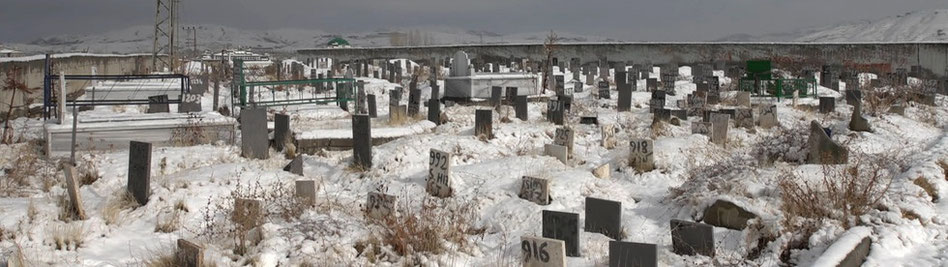
  • CommemorAction in Zarzis/Tunesia 2022

    CommemorAction in Zarzis/Tunesia 2022

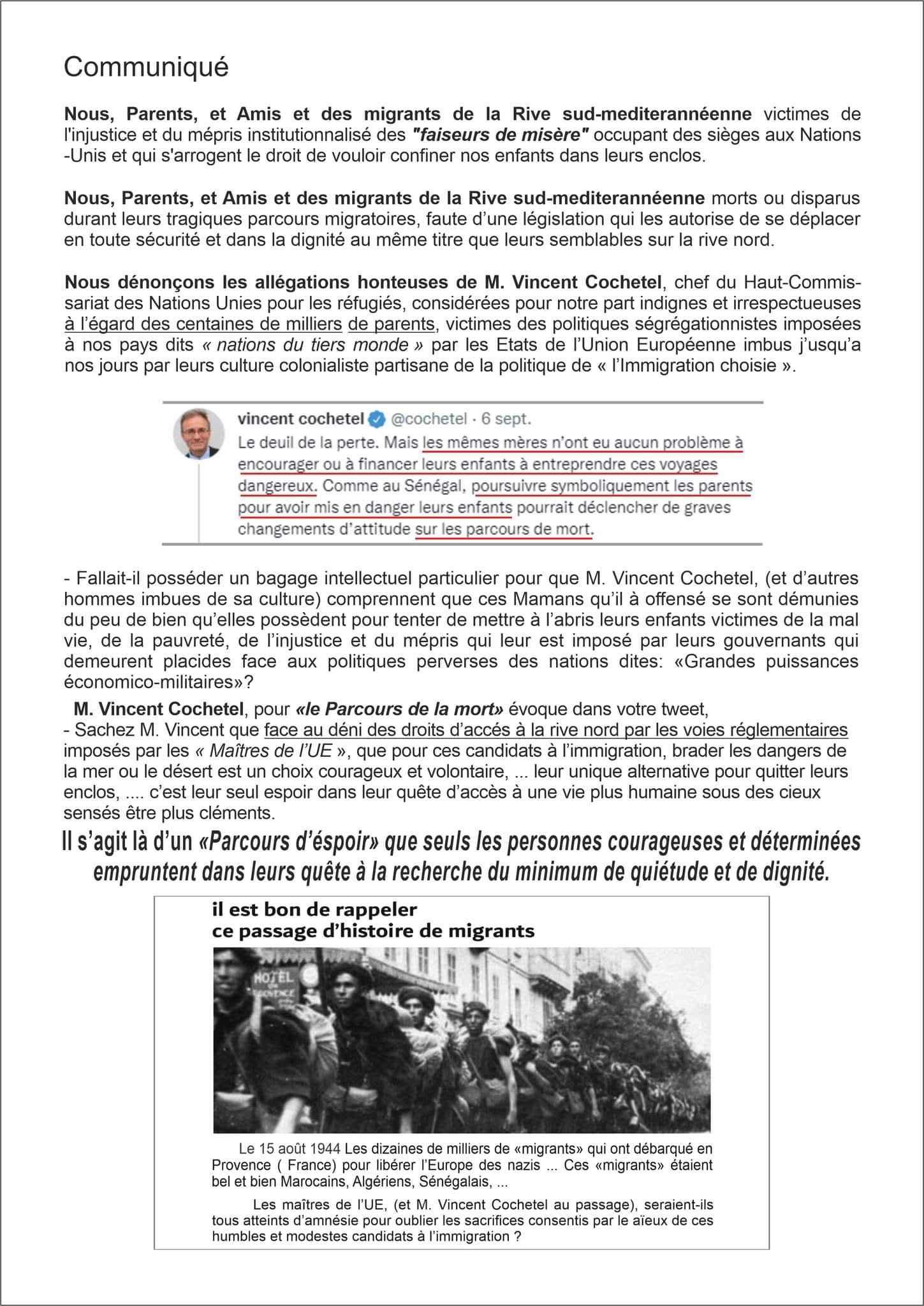
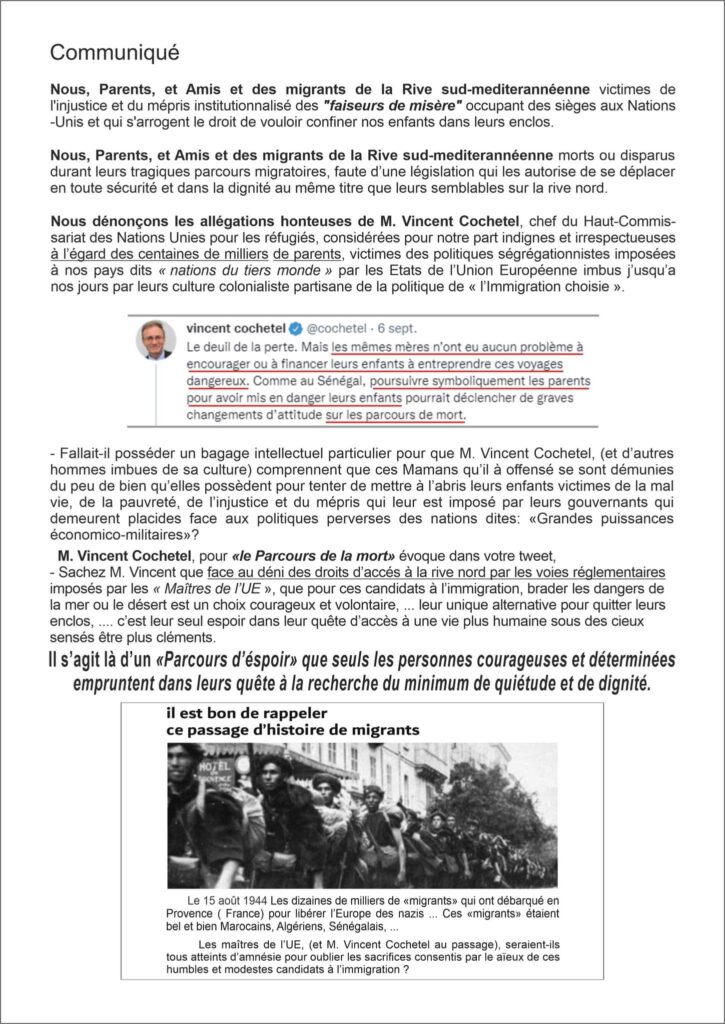
    Joint Statement calling for the dismissal of UNHCR’s special envoy Vincent Cochetel

    On Tuesday, 6 September 2022, while families of the disappeared and deceased at EU borders came together for a protest action in Zarzis, Tunisia, Vincent Cochetel, the UNHCR’s special envoy for the Western and Central Mediterranean sent out a tweet:

    “Grieving for the loss. But the same mothers had no problem encouraging or funding their children to embark on those dangerous journeys. Like in Senegal, symbolically prosecuting parents for putting at risk their children could trigger serious attitudinal change on death journeys.”

    Blaming mourning mothers, some of whom have searched for answers for over a decade, and even calling for their criminalisation through ‘symbolic prosecution’ is simply outrageous. In this joint statement, we want to denounce Mr Cochetel’s words in the strongest of terms. Mr Cochetel sent his tweet as a response to a ‘CommemorAction’, a large gathering in Zarzis that brought together the families of the disappeared, local fishermen, as well as activists from Africa and Europe. While the mothers, who are deeply traumatised, were publicly demanding answers, Mr Cochetel insulted them by making them responsible for their sons’ disappearance.

    Some of the mothers and sisters of the disappeared have responded to Mr Cochetel:

    Jalila Taamallah (mother): It is the visa and border system that has put migrants in danger, not their mothers. It is the fault of migration policies that cause the deaths of people crossing the Mediterranean. Therefore we will continue to participate in the demonstrations for freedom of movement. You can’t kill our demand for truth and justice.
    
    Hajer Ayachi (mother): It should be a shame to accuse mothers and sisters of missing migrants who have lost their loved ones of being responsible for their deaths. We have been fighting against governments since 2011 to show that it is migration policies that endanger the lives of our sons, not us. Every time the authorities deny their responsibility our sons die for a second time.
    
    Gamra Chaieb (mother): We, the mothers of the disappeared, consider it a great shame that we are given the responsibility for the death of our sons. Our sons are victims and so are we, without any response from the governments and the visa system. They are the criminals, they pushed our sons to leave because they were in misery and then they abandoned us. My son left because he was sick with cancer. He just wanted to get well and live for his family and his little daughter.
    
    Samia Jabloun (mother): I believe that this man is sick because never a mother pushes her son to immigrate. He is not humanitarian, he does not feel our pain, the policies of the “third world countries” are responsible and also the European Union which takes advantage of the wealth of these countries and makes them poor, for this reason the young people are unemployed, the poverty which pushes them to immigrate to improve their standard of living.
    
    Awatef Daoudi (mother): If our children go to sea it is to do good to their families because in their country they are badly treated and badly paid and there is always segregation. Those who have money have the power and can do whatever they want even for visas, these are the businessmen and politicians, but most of the young people do not have rights and that is why they throw themselves into the water. In both cases, either at sea or in their country, they are dead. But unfortunately it is a shame that our government does not want to keep our young people well.
    
    Nourhene Khenissi (sister): Before attacking the mothers of the disappeared, it would have been better if you had criticised the Tunisian and Italian states, especially the European Union, because it is the first and last cause of all these tragedies. And know that freedom of movement and travelling is a right for every human being.
    
    Besbes Sarra (sister): It’s not true what he wrote about the mothers of the missing migrants, there are no families who throw their sons into the sea which represents hell and danger. So you don’t have the right to judge the feelings of the family because the relationship between the mother and her son is not just a word but it is more than that. You have to know that especially the relationship between all the members of the family is intimate because the son for the mother replaces the father, for the sister the brother represents the second father and all the supports of life, for the father the son represents the person who is the first responsible for the family during his absence and for the brother he is the help and the power. Finally, it is important to know that if a member of the family is absent, the whole family will be devastated.
    
    Rania Abdeltif (sister): The mother will not put her son in danger, on the contrary, the mother wants her son to always be by her side, but the young people did not have a chance in their country, so they decided to emigrate to improve the life of their family. The mothers will never abandon their children, they are now fighting for their missing children. The feeling of a mother or sister losing her son or brother is a very painful feeling that no one will understand unless they live it.

    Instead of blaming the EU border and visa regime, instead of denouncing the deadly migration policies of Europe, Mr Cochetel chose to blame the victims, turning them into perpetrators. This is unbearable and we are astonished: how can such a person remain in the position of a high-level official at the UNHCR?

    We acknowledge that Mr Cochetel has apologised and we also appreciate that the UNHCR has apologised for the statement of their special envoy. Nonetheless, and not least as Mr Cochetel has made unacceptable remarks already in the past, we believe that this is not enough. We call on the UNHCR to take action and to dismiss their special envoy or for Mr Cochetel to resign.

    Importantly, we believe that the UN agency’s problems are not solved through the dismissal of an individual. The UNHCR as a whole has deep institutional flaws and has time and again failed those it claims to protect. The behaviour of the UNHCR toward vulnerable groups in places such as Libya and Tunisia, and the appalling response of their staff to refugee protests there, highlight some of the many severe shortcomings of this UN agency.

    Déclaration

    Mères / parents et familles des disparus Marocains

    Les mères de famille, et les amis des personnes disparues candidates à la migration informel ont reçu avec une grande surprise et un grand regret le tweet déclaration du 6 septembre de M. Vincent Cochetel, le Rapporteur spécial des Nations Unies sur les migrations. Méditerranée central et occidental , de tenir les mères responsables des tragédies des noyés et des disparus en mer, au lieu de critiquer et de blâmer son institution Le HCR et d’autres institutions telles que l’Organisation internationale pour les migrations (OIM), et de parler de leurs démarches discriminatoires et racistes pour ces institutions, qui ont été démontrées par la crise ukrainienne et qui ont n’a pas le courage de condamner les politiques européennes meurtrières, a lancé des accusations contre les familles dans un geste étrange du genre.

    Cette déclaration indique que le respect du droit international et international humanitaire n’existe pas dans son dictionnaire, car il représente une instance internationale dans laquelle les droits de l’homme sont censés être respectés, et qui tant vers ces déclarations pour criminaliser les mères et les familles, et pour légitimer le comportement des pays du Sud à l’égard du ce dossier des disparus, ainsi les pays du Nord, dont l’Europe, fuient ses responsabilités morales et politique à l’égard de ce dossier résultant des politiques européennes téméraires et meurtrières, légitimant l’externalisation et militarisation des frontières, en pompant encore des milliards d’euros pour équiper et armer l’Agence européenne Frontex, cette agence dont les violations et les crimes ne vous sont pas cachés, alors que les mères vous semblaient le petit mur auquel vous accrochez un piquet à ces crimes.

    La jeunesse perdue du Sud migre à la recherche de la liberté, de la dignité et de la justice qui lui étaient avortés dans son pays, et que la politique de votre institution n’a pas approuvée après avoir volé son rêve dans son pays en pillant les richesses, en appauvrissant les peuples, en alimentant guerres et conflits dans les pays du Sud, et établir un système injuste dans la liberté de circulation à travers l’ère du régime des visas injuste et inéquitable.

    Ainsi, les mères, familles et amis des personnes disparues candidates à la migration informel au Maroc confirment ce qui suit :

    • Condamnant ces déclarations, qui touchent aux sentiments et aux sentiments d’injustice que nous ressentons après l’absence de nos proches, même si l’élément d’excuse que vous avez présenté ne cachera pas que vous ne serez jamais partisan des questions de droits de l’homme les plus simples et que votre naturel la position est simplement sur la touche.
    • Cessation immédiate de la duplicité et de l’hypocrisie de vous et de vos institutions, ce qui a été confirmé par la crise ukrainienne.
    • Les mères de famille, et les amis des personnes disparues, candidates à la migration informel et bloquées aux frontières, ont insisté pour savoir, clarifier la vérité, rendre justice et révéler le sort de ceux qui ont disparu à la lumière de ces politiques et frontières meurtrières .
    • Appelant les organisations et réseaux de défense des droits humains à condamner ces propos honteux et racistes,
    • Le fait que ces déclarations honteuses à notre encontre ne feront qu’augmenter la détermination et lutte des mères des familles, et des amis des disparus et leur détermination à lutter pour la connaissance et l’élucidation de la vérité sur le sort de leurs enfants et la justice. des politiques d’immigration meurtrières et nous renouvelons notre soutien aux luttes, à la lutte et à la fermeté des mères de famille, des familles et des amis des disparus dans les pays d’Amérique centrale.

    Et notre lutte continue pour que nos enfants révèlent toute la vérité et justice.

    1. Groupe des disparus Marocains 2002.
    2. Collectifs des mères des disparus Marocains en Libye 2017-2018-2019.
    3. Collectif des jeunes Marocains bloqués et détenus en Libye.
    4. Collectifs des familles des disparus Marocains en Algérie.
    5. Groupe de travail sur la disparition Association d’aide des migrants Maroc.
    6. Collectifs des mers et parents des disparus en méditerranée 2018 au 2022.
    7. Collectifs des mères des disparus en Atlantique 2020/2021/2022.
  • Front-Lex

    Front-Lex

    Taking the EU to Court

    The First Legal Action v. Frontex :

    Press Release (Adobe Acrobat Document 234.6 KB)

    Full Document (Adobe Acrobat Document 841.8 KB)

    https://www.front-lex.eu//

    Taking the EU to Court

    EU migration policy aims to stem migration flows from Africa at all costs. With a 90% decrease in arrivals to EU soil, this policy is highly successful.

    It is also genocidal. The costs in human lives and rights are unprecedented: 20,000 deaths in the Mediterranean and 50,000 survivors in “concentration camps-like conditions” in the past 5 years. And counting.

    EU migration policy constitutes a flagrant breach of all the international and European law frameworks regulating migration and borders: refugee, human rights, maritime and criminal law.

    For the first time since WWII, European institutions, governments and officials are committing countless crimes against humanity.

    These atrocious crimes are targeting the most vulnerable population on earth: civilians in need of international protection.

    Front-Lex reinstates the Law at Europe’s borders by holding the EU, its Member States and their officials responsible.

    Through legal actions and public trials, we will seek to terminate EU migration policy, provide remedy for its victims, and hold the culprits to account.

    Front-Lex is organising a civil tribunal in Brussels in 2022 on the liabilty of the European Union, its institutions, agencies and members, and of individual politicians responsible for crimes against humanity at EU-borders: Asylum and Migration Tribunal. Please join!!

  • Asylum and Migration Tribunal (AMT)- a civil society Tribunal

    Asylum and Migration Tribunal (AMT)- a civil society Tribunal

    (Brussels 2021/2022)

    The Asylum and Migration Tribunal (AMT) is an ambitious new project:

    An initiative taken by refugee organisations and outraged individuals.

    Since the numerous protests against the homicidal European deterrence policy towards refugees – rightly called Europe’s disgrace by some – have remained ineffective, we shall be forced to take legal action against those responsible.

    The European Union, its members and associates, their governments, ministries, responsible policy makers, and functionaries should be held accountable for their crimes against refugees in the Mediterranean and at the EU borders.

    This project is inspired by the International Monsanto Tribunal in The Hague 2016, which reunited hundreds of participants from different continents. Witnesses, victims, and experts described the violation of workers’ and consumers’ rights, the health injuries as well as the damage to Nature this multinational corporation has caused by spreading its toxic chemicals all over the globe through criminal activity. This tribunal attracted considerable attention. A small group of five renowned and recognised expert judges unanimously agreed on a legal opinion, which constitutes a precedent in the fight against the crimes of a multinational corporation.

    Numerous scientific studies confirm what is already obvious: refugees are forced to choose dangerous routes because legal and safe pathways are blocked.

    Countless injuries and deaths have been recorded by NGOs as well as official international agencies.

    When the European Union and its members withdrew their sea rescue efforts, many rescue organisations documented the violation of human rights and the failure to provide help for persons in distress at sea facing mortal danger. This is one of the main charges for the Tribunal.

    Technical investigations have recently brought to light concrete evidence for physical injuries, repression, and other violations, made known by journalists and social media. Furthermore, there is growing evidence and criticism of the complicity by European states and institutions in human rights abuses by buffer states like Libya, to where EU border control has been externalised.

    For the Tribunal, we want to assemble a group of renowned judges from European countries in order to hear expert reports, statements by refugees, and their advocates’ pleas.

    The possible charges (failure to help, accessory to murder, violation of sea rescue regulations, human rights abuse etc.) will be thoroughly examined by lawyers and experts beforehand.

    The experts’ assessment and the final legal opinion of the judges will provide a legal basis for subsequent trials.

    The Tribunal will also rehabilitate aid agencies, sea rescuers, and refugee workers who have been wrongly criminalised. Assistance is a human duty, not a criminal offence.
    Preventing people and civil organisations from giving aid, on the other hand, is inhuman. Those responsible must be held accountable.

    We will create a European documentation centre and connect organisations and individuals working in the Mediterranean or at the external borders in order to share their knowledge and experience.

    Our goal is to collaborate with righteous members of the European Parliament willing to actively support our cause.

    Front-Lex

    Plantage Doklaan 12

    NL-1018 CM Amsterdam

    The Netherlands

    https://www.front-lex.eu/

    info@front-lex.eu

    twitter: @LexFront & @AsylumTribunal

    Wanting to subscribe to newsletter, send a mail to: info@front-lex.eu

    Questions or comment, write to: info@front-lex.eu

    complaint in 2019 at the International Criminal Court in The Hague: EU Migration Policies in the Central Mediterranean and Libya (2014-2019) by Omer Shatz and Juan Branco

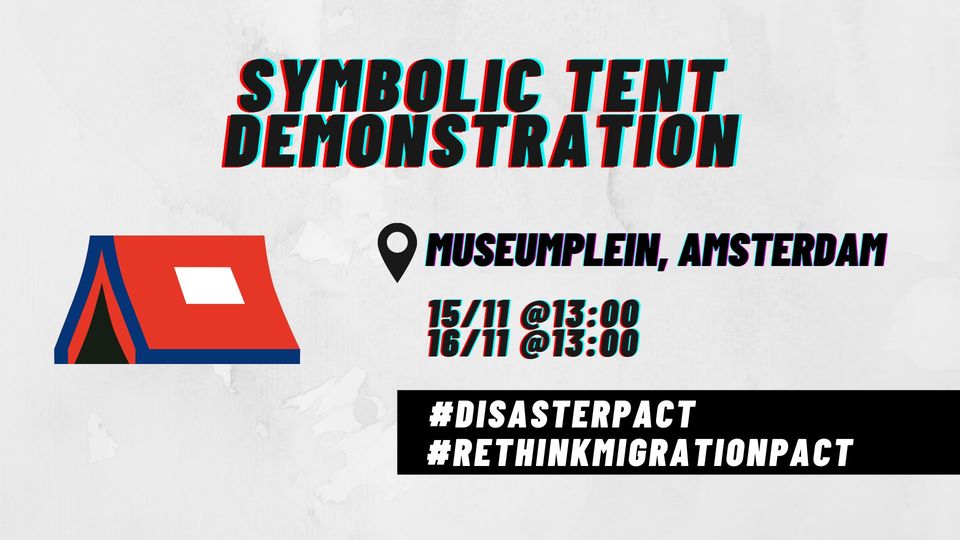
  • 24-hour protests all over Europe against the new European Migration Pact

    24-hour protests all over Europe against the new European Migration Pact

    sunday 15 nov. – monday 16 nov.
    Museumplein in Amsterdam & Neude square in Utrecht center

    The locations will be transformed into a (refugee) camp for 24 hours from Sunday the 15th of November 13.00 until Monday the 16th of November 13.00.

    Two weeks after the overcrowded Moria camp in Lesvos burnt to the ground the European Union presented the so-called New Pact of Migration and Asylum which turned out to be a justification of putting even stronger borders and establishing a new dehumanizing system based on exclusion and deportation of refugees. It comes as a slap in the face of asylum seekers and refugees still suffering violence and injustice along our borders.

    Organised by MiGreat, SOS Moria, Europe Must Act, We Gaan Ze Halen

    Amsterdam: https://www.facebook.com/events/s/tent-demonstration-amsterdam/636302340369813/?ti=icl

    Utrecht: https://www.facebook.com/events/2770698106521519/?active_tab=about

    Do you want to participate during the demonstration? Great! We have created a Google Form registration so everybody can reserve a specific timeslot to demonstrate with us. Doing so will create the possibility for everybody to join this 24hour demo and simultaniously create a safe situation corona wise 🙌🏼
    Each timeslot covers 2 hours of the demonstration and focusses on a specific topic. More information about each timeslot will be revealed in the next days towards Sunday. For now we can already promiss 2 speakers per hour on the timeslots on Sunday the 15th from 13.00 – 18.00 and Monday the 16th from 11.00 – 13.00 ✊🏼
    https://www.facebook.com/events/2770698106521519/?active_tab=discussion

    More information:
    Europe Must Act
    https://de.europemustact.org/post/our-wave-of-solidarity-will-grow?fbclid=IwAR2cHp7qikUbCQWDdZ46ijfTswpZSCIOoDC4KDnCHb5B2whN69U5sbW1hPw
    Walk of Shame https://walk-of-shame.eu/joint-statement/?fbclid=IwAR2O9UyLS3lqGeFGuqY4c3WfwinEYyfB_9elznckJ_usJEl8FmKINRv9srk

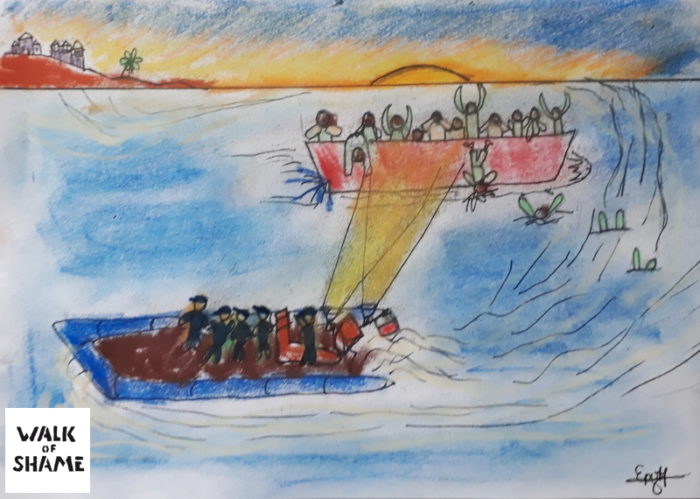
    Art of Shame

    Sorrow by EP
    July 10, 2020
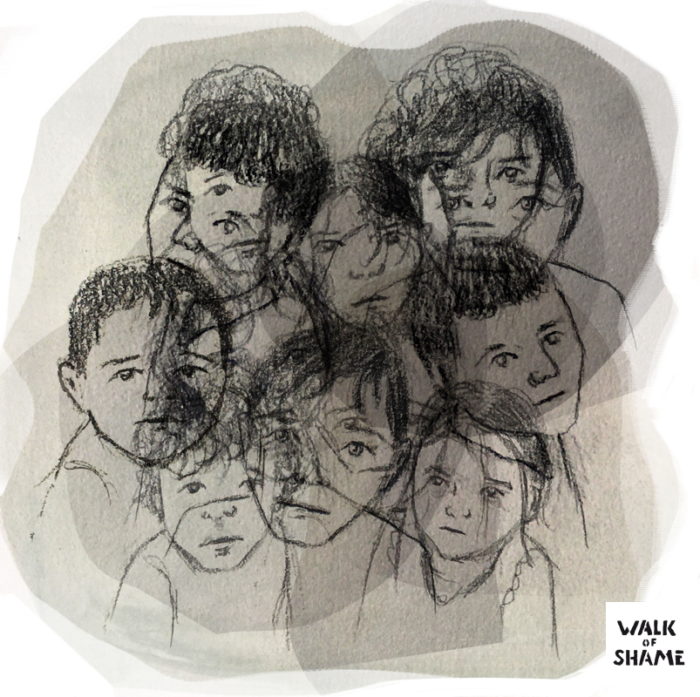
    The Children of Moria by Linda Zwart
    May 26, 2020
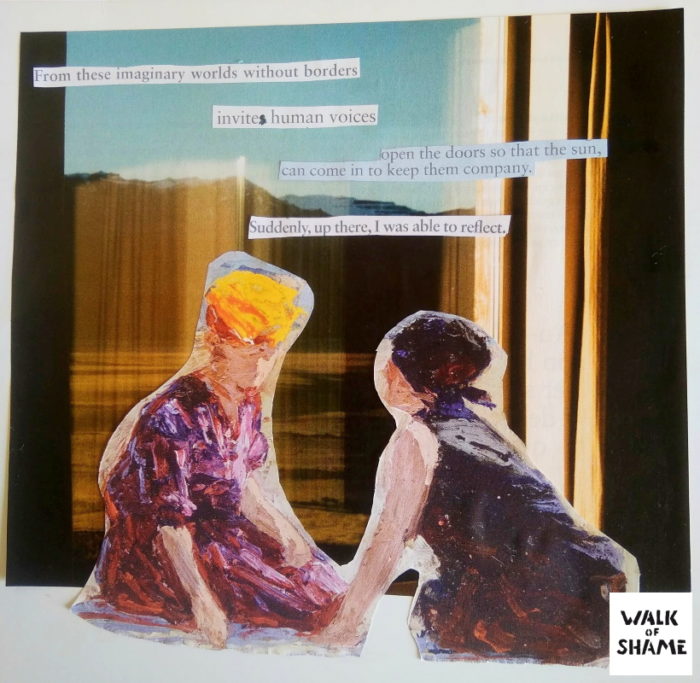
    Human voices by Hanna Bubień
    July 18, 2020
  • Free the El Hiblu 3 – dismiss the trial immediately! Resisting illegal push-backs to Libya is not a crime.

    Free the El Hiblu 3 – dismiss the trial immediately! Resisting illegal push-backs to Libya is not a crime.

    [Fr] en dessous

    FREE El Hiblu 3! – the site

    The Rescue – A flimsy raft, more than 100 souls, and three teenage heroes—or are they pirates? (Zach Campbell / The Atavist Magazine 2019)

    Appeal to stop the criminalisation of three young migrants in Malta.

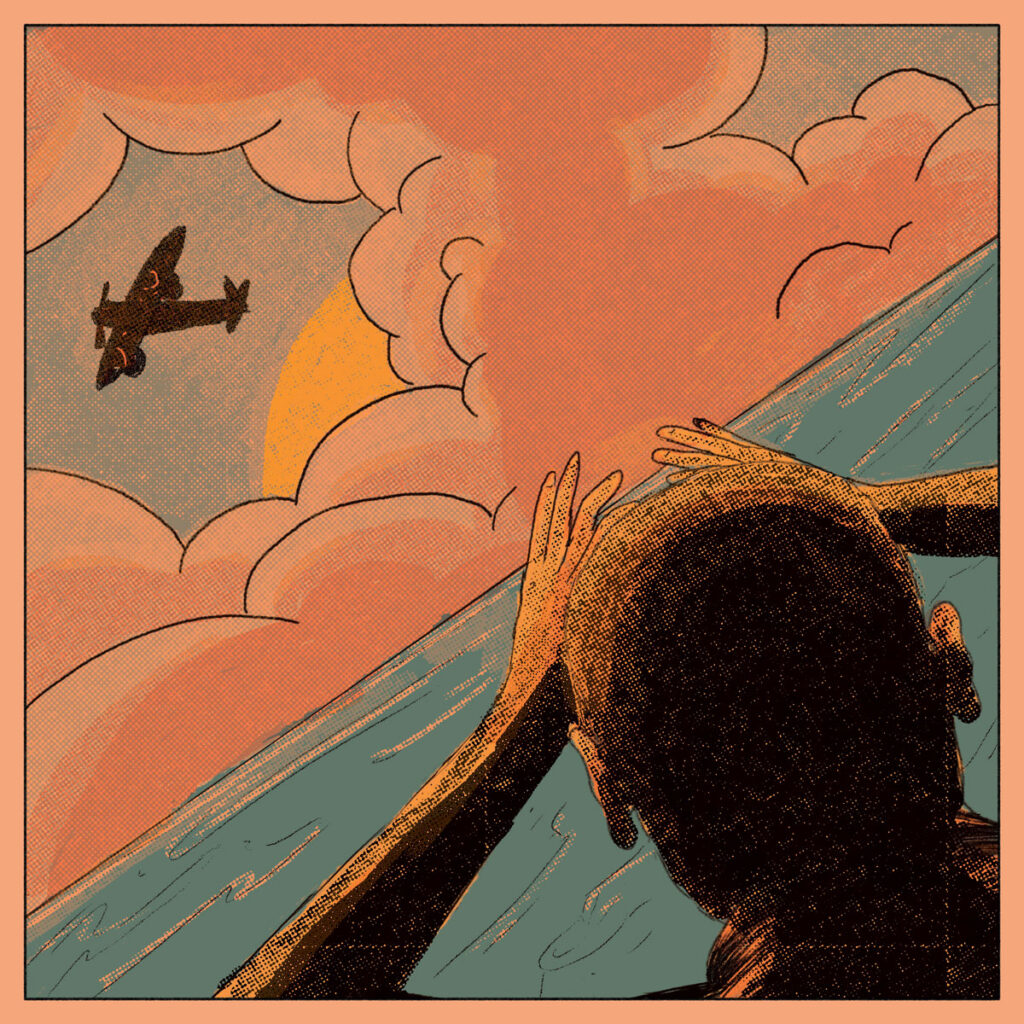
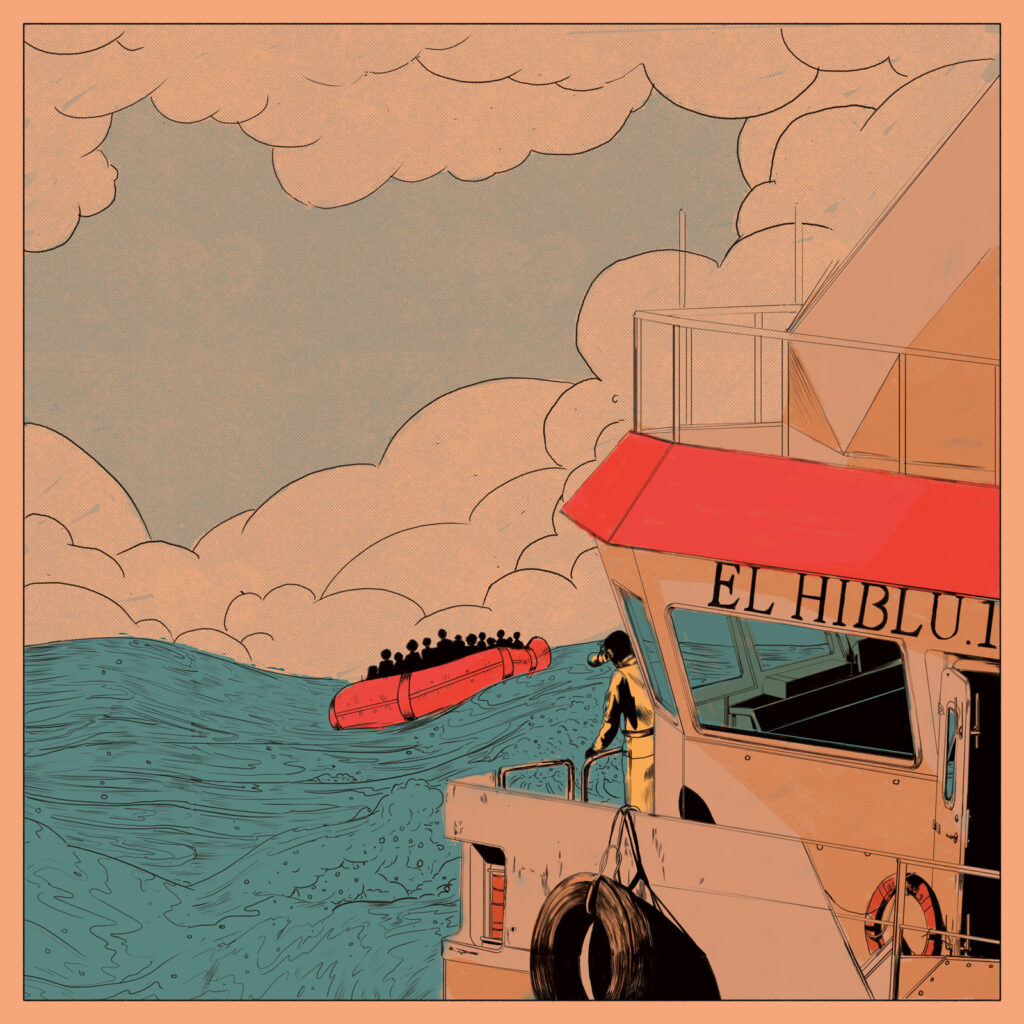
    In late March 2019, a rubber boat with 108 people on board, was escaping the Libyan coast and trying to reach Europe. Coordinated by an airplane of the Eunavfor Med operation, the people in distress were found and rescued by the merchant vessel El Hiblu 1.


    During the rescue the captain of the El Hiblu 1 reassured the people that they would reach a port of safety in Europe. Following the order of European authorities, the crew tried to return them to inhumane conditions in Libya, from which they had just escaped.


    When the rescued passengers realised they were being returned to Libya, they began to protest. Collectively they were able to prevent being pushed-back. The crew re-directed the El Hiblu 1 and steered north towards Malta.

    Nobody was injured during this protest, nothing was damaged. When the Maltese military stormed the vessel in Maltese territorial waters, they expected “pirates” or “terrorists”, but they only met humans who were seeking help and hoped for a safe place.


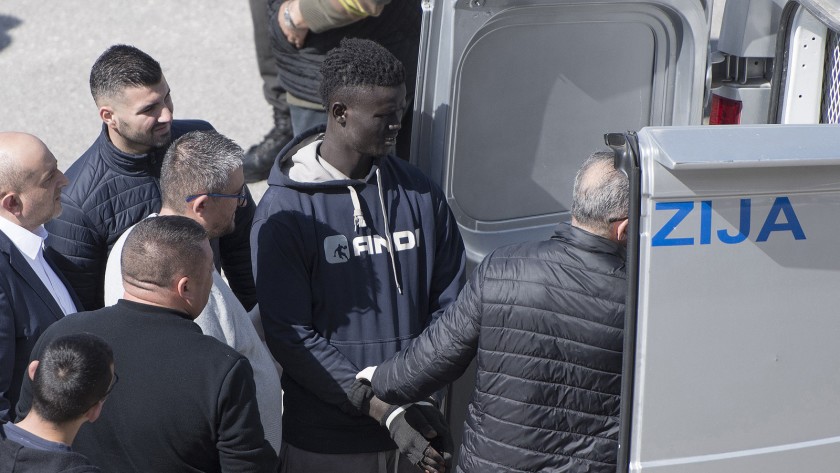
    Three of the 108 rescued passengers – 15, 16, and 19 year-old teenagers – were arrested as the ring leaders of the protest and accused of several crimes, including terrorism. They were immediately detained, taken to a high security unit, and then imprisoned in Malta for seven months. They were eventually released on bail in November, 2019.

    Having been released on bail, the three have to register every day at the police station. They continue to face a severe prison sentence if they are found guilty of the charges. Clearly, the Maltese state is trying to make an example of the three, in order to deter others from similarly resisting push-backs to Libya.

    The three teenagers were acting as translators and mediators during the protest on board. Their imprisonment and prosecution constitutes a deep injustice. Instead of being prosecuted, the “El Hiblu Three” should be celebrated for their actions in preventing the return of 108 precarious lives to Libya.

    As signing organisations and groups, we demand the immediate dismissal of the trial.

    We agree that protesting illegal push-backs to Libya is not a crime.

    We demand the end of all illegal returns to Libya and mass human rights violations resulting from Europe’s collaboration with the so-called Libyan coastguards.

    We will continue to work toward corridors of solidarity and the fair relocation of refugees and other migrants in welcoming cities all over Europe.

    [Fr]

    Libérez les trois détenus du El Hiblu – annulez le procès immédiatement !Résister à des refoulements illégaux vers la Libye n‘est pas un crime.

    Appel pour mettre fin à la criminalisation de trois jeunes migrants à Malte.

    LES EL HIBLU 3! – le site

    Fin mars 2019, un bateau en caoutchouc avec 108 personnes à bord, s’échappait des côtes libyennes et essayait de rejoindre l’Europe.

    Suite à la coordination d’un avion de l’opération Eunavfor Med, les personnes en détresse ont été retrouvées et secourues par le navire marchand El Hiblu 1.

    Pendant le sauvetage, le capitaine du El Hiblu 1 a rassuré les personnes à bord en leur disant qu’elles atteindraient un port de sécurité en Europe. Suivant l’ordre des autorités européennes, l’équipage a tenté de les renvoyer dans des conditions inhumaines en Libye, dont ils venaient de s’échapper.

    Lorsque les passagers secourus ont réalisé qu’ils étaient renvoyés en Libye, ils ont commencé à protester. Collectivement, ils ont réussi à empêcher qu’ils soient repoussés.

    L’équipage a redirigé le El Hiblu 1 et s’est dirigé vers le nord, vers Malte.

    Personne n’a été blessé lors de cette manifestation, rien n’a été endommagé. Lorsque les militaires maltais ont pris d’assaut le navire dans les eaux territoriales maltaises, ils s’attendaient à des “pirates” ou des “terroristes”, mais ils n’ont rencontré que des humains qui cherchaient de l’aide et espéraient débarquer dans un endroit sûr.

    Trois des 108 passagers sauvés – des adolescents de 15, 16 et 19 ans – ont été arrêtés en tant que meneurs de la protestation et accusés de plusieurs crimes, dont celui de terrorisme.

    Ils ont été immédiatement détenus, emmenés dans une unité de haute sécurité, puis emprisonnés à Malte pendant sept mois. Ils ont finalement été libérés sous caution en novembre 2019.

    Ayant été libérés sous caution, les trois personnes doivent se présenter tous les jours au poste de police. Ils sont toujours passibles d’une lourde peine de prison s’ils sont reconnus coupables des faits qui leur sont reprochés.

    Il est clair que l’État maltais essaie de faire un exemple des trois, afin de dissuader d’autres personnes de résister au fait d’être ramenés en Libye.

    Les trois adolescents ont joué le rôle de traducteurs et de médiateurs pendant la manifestation à bord. Leur emprisonnement et les poursuites engagées contre eux constituent une profonde injustice. Au lieu d’être poursuivis, les “Trois du El Hiblu” devraient être célébrés pour leurs actions qui ont empêché le retour de 108 vies précaires en Libye.

    En tant qu’organisations et groupes signataires, nous demandons l’annulation immédiate du procès.

    Nous sommes d’accord que protester contre les refoulements illégaux vers la Libye n’est pas un crime.

    Nous exigeons la fin de tous les retours illégaux en Libye et des violations massives des droits de l’Homme résultant de la collaboration de l’Europe avec les prétendus garde-côtes libyens.

    Nous continuerons à œuvrer en faveur de couloirs de solidarité et de la réinstallation équitable des réfugiés et autres migrants dans des villes d’accueil dans toute l’Europe.

  • “privatized push-backs” – Legal Case against Italy with the UN Human Rights Committee

    “privatized push-backs” – Legal Case against Italy with the UN Human Rights Committee

    GLAN has filed complaint against Italy with the UN Human Rights Committee on behalf of an individual whose journey from Libya was intercepted in the high seas by the Panamanian merchant vessel, the Nivin. The complaint is the first submitted to an international human rights forum aimed to the phenomenon of “privatized push-backs”, whereby EU coastal States engage commercial ships to return refugees and other persons in need of protection back to unsafe locations in contravention of their human rights obligations.

    CASE: PRIVATISED MIGRANT ABUSE

    The cooperation and collaboration between Italy and Libya on migration and border control has a long history. In the framework of the 2008 Treaty of Friendship, Partnership and Cooperation, Italy carried out several naval operations intercepting irregular migrants and returning them to Libya. In 2012, after the European Court of Human Rights delivered its judgment in the Hirsi Jamaa and Others v Italy, this direct modality of migration control was suspended. Thereinafter, the Italian government adopted strategies that increasingly involved ‘contactless’ measures, yet exercising strategic control over the Libyan Coast Guard, which has operated as its proxy to intercept migrants and bring them back to a country in which they would be subjected to extreme forms of violence and exploitation.

    The adoption of a ‘closed port policy’ and the progressive criminalisation of rescue NGOs, coupled with the retreat of the European Union’s search and rescue missions at sea, left a gap in the Mediterranean. In that vacuum, only two actors remained present: the Libyan Coast Guard and merchant ships. Merchant ships became therefore unwillingly mobilised towards a modality of strategic delegation of border control, rather than one of rescue, in the attempt by the Italian government to avoid accountability for human rights violations.

    [Warning: Distressing imagery] A video op-ed by the New York Times of their investigation into the increasing number of partnerships by state actors in Mediterranean search-and-rescue operations. With contributions from GLAN.

    In the afternoon of November 7, 2018, the Italian Maritime Rescue Coordination Centre (MRCC) instructed the Nivin to rescue a distressed migrant boat and to liaise with the infamous Libyan Coast Guard (LYCG). The LYCG then directed the Nivin towards Libya, where the captured passengers staged a stand-off, resisting their illegal debarkation. Libyan security forces violently removed from the vessel after 10 days using tear gas and rubber as well as live bullets. The claimant was shot in the leg and was arbitrarily detained, interrogated, beaten, subjected to forced labour and denied treatment for months.

    The legal submission made use of evidence in a report compiled by Forensic Oceanography, part of the Forensic Architecture agency based at Goldsmiths, University of London with Charles Heller as lead investigator. The report, published today, combined the analysis of multiple sources of evidence to offer a detailed reconstruction of the incident. It demonstrates that privatized push-backs have risen sharply since June 2018. The result is that seafarers are being used by states seeking to circumvent their obligations towards refugees.

    The complaint sets out an argument that Italy and other states are breaching their obligations under international law by using private merchant vessels as an instrument of refoulement – the returning of refugees to where they will suffer persecution and torture. By relinquishing its responsibility to offer a port of safety, Italy violated its human rights obligations, including under the International Covenant on Civil and Political Rights, and the Convention Against Torture.

    ​The case breaks new ground as it calls attention to the ways in which merchant vessels are being implicated in border violence. Seafarers are increasingly being compelled to take responsibility for migrants and make risky choices of their own – choices that may lead them to act illegally and result in deaths not to mention bearing the costs of imposing border control. The Nivin incident represents a further development of the externalisation of border control and a new modality of delegated containment of migrants. This policy threatens to annul fundamental rules of public international law, such as the jus cogens norm of non-refoulement; as well as the principle of disembarkation in a place of safety, recognised under customary norms of the law of the sea.

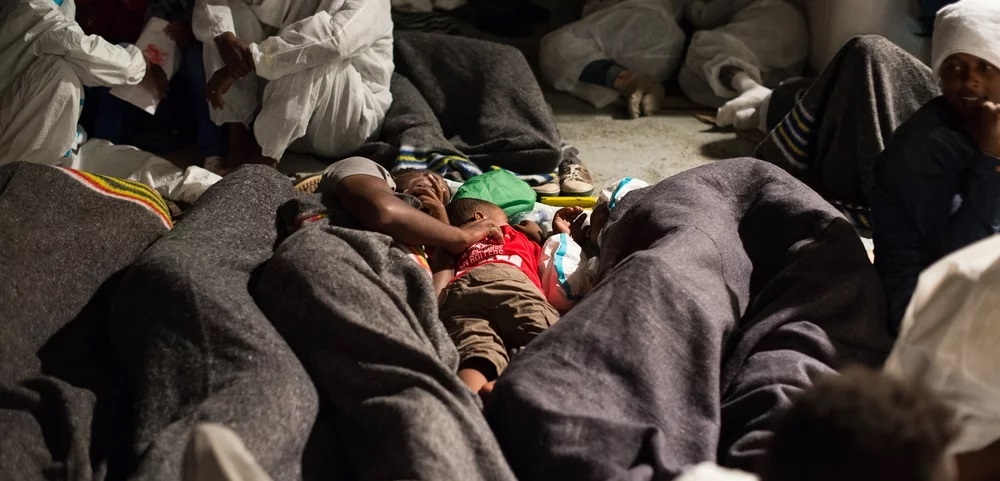
    Migrants sleeping aboard the Nivin

    Wider Context

    In May 2018, Forensic Oceanography published its Mare Clausum report, which demonstrates that Italy and the EU have implemented since 2016 a two-pronged strategy aimed at stemming migration across the central Mediterranean. The strategy aimed to oust rescue NGOs from the Mediterranean, on the one hand, and outsource border control to the Libyan Coast Guard on the other by providing material, technical, and political support. The role of the EU and Italy in creation and maintenance of the Libyan Coast Guard is decisive as demonstrated in the SS v Italy case that GLAN filed in May 2018 in partnership with Forensic Oceanography.

    This strategy has been accompanied by the progressive retreat from the Mediterranean of the EU, which narrowed the geographical scope of its missions and increasingly deployed assets that are not equipped to perform search and rescue activities. In this scenario, the only actor left at sea alongside the Libyan Coast Guard is merchant vessels. Due to the inability or unwillingness of the Libyan Coast Guard to perform duties related to search and rescue, merchant ships were called upon to contribute to filling this gap.

    Between June 2018 and June 2019, a total of 13 privatized push-back attempts were recorded, a list that is most probably incomplete, as indicated by Forensic Oceanography. Much of this is related to the implementation of the Mare Clausum strategy, exacerbated by the so-called “closed ports” policy in Italy, which prevented ships that carried out rescue operations to enter Italian territorial waters to disembark rescuees.

  • « LA PAROLE AUX MIGRANTS » conference Rabat

    flyer:Conférence Rabat 2018
    texte & programme: Texte Conférence & Programme


    CONFERENCE INTERNATIONALE DES MIGRANTS AU MAROC, 1-2 dec. 2018 in Rabat/Morocco

    Terwijl de Europese Unie Noord- en subsahara-Afrikaanse landen steeds meer onder druk zet om hun grenzen voor migranten te sluiten, zien we geen serieuze duurzame initiatieven die werken aan de gronden waarom migranten hun land willen verlaten. Er is daarom geen vooruitzicht op een verandering van de komst van migranten naar Europa voor een beter leven (voornamelijk geld sturen naar de familie in land van herkomst).
    Tegelijkertijd zien we dat migranten zich organiseren in zelf opgezette groepen en netwerken in landen van herkomst, transit en vestiging. Bovendien zien we dat er tussen deze organisaties uitwisseling en bundeling is. Dat zijn migranten maar ook zelforganisaties van mensen die in het zuiden willen blijven en daar werken aan duurzame en solidaire sociale bewegingsstructuren. Dat is onze steun waard. En door samenwerking tussen sociale organisatie in Europa en in het zuiden kunnen stappen gezet worden.

    Op 1 en 2 december 2018 vindt er in een migrantenwijk van Rabat een grote migratiebijeenkomst plaats genaamd « LA PAROLE AUX MIGRANTS ». Het zal gaan over vrijheid van migratie, de Europese druk en invloed op de Afrikaanse landen, de omstandigheden waarin migranten verkeren in de bufferstaten als Marokko en het verzet van migrantenzelf- en migrantensteun-organisaties uit Afrika en Europa.

    Er zullen zo’n 200 mensen aanwezig zijn, voornamelijk subsahara migranten (en migranten-zelforganisaties) uit Rabat en elders in Marokko (Oujda, Tanger, Nador en Casablanca), lokale zelforganisaties van migranten en niet-migranten uit enkele Afrikaanse landen (Mali, Niger, Kongo en Gabon), Marokkaanse NGO’s en migrantensteunorganisaties uit Europa (Duitsland, Oostenrijk, Nederland, Zwitserland en Luxemburg) zoals All Included, Afrique-Europe Interact, Whatch the Med Alarm Phone.

    Het initiatief en de organisatie zijn in handen van de Vereniging van Vluchtelingen en Migrantengemeenschappen in Marokko (ARCOM) en het Platform van Subsaharaanse Verenigingen en Gemeenschappen in Marokko (PASCOMS).
    Het moment is gekozen vanwege het UN Wereldforum over Migratie en Ontwikkeling plaats in Marrakesh/Marokko 5-7 dec. 2018. De migrantenbijeenkomst wil haar stem laten horen over migratie en ontwikkeling.

    Bovendien is het nu vijf jaar geleden dat Marokko begon met de ontwikkeling van een nationaal migratiebeleid met inbegrip van een asielwetgeving. In de afgelopen 50 jaar is Marokko eerst van een migratieland veranderd in een doorvoerland en nu in een land van bestemming.
    Wat is de impact van het Marokkaans migratiebeleid op het leven van de migranten in Marokko en op de mogelijkheden om te migreren?

    In deze manifestatie zal zowel worden teruggekeken naar de ervaringen van migrantenstrijd en van migratiebeleid in een Noord-Afrikaanse bufferstaat en wordt de stem aan de migranten in Marokko gegeven. “La Parole aux Migrants” zal een uitwisseling worden van de opbouw van migranten-netwerken in de strijd tussen Noord en Zuid, tegen de grenzen en tegen de repressieve politiek van landen uit zowel het noorden als het zuiden.

    ARCOM is een van oorsprong Kongolese zelforganisatie uit Rabat die voordater een Marokkaanse migratie- en asielbeleid was als eerste opkwam voor de rechten van (irreguliere) migranten in Marokko. Momenteel beheert het een vijftal ondergrondse opvanghuizen voor net aangekomen subsahara vrouwen en kinderen in Rabat.

    Wil je financieel bijdragen, dan kan je storten op de bankrekening van All Included IBAN NL94 INGB 0004 8645 27 ovv « LA PAROLE AUX MIGRANTS ».

    Meer informatie: https://afrique-europe-interact.net/38-1-Our-Network.html?article_id=38&clang=0

    5401964524_bfacef4443_o

  • Duizenden reddingsvesten in de hofvijver uit protest tegen het dodelijke EU migratiebeleid

    twee jaar na de totstandkoming van de EU-Turkije deal

    Duizenden Reddingsvesten in de Hofvijver in Den Haag from Alarmphone on Vimeo.

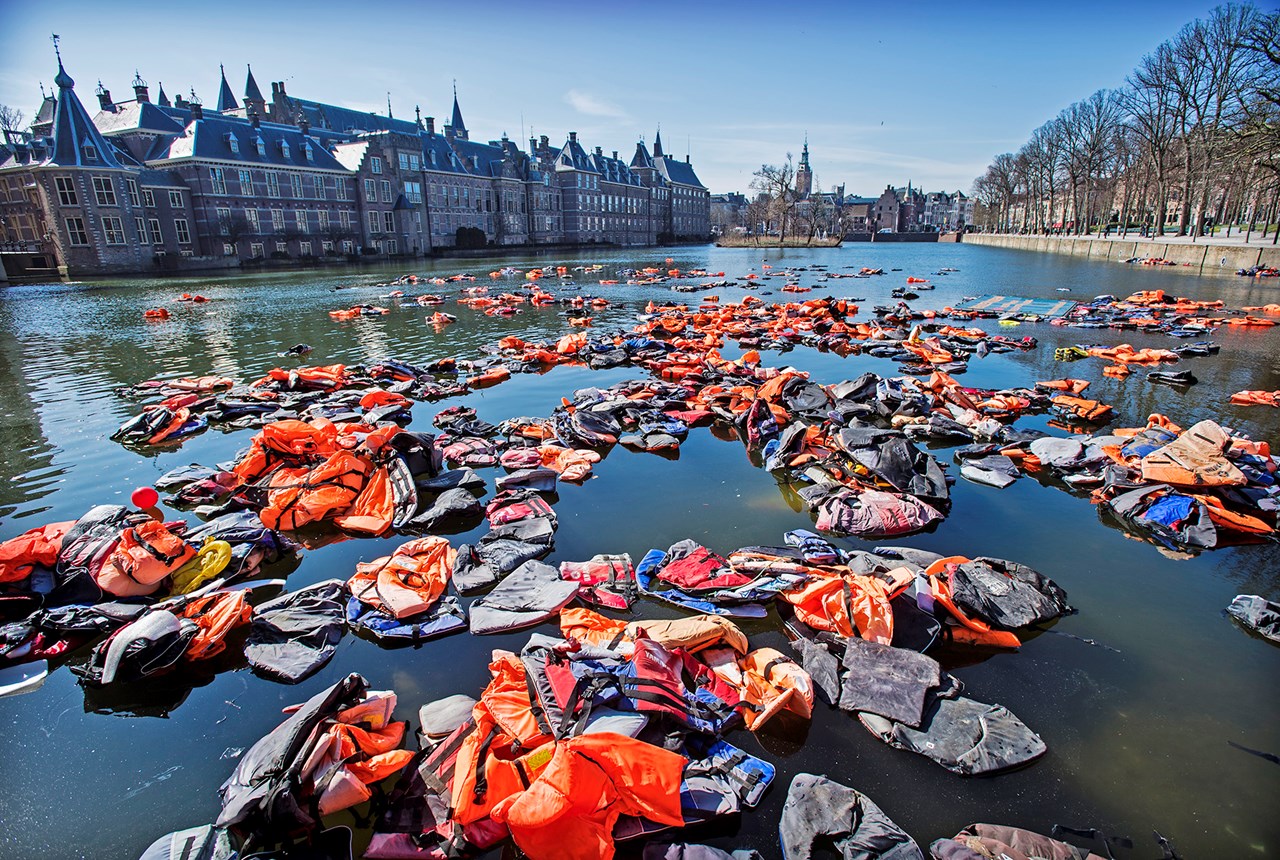
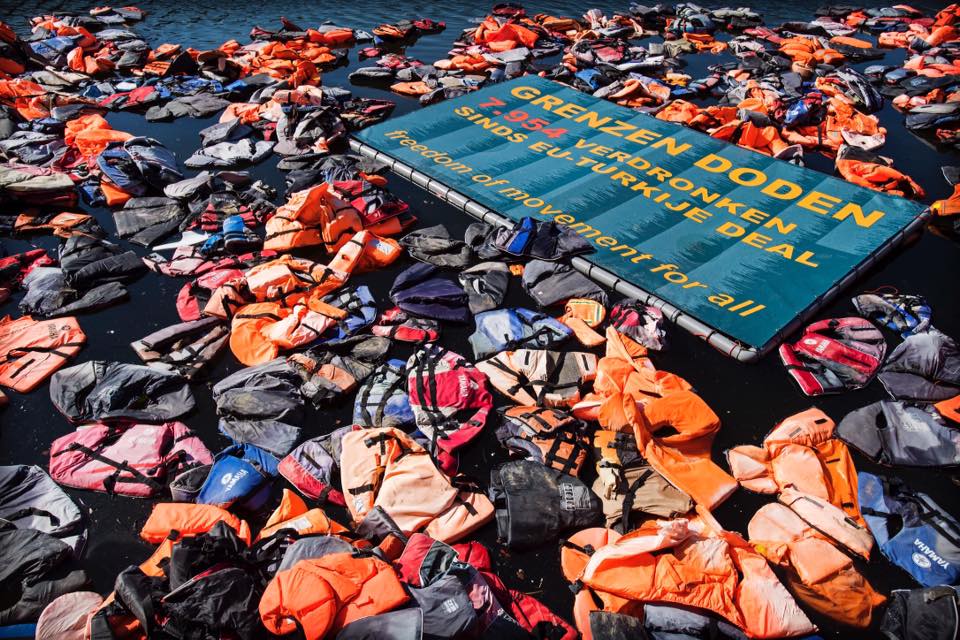
    Watch The Med Alarmtelefoon Nederland verplaatst buitengrenzen van de EU naar de Hofvijver in Den Haag. Enkele tientallen mensen hebben duizenden reddingsvesten verspreid in de hofvijver. De vesten komen van het Griekse eiland Lesbos en zijn gebruikt door migranten op weg naar Europa.

    We voeren hiermee actie voor het recht op vrijheid van migratie, twee jaar na de totstandkoming van de EU-Turkije deal. Terwijl een van de bedenkers van die deal aan de Kamercommissie uitlegt dat zijn plan gefaald heeft. Watch The Med Alarmtelefoon Nederland roept de Europese Commissie, het EU parlement en de verschillende lidstaten waaronder Nederland op om een einde te maken aan de massale verdrinkingsdood van migranten in de Middellandse zee.

    In plaats van hiertegen op te treden werpt de EU steeds hogere grenzen op. Ze sluiten deals met landen waar dagelijks mensenrechten worden geschonden. Twee jaar geleden nam Nederland het voortouw bij het opzetten van deze deal. Sinds de EU Turkije deal zijn evenveel mensen verdronken als in de twee jaar ervoor. Desondanks blijft de deal in stand. Ook de recente ontwikkelingen in Turkije, met veel mensen-rechtenschendingen en de bombardementen op Afrin veranderen niet de houding van de EU, waaronder Nederland.

    Wij eisen:

    – een einde te maken aan de omstreden deals met landen als Libië, Soedan en Turkije
    – een einde te maken aan de financiering van de Libische kustwacht / milities
    – een grootschalige permanente search en rescue operatie veilige routes naar Europa
    – te werken aan aan eerlijke internationale welvaart verdeling

    VRIJHEID VAN MIGRATIE VOOR ALLEN

    Watch The Med Alarmtelefoon Nederland

    Deaths at the Borders of Southern Europe (VU University Amsterdam) – click Play on the animated map

    WTMAP_ANP_zwemvestenActievoerders hebben maandag enkele honderden reddingsvesten in het water van de Hofvijver gegooid. De vesten lagen pal voor het Torentje van premier Mark Rutte. Met de actie wil de organisatie ‘Watch the Med Alarm Phone Nederland’ aandacht vragen voor de tweede verjaardag van de ‘Turkijedeal’. In een flyer stelt de organisatie dat er, sinds de migratieafspraken met Turkije gemaakt werden, 7954 mensen verdronken zijn in de Middellandse Zee. Volgens Watch the Med, een Duitse hulporganisatie die verdrinkingen van en geweld tegen vluchtelingen op zee in kaart brengt, zijn dat evenveel doden als in de twee jaar vóór de deal. De organisatie stelt dat de Europese Unie ‘steeds hogere grenzen opwerpt’, in plaats van vluchtelingen te helpen via veilige routes naar Europa te komen. Watch the Med wil dan ook een ‘vrijheid van migratie’, in plaats van ‘deals met landen waar dagelijks mensenrechten worden geschonden’. Ook wil de organisatie dat de EU een grootschalige operatie opzet om vluchtelingen op zee te vinden en te redden. < | beeld anp / Marten van Dijl
    29425032_1825215460845342_8787485869092110336_n

  • Burgerlijke ongehoorzaamheid op zee – Drie jaar Alarm telefoon

    Ervaringen analyses en interviews vastgelegd in brochure In solidarity with migrants at sea! The Alarm Phone 3 years on

    Oktober 18, 2017
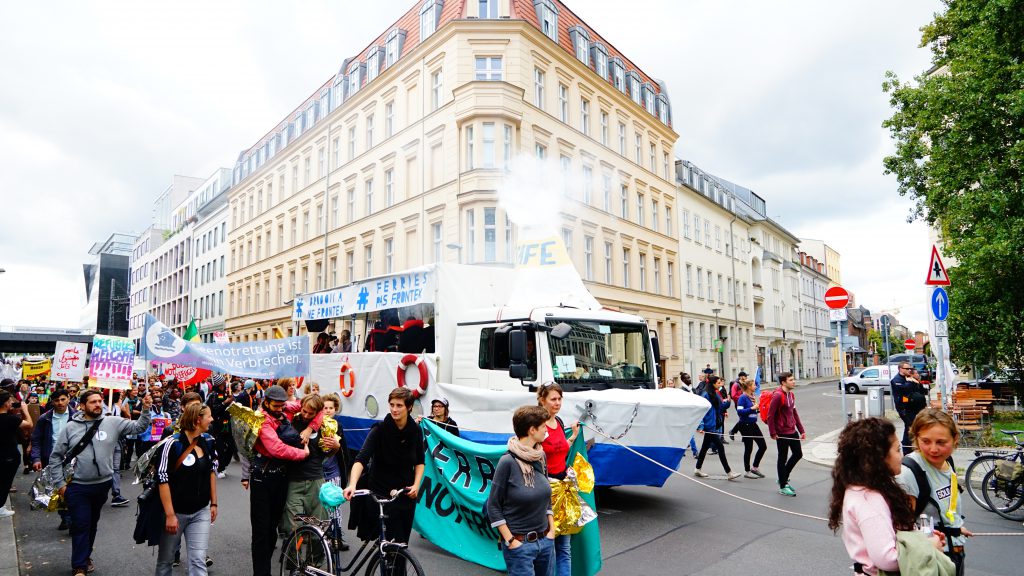
    3y_ap_intro_welcomeunited-1024x576            Geen “Frontex maar Veerboten wagen” op de We’ ll come United Demonstratie in Berlijn op 16 september 2017 (Photo: Mazlum Demir)

    Op 25 juni 2017 , zoals zo vaak daarvoor gebeurde, ontving ons alarmtelefoon team een bericht van Vader Mussie Zerai. Hij was gewaarschuwd door migranten op een boot in nood waar zo’n 100 mensen aan boord waren. Ze waren vertrokken uit Al Khums in Libie en bevonden zich in een gebied ver verwijderd van de zogenaamde Search and Rescue zone’ s waar verschillende NGO schepen actief waren. Terwijl het alarm telefoon team ze snel en vaak probeerde te bereiken slaagden zij er niet in, wat wel lukt was om het tegoed op hun telefoon van een afstand op te laden zodat zij contact konden blijven houden met de buitenwereld. En dat er contact was dat konden we waarnemen aan het steeds meer dalende tegoed op hun telefoon. We informeerde het  Italiaanse kustwacht coördinatie centrum in Rome en namen contact op met de Moonbird, een door Sea watch en het Humanitaire piloten initiatief gestart zoek verkeningsinitiatief. We stuurden hun de GPS locatie van de boot en zij beloofden in dat gebied een zoektocht te starten. Kort daarna het vliegtuig van de NFGO vertrok en vond het schip in de buurt van de opgegeven locatie, en gaven de nieuwe locaties door aan ons en aan de autoriteiten. Enkele uren later ontvingen wij een bevestiging dat de boot met alle mensen aan boord gered was.

    Deze zaak was 1 van de 1840 zaken van de  Watch the Med Alarmtelefoon waar wij in onze eerste 3  operationele jaren mee te maken hebben gehad. Deze zaak is , net als vele andere zaken, exemplarisch voor een nieuwe vorm van activisme , 1 waarbij een diverse groep van actoren, waarvan sommige onbekenden zijn van elkaar, samenkomen  en een complexe solidariteitsketting vormen met als doel om razendsnel te interveniëren en hun te ondersteunen die zeegrenzen oversteken.

    Vader Zerai wereld wijd bekend binnen de Oost Afrikaanse gemeenschap en diaspora, ontving een SOS bericht van een boot en alarmeerde een van onze vele shift teams die opereren vanuit landen in heel Europa vanuit noord Afrika en Turkije. Aangezien veel zogenaamde Search and Rescue schepen  buiten het SOS gebied van deze boot actief waren, alarmeerde wij de Moonbird, crew die vanuit Malta opereren, en zetten zo een lucht verkenningsoperatie in gang. Deze nieuwe samenwerkings- verbanden zowel op de grond als in de lucht hebben als doel en dragen bij aan zogenaamde Freedom of Movement en Safe passage van migranten. Deze nieuwe vormen van solidariteit komen niet uit de lucht vallen maar vloeien voort uit de tomeloze wil en energie vanuit Grassroot organisaties om samen te werken in de strijd tegen  het Europese Grenzenregime.

    Onze Alarm telefoon ging van start op 11 oktober 2014 en is nu meer dan drie jaar 24/7 operationeel. 11 oktober 2017 was het de vierde “ verjaardag “ van een afschuwelijk scheepsramp waarbij meer dan 260 gestorven zijn, of beter gezegd:Where left to die. Italiaanse en Maltese autoriteiten   waren op de hoogte van de positie van dit schip en van de situatie aan boord maar vertraagde willens en wetens de reddingsoperatie waardoor deze afschuwelijke tragedie kon plaats vinden. En zijn ook direct verantwoordelijk hiervoor.
    De afgelopen drie jaar zijn we getuige geweest en hebben onderdeel uitgemaakt van onvoorstelbare en ongelooflijke gebeurtenissen, van de onvoorspelde massale grens overschrijdingen in 2015 toen meer dan een 1 miljoen mensen hun boot tocht overleefden en vele van hun te voet verder trokken Europa in, de gewelddadige pogingen om de Balkan route te sluiten, waarin maritieme migratie in de Egeïsche zee werd bestreden  door omstreden Deals te sluiten, tot het op uiterst cynische wijze in diskrediet brengen en  criminaliseren van NGO’ s die bezig zijn met uiterst belangrijke zoek en reddingsoperaties op zee in 2017. Dit terwijl de hele tijd het dodental in het Middellandse zee gebied  schrikbarend blijft stijgen meer dan 11000 doden waren er in de afgelopen paar jaar officieel geregistreerd, maar hoeveel mensen er daadwerkelijk zijn gestorven zal onduidelijk blijven.

    Op dit moment hebben we te maken met ongekende repressie, of wat we zouden kunnen beschrijven als een “roll back” van het Europese grenzen regime. Als reactie op de massale doorbraak van de grenzen voornamelijk  2015  en begin 2016, zijn we er nu getuige van  hoe de EU samen met haar Lidstaten op uiterst Cynische wijze grenzen aan het versterken is en obstakels aan het opwerpen zijn om vrijheid van beweging tegen te gaan. Door ondermeer samen te werken met dictatoriale regimes en de buiten grenzen van Europa te verplaatsen naar landen als Mali, Niger en Soedan, door het criminaliseren van NGO’ s, door buiten grenzen te militariseren, en door het aanscherpen van het Dublin verdrag geeft de EU vorm aan deze zogenaamde “Roll back”.

    Deze maatregelen worden in Europa gemengd ontvangen, waar sommige staan te applaudisseren of roepen om nog verder gaande repressieve maatregelen,  organiseren andere zich en komen hier tegen in opstand. Je kunt stellen dat er een sterke polarisering binnen de samenleving plaatsvind. In dit klimaat van repressie en van onduidelijkheid maar ook van toenemend collectief solidariteit organisatie en verzet gaan wij door met ons werk  van ; vastleggen, netwerken en interveniëren.

    Verschillende nationale en Europese actoren proberen het werk van zogenaamde SAR NGO’ s onmogelijk te maken en ze weg te jagen uit het Middellandse zee gebied.  Zodat er een gebied ontstaat waar migranten ongezien slachtoffer worden van de straffeloze acties uitgevoerd door deze actoren. Is dit cynisch ja maar helaas wel de realiteit. Dit is precies de reden waarom onze mogelijkheid als alarmtelefoon om te kijken, luisteren, en om burgerlijk ongehoorzaam op te treden daar waar nodig,  in het leven is geroepen en noodzakelijk is.

    We weten dat mensen zullen blijven migreren, ondanks de zogenaamde “ Roll back” en steeds meer gewelddadige grenzen en gevaarlijke paden die worden opgeworpen en moeten worden genomen. In onze tijden van onrust, conflicten, oorlog en economische uitbuiting zijn redenen om een grens over te steken veelzijdig – er zijn gewoon zoveel mensen die willen, en moeten ontsnappen. Wanneer honderden door de hekken van de Spaanse enclaves in Marokko breken of met de boot in het zuiden van Spanje aankomen en ‘Boza!’ Schreeuwen, wanneer boten op de Griekse eilanden komen ondanks de overeenkomst tussen de EU en Turkije of wanneer duizenden aan de gruwelijke omstandigheden in Libië ontsnappen en aankomen in Italië, stuk voor stuk  tonen ze aan dat ondanks repressie migratie haar wegen vindt. Het is hun kracht en strijd die ons activisme inspireert, hun vastberadenheid, die onwillig is om te buigen voor wat soms een onoverkomelijke grensapparaat lijkt. Niet alleen langs de Middellandse Zee, maar ook veel verder in het zuiden en het oosten, in landen van herkomst organiseren groepen en gemeenschappen zich om onbevoegde grensoverschrijding mogelijk te maken  en te ondersteunen.

    Terwijl de EU barrières bouwt, mobiliseren wij langs de oevers van de Middellandse Zee aan beide kanten om bruggen te creëren. De waarde van het Alarm telefoonproject kan niet alleen worden afgemeten aan het het aantal noodoproepen dat het ontvangt, maar ook aan de vele initiatieven, netwerken en projecten die het heeft ondersteund of geholpen. Wij zien de Middellandse Zee niet als een dodelijke grenszone, maar een ruimte van ontmoeting, verbinding en gemeenschap. Naast ons dagelijks ondersteuningswerk  van mensen die onderweg zijn via ons telefoonactivisme, zijn er zusterprojecten opgetreden, waaronder de Desert Phone, Missing at Borders en Boza Tracks, die ook in onze bijgesloten brochure worden gepresenteerd. We hebben daarnaast deelgenomen aan campagnes die de dramatische situatie in het Middellandse-Zeegebied aankaarten en tegen gaan. Eind september 2017 organiseerden onze Tunesische Alarmtelefoonleden bijvoorbeeld een grote conferentie in Tunis, waar migranten-gemeenschappen, activisten en NGO’s uit Noord-Afrika en elders samen kwamen om te spreken over ‘Migratiebewegingen rondom de Middellandse Zee, onder het motto:  Realiteiten en Uitdagingen’ . Ongeveer dezelfde tijd in Berlijn, meer dan 1.500 kilometer verderop, vond er een grote demonstratie plaats onder het motto ‘‘We’ll Come United’’ ter herdenking aan de “ March of Hope”  . De mars van migranten die twee jaar geleden door verschillende Europese grenzen brak en daarmee de ‘lange zomer van migratie’ ingang zette die Europa veranderde.

    Net zoals het Alarmtelefoon netwerk zelf, is deze brochure een collectie van verschillende artikelen. Het biedt analyses van de situaties in de drie belangrijkste mediterrane regio’s en reflecties over enkele van de gedenkwaardige ervaringen die we de afgelopen drie jaar hebben mee gemaakt. Het bevat interviews met sommige leden, onze vrienden, kameraden, contactpersoon of migranten  die we in noodgevallen tegenkwamen, waarin zij gehoord worden, en het geeft een overzicht van de verschillende netwerken en zusterprojecten waarbij de alarmtelefoon betrokken is.

    Laten we verder gaan!
    De WatchTheMed Alarm telefoon!

  • The Valletta Process: Round 2

    http://www.obsmigration.org/en/2017/02/the-valletta-process-round-2/

    febr. 2017/ West African Observatory on Migrations

    The island of Malta’s geographical location makes it an ideal link between the European and African coasts.  In recent years, its location has encouraged thousands of migrants to brave the 340 km of waters separating the archipelago from the Libyan coast to get to Europe. Groups of migrants can, therefore, be seen wandering the streets of Valletta, the Maltese capital, awaiting a hypothetical regularization of their status which will allow them to continue on their way to other countries situated on the old continent.
    Frontière-Togo-Bénin-1-710x400Border Togo-Benin

    It was this symbol of Euro-African migration that was chosen by the European Union (EU) as the venue for a summit meeting between the governments of the two continents in November 2015, with the aim of stemming the flow of African migrants arriving off the Mediterranean coasts[1]. This summit gave rise to the Valletta process and its action plan. The Valletta process would redesign development cooperation between the European Union and Africa by making European aid conditional on the control of African migration to Europe.   A five point action plan would be adopted to address the root causes of irregular migration, promote legal migration and mobility, protect and ensure the right of asylum for people fleeing conflicts,  combat human trafficking, and finally, to improve the return, readmission and reintegration of irregular migrants living in Europe.  A trust fund[2] of 1.8 billion Euros was also to be set up to finance “Emergency” projects to be implemented under the Valletta Action Plan in order to block the “clandestine” arrival of African migrants in Europe.

    A little more than one year after the Valletta Summit, it was time for an assessment of the situation. Thus, on the 8th and 9th February 2017, senior African and European officials returned to Malta for a meeting to evaluate the implementation of decisions taken in November 2015.

    An atmosphere of security
    The island of Malta was particularly suited to this follow-up meeting, almost totally closed to the outside world, and characterized as it was by its insularity.  Far from their continents’ respective coasts, protected from prying eyes and any trouble, senior civil servants were left in peace to discuss the action taken to curb migration during the previous months.  Although they had withdrawn to the small Maltese city of St Jullian to hold the meeting, the Westin Dragonara Resort was, nevertheless, under high surveillance.  To access the meeting rooms, the hundred or so European and African delegates had to undergo security checks that included scanning their badges and a visual control of badges.

    The few journalists that had had the audacity to come and cover the meeting were banned from entering the room.  The lack of openness surrounding the meeting led to the impression that the parties present were extremely worried about the extent to which public opinion in their respective countries might receive negative accounts of the issues under discussion within the four walls of the hotel.  Four African and European civil society organizations managed to hurdle the political, diplomatic and security obstacles and find a seat at the discussion table.  Up until the very last minute, there were doubts as to whether this was going to be possible due to opposition from certain countries.

    An imbalance in implementation
    This was the opinion expressed by the African Union and some other African countries about the implementation of the Valletta Action Plan.  From the start of the meeting and in its introductory speech, the African Union condemned the fact that its European partners were keen to place the emphasis on funding projects aimed at combating migrant trafficking and repatriating irregular migrants.  It also criticized the European Union’s lack of effort in proposing legal channels for African citizens’ mobility into Europe while, on the contrary, encouraging a brain drain from Africa by promoting grants via ERASMUS plus.  This imbalance was proven by the number of senior African officials denied visas and consequently prevented from participating in the follow-up meeting.  Certain senior African officials condemned the way in which they had been treated in their countries’ European consulates.  They had only been granted four-day visas for an official mission to Europe, placing them in a difficult situation should there be flight cancellations.  The issue of legal mobility was to be the subject of bitter discussion between the European and African parties throughout the meeting.

    For their part, the senior European officials congratulated themselves on having respected their commitment to increase the amount of the Emergency Trust Fund to 2.5 billion Euros[3] in addition to the upcoming launch of the European External Investment Plan[4] in the amount of 40 billion Euros. Each of the European countries reminded the Africans of their expectations concerning the migration policies to be implemented on their continent. Germany insisted on the need for its African partners to make more efforts to accept the readmission of irregular migrants.  As for the United Kingdom, it withdrew its initial proposal to see the refugees confined to areas closest to their country of origin, near conflict zones. And all of the countries of the European Union expressed their approval for Niger’s “good policy” in fighting irregular migration.  As defined by the new principle that directs how development cooperation between the European Union and Africa will pan out, the good pupils will get the most funding from the emergency trust fund:   “More For More” (“You Do More, You get More”).

    Competition for the crumbs from the Trust Fund
    Competition between the African countries for funding was to get the better of their cohesion during the meeting. Although the way in which the trust fund functions appears very much like blackmail to the African Union, on the contrary the African countries that are considered to have priority by the EU and thus benefit most from the allocation of funds showed their satisfaction.  Once again, it was left up to the African Union to explain that the real beneficiaries of funding are first and foremost the development agencies of the various European countries. This was clear in the analysis presented by the department responsible for the management of the trust fund within the EU (DEVCO) that showed that the French Development Agency, the German Cooperation Agency (GIZ), the Spanish Cooperation Agency for International Development, etc. are the primary recipients of the money from the trust fund.  As is usually the case in international development, the money will be used to employ experts and European operatives to come and develop Africa in the name of Official Development Assistance. The representatives of the African Union condemned this practice, stating:  “What you give to us with one hand, you take with the other”.

    Nevertheless, this situation doesn’t seem to weigh heavily on some of the African countries who are happy enough to accept the crumbs offered from the trust fund, as long as they receive some money, and to implement the policies that will put a stop to migration of their citizens.  Thus, presentations were made to their European partners by various African countries illustrating some of the action that their particular country had taken to block the irregular migration of their citizens in order to prove their willingness to collaborate.  Niger congratulated itself on its legislative reform to curb migrant smuggling and trafficking, its arrest of several of its citizens and seizure of a hundred cars used to transport migrants from Agadez to the Libyan border.  As for Ethiopia, it had arrested more than five hundred of its citizens accused of human trafficking.  Other countries spoke of their efforts to install a biometric system for travel documents (passport, identity card…) and of their exchange of information with European security services.  Finally, certain African countries presented missions carried out in Europe by their immigration officials to identify irregular migrants’ country of origin as proof of their commitment to combat irregular migration.  Ultimately, the Ivory Coast, Ghana and Guinea were the ones to receive the good news from the EU[5]that they were the three new African countries to be granted priority status and would now, therefore, be the recipients of the Trust Fund’s generosity.  A senior African official from a country that was not considered a priority later confided to me in an informal discussion after the meeting: “It’s clear that the more irregular citizens you have in Europe, the faster you’ll be eligible to receive funding from the trust.  So we’ll let them leave”.  The irregular migrants belonging to the African diaspora have now become bargaining chips in obtaining European Official Development Assistance.

    Civil Society was there too
    During the meeting, civil society members that were present had no hesitation in condemning the lack of openness surrounding the Rabat Process, Khartoum Process and Valletta meetings during which negotiations on migration between the European Union and Africa were held.  One of the major elements criticized by civil society at the very beginning of the meeting was the recent declaration of the European Council of heads of state of the 3rd February 2017 in Malta.   The Council had announced their decision to support the Libyan coast guards in order to prevent departures from the Libyan coasts.  This decision, intended to save lives in the Mediterranean, in fact condemns the migrants to hell in Libya.  It leaves them trapped in a country that has been condemned in human rights organizations’ reports for its attacks on migrants and its detention conditions worthy of concentration camps.

    Although the European Union is aware of the situation of the migrants in Libya and the atrocities to which they are subjected, it does not hesitate, for electoral reasons, to condemn them to a certain death in Libya. They tend to forget that the majority of migrants taking the Libyan route are asylum seekers that benefit from the principle of non-refoulement recognized by the Geneva Convention.

    The meeting also provided civil society with an opportunity to reiterate their concerns regarding the impact that the projects financed by the Emergency Trust Fund are having on the free movement of Africans on the continent.  Thus, civil society, made its voice heard in denouncing the hypocrisy of Europe that wants its own area of free movement without borders while ensuring that border management is reinforced in regions of Africa that also aspire to the free movement of people.   The question of the European laissez-passer, also a source of friction between the European Union and African countries, was another sensitive subject put on the table by civil society.  Unfortunately, no comment on this issue was forthcoming from any of the government parties.  And to finish, the delicate questions of access to Trust Fund funding and citizen follow-up of the implementation of the Valletta Action Plan were raised.  Delicate questions which also remained unanswered.

    The presence of civil society around the discussion table represents a breakthrough and should be greeted by all as a victory.  However the upcoming elections in Europe presage uncertain times for the Euro-African dialogue on migration.  There is no doubt that EU countries will continue to reinforce security mechanisms within their migration policy to the detriment of their African partners.  And that is why it is more important than ever to make sure that civil society has a strong presence at the next meetings on the various processes of Euro-African dialogue on migration.

    Mobilization continues.

    [1]http://www.consilium.europa.eu/en/meetings/international-summit/2015/11/11-12/

    [2]http://europa.eu/rapid/press-release_MEMO-15-6056_en.htm

    [3]http://ec.europa.eu/europeaid/regions/africa/eu-emergency-trust-fund-africa_en

    [4]https://eeas.europa.eu/headquarters/headquarters-homepage/10415/joint-op-ed-hrvp-federica-mogherini-and-commissioner-johannes-hahn-new-eu-external-investment_en

    [5]https://ec.europa.eu/europeaid/news-and-events/la-cote-divoire-le-ghana-et-la-guinee-rejoignent-la-liste-des-pays-eligibles-au_en