Category: campaign against Frontex

  • Rapport de la manifestation du Jeudi 9 Juin 2016 à Sokodé (Togo)

    RESEAU AFRIQUE-EUROPE INTERACT SECTION TOGO (AEI-TOGO)

    Le jeudi 9 Juin 2016, l’Association Togolaise des Expulsés a organisé une manifestation à Sokodé (Togo). L’objectif de la manifestation était de dénoncer la politique migratoire de l’union européenne en Afrique et surtout le plan d’action de la valette au sommet Afrique Europe en novembre 2015. La population de Sokodé a été sensibilisée sur quatre points :

    • Visa et tracasseries aux frontières

    • Déportations et la politique migratoire européenne

    • Situation de migrants en mer et dans le désert

    • Approches de solutions à la question migratoire en Afrique et en Europe.

    Le facilitateur de cette sensibilisation, le Coordinateur du Réseau Afrique-Europe InternAct section-Togo a expliqué les quatre points sus-indiqués.

    Dans son explication, il a apporté la lumière de la complicité des chefs d’Etat africains de refuser aux ambassades européens de donner des visa à leur concitoyen désireux de voyager.

    Le facilitateur a ensuite dénoncer la politique de l’union européenne aux participants. En effet, l’UE a crée une agence européenne dénommée le FRONTEX pour empêcher les migrations vers l’Europe. L’UE a donc signé des accords avec les pays africains membre de FRONTEX.

    Abordant la situation des migrants dans la mer méditerranée et dans le désert, le facilitateur a fait comprendre à la population d’importants dégâts en vies humines dans la mer et dans le désert. Il a souligné le décès de deux (02) jeunes gens de Sokodé dont l’un est coiffeur l’autre un photographe. Selon l’OIM, on compte plus de 5 000 morts en 2015.

    Que faut-il faire face à cette situation de départ des jeunes africains vers l’Europe ?

    Selon les participants à la manifestation, il faut : (voir la déclaration en annexe)

    Fait à Sokodé, le 14 Juin 2016

    Le Rapporteur

    Razakou ABOUBAKARI

    Thème : « Sauvons la vie des migrants »

    DECLARATION

    Le Jeudi 9 Juin 2016, le Réseau Afrique Europe Interact Section Togo à organisé une manifestation sur le thème « Sauvons la vie des migrants » dans la ville de Sokodé (Togo). En effet, Sokodé est l’une des principales villes togolaises de départ de migrants et compte au sein de sa population actuelle beaucoup d’anciens migrants expulsés d’Europe et de divers pays d’Afrique vers le Togo.

    Etaient présents à la manifestation les membres de l’Association Togolaises des expulsés (ATE), les migrants de transit (Nigérien, Malien, Peuls nomades…) le groupement des femmes migrantes de l’Afrique Subsaharienne et de l’Europe et une centaine d’habitants de la ville de Sokodé.

    L’objectif de la manifestation était de dénoncer le plan d’action de la valette sur les nouvelles politiques migratoires adoptées par l’Union Européennes. Les participants à la manifestation, à la suite des témoignages et exposé débat du thème entendus, déclarent :

    • La migration est un mouvement d’individus dans le temps et dans l’espace.

    • La nécessité de mettre fin aux expulsions des migrants dans tout pays (Afrique ou Europe)

    • L’urgence de soutenir des migrants expulsés ou refugiés.

    Ils a appellent à :

    • Ouvrir les frontières et permettre la libre circulation des personnes et des biens.

    • Revoir la p politique de contrôle des frontières par l’agence FRONTEX.

    • Mettre plus de ressources suffisantes sur le plan économique, social et culturel en Afrique pour la réduction de la pauvreté.

    • Organiser des forums à l’échelle internationale pour une résolution définitive de la question de la migration.

    Non à l’agence européenne de contrôle des frontières (FRONTEX) !

    Non aux accords signés par les Etats africains pour empêcher leur propre population de migrer.

    Fait à Sokodé, le 9 Juin 2016

  • Joint NGO statement condemning new EU policies to contain migration

    At the upcoming European Council, European Union (EU) leaders will discuss the European Commission’s Communication on a new Partnership Framework with third countries. The Communication proposes an approach which aims to leverage existing EU and Member States’ external cooperation instruments and tools in order to stem migration to Europe. The undersigned organisations express their grave concern about the direction the EU is taking by making deterrence and return the main objective of the Union’s relationship with third countries. More broadly, this new Partnership Framework risks cementing a shift towards a foreign policy that serves one single objective, to curb migration, at the expense of European credibility and leverage in defence of fundamental values and human rights.

    http://oxf.am/ZB8f

    The proposed approach is inspired by the EU-Turkey deal which although touted as a successful example of cooperation, has actually left thousands people stranded in Greece in inhumane and degrading conditions. This has particularly affected children, with the result that hundreds of unaccompanied children have been held in closed detention facilities on the islands or forced to sleep in police cells on the Greek mainland. The wider repercussions of this should not be underestimated. It is hard to see how Europe can ask partner countries to keep their doors open, to host large-scale refugee populations and prevent further movements while at the same time Member States refuse to shoulder their fair share of responsibility for protecting people who flee
    their homes. The right to asylum is being significantly undermined, and it will become more and more challenging for civilians in conflict zones to seek international protection.

    The Commission’s proposal ignores all the evidence on the ineffectiveness of deterrence strategies aimed at stopping migration. This approach will not only fail to “break the business-model” of smugglers but increase human suffering as people are forced into taking more dangerous routes. Moreover, despite the stated commitment to respect the principle of non-refoulement, there are no safeguards envisaged to ensure that human rights, rule of law standards and protection mechanisms are in place. As a result, people risk being deported to countries where their rights are not safeguarded. Responsibility and liability for human rights violations do not end at Europe’s borders.

    We are disappointed to see that once again the emphasis on deterrence leaves no clear commitments to open up safe and regular channels to Europe for those in need of international protection and for other migrants, e.g. through resettlement, humanitarian admission schemes, family reunification, educational visas, labour mobility and visa liberalisation. Resettlement, labour migration and visa liberalisation are only mentioned as possible leverage with partner countries in a quid pro quo approach.

    Another major concern is the financing of the proposed Partnership Framework which would represent a wholesale re-orientation of Europe’s development programming towards stopping migration. This is an unacceptable contradiction to the commitment to use development cooperation with the aim to eradicate poverty, as enshrined in the Lisbon Treaty. Aid is for thebenefit of people in need, and should not be used as a leverage for migration control. EU funding should be transparent and adhere to clearly established principles, such as the Busan principles on effectiveness and the Paris principles of ownership by and alignment to partner countries’ strategies. In addition, striking ‘migration management’ agreements with countries where grave human rights violations are committed will be counter-productive in the longer term – undermining
    human rights around the globe and perpetuating the cycle of abuse and repression that causes people to flee.

    Migration has many drivers; people may be on the move in search of new livelihood opportunities, an education or to reunite with family, while conflict and violence, human rights violations, climate change, poverty and unemployment can all trigger migration and forced displacement. Any cooperation to manage migration should take into consideration this complex and multi-faceted reality, be evidence and needs-based, and ensure that the benefits of migration are maximised and the risks are mitigated.

    If the EU wants to call for more global solidarity, it needs to set the right example. The EU, a project built on the rubble of a devastating war, is about to embark on a dark chapter of its history. We urge EU leaders to choose a rights-based system to manage migration, based on a viable long-term strategic vision, rather than pursuing an unattainable and inhumane deterrence objective and thereby abandoning its core founding principles.

    As human rights, humanitarian, medical, migration and development agencies, and key implementing partners of development programmes in third countries, we call on European leaders to:

    1. Reject the current Commission Communication and develop a sustainable long-term and evidence-based strategy for migration management, in consultation with civil society and experts.

    2. Facilitate safe mobility by opening and strengthening safe and regular channels to Europe both for those in need of international protection and other migrants including through resettlement, humanitarian admission and humanitarian visas, family reunification, worker mobility across skill levels and student visas. Member States must commit to clear benchmarks and appropriate timelines for implementing a migration framework that meets
    the needs of migrants , asylum-seekers and refugees, their families, as well as the needs and obligations of Member States.

    3. Exclude any conditionality based on migration control indicators in the allocation of development aid to third countries. Development aid is a tool to fight poverty and inequality, not to manage migration. Vulnerable populations should not be punished because of concerns that are largely political.

    4. Stop any readmissions or removals of people by the EU to a third country that violate – or risk violating – fundamental rights and rule of law, including the principle of non-refoulement. Ensure access to protection, justice and effective remedy for all people in migration and asylum procedures.

    5. Ensure transparency in the development of any instruments to manage migration and accountability for human rights violations resulting from EU migration policies.6. Commit to a foreign policy and action focused on preventing and unlocking protracted crises. While the Communication mentions the need to address root causes of displacement in the long term, it does not include engagement to prevent and manage crises.

    Signatories
    ACT Alliance EU
    ActionAid
    aditus foundation
    Afrique Culture Maroc
    Agir Ensemble pour les Droits de l’Homme
    Aid Services
    Amnesty International
    Amycos
    Andalucía Acoge
    Asamblea de Cooperacion Por la Paz ACPP
    Asgi – Associazione per gli Studi Giuridici sull’Immigrazione
    Asociacion por ti mujer
    Asociacion Salud y Familia – Spain
    Association for action against violence and trafficking in human beings-Open Gate
    La Strada Macedonia.
    Association for the Social Support of Youth
    Ayuda en Acción
    British Refugee Council
    CAFOD
    Care International
    CCOO de Andalucia
    Centre for Youths Integrated Development.
    Centro de Investigaciones en Derechos Humanos PRO IGUAL
    ChildFund Alliance
    Church of Sweden
    Churches’ Commission for Migrants in Europe
    Citizens’ association for combating trafficking in human beings and all forms of gender-
    based violence
    CNCD-11.11.11
    Comisión Española de Ayuda al Refugiado –CEAR-
    Concern Worldwide
    CONCORD Europe
    CONCORD Sweden
    Conseil des Béninois de France
    Consortium of Migrants Assisting Organizations in the Czech Republic
    Coordinadora Andaluza de ONGD
    Coordinadora Cantabra de ONGD
    Coordinadora de ONGD de la Región de Murcia
    Coordinadora de ONGD del Principado de Asturias38.
    Coordinadora de ONGD España
    Coordinadora de ONGD Navarra
    Coordinadora Extremeña de ONGD
    Coordinadora Gallega de ONGD
    Coordinadora ONGD de Castilla y León
    Coordinadora Valenciana de ONGD
    Cordaid
    Detention Action
    Detention Forum
    Doctors of the World International network
    EU-CORD Network
    Eurochild
    EuroMed Rights
    European Association for the Defence of Human Rights
    European Council on Refugees and Exiles
    European Youth Forum
    Federación Aragonesa de ONGD
    Federación de Asociaciones de Derechos Humanos
    Federation of Christian NGOs in Italy
    FIACAT
    FIDH
    FIZ advocacy and support for migrant women and victims of trafficking
    Flüchtlingsrat Niedersachsen e.V.
    Forum des Organisations de Solidarité Internationale issues des Migrations
    Fundacion 1o de Mayo de Comisiones Obreras
    Fundación Alianza por los Derechos, la Igualdad y la Solidaridad Internacional –APS-
    Greek Forum of Refugees
    Habitat for Humanity International, Europe, Middle East and Africa
    Handicap International
    Human Rights Watch
    Human Rights Without Frontiers
    Instituto Sindical de Cooperación al Desarrollo –ISCOD-
    InteRed
    INTERSOS
    Islamic Relief UK
    Jesuit Refugee Service Europe.
    Justice and Peace Netherlands
    KISA-Action for Equality, Support, Antiracism
    Koordinierungsstelle der Österreichischen Bischofskonferenz für internationale
    Entwicklung und Mission
    La Strada International
    Lafede.cat – Organitzacions per a la Justícia Global
    Le Monde des Possibles
    Macedonian Young Lawyers Association
    Menedék – Hungarian Association for Migrants
    Migrant Voice UK83.
    Migrants’ Rights Network
    Movimiento contra la Intolerancia
    Movimiento por la Paz –MPDL-
    Nasc, the Irish Immigrant Support Centre
    Norwegian Refugee Council
    Oxfam
    PAX
    Pax Christi International
    PICUM-Platform for International Cooperation on Undocumented Migrants
    Plan International EU office
    Platform Minors in exile / Plate-forme Mineurs en exil / Platform Kinderen op de vlucht
    (Belgium)
    94. Red Acoge
    95. Réseau de Compétences Solidaires – Groupement d’Economie Sociale et Solidaire France –
    Europe – Afrique
    96. Réseau Immigration Développement Démocratie – IDD
    97. Save the Children
    98. SOS Children’s Villages International
    99. SOS Racisme – Touche pas à mon pote
    100. Stichting LOS
    101. Swedish Refugee Advice Centre
    102. Télécoms Sans Frontières
    103. Terre des Hommes International Federation
    104. The International Federation of Social Workers European Region
    105. The International Rehabilitation Council for Torture victims
    106. the Norwegian Centre Against Racism
    107. Trócaire
    108. World Vision Brussels and EU Representation
    109. ZOA

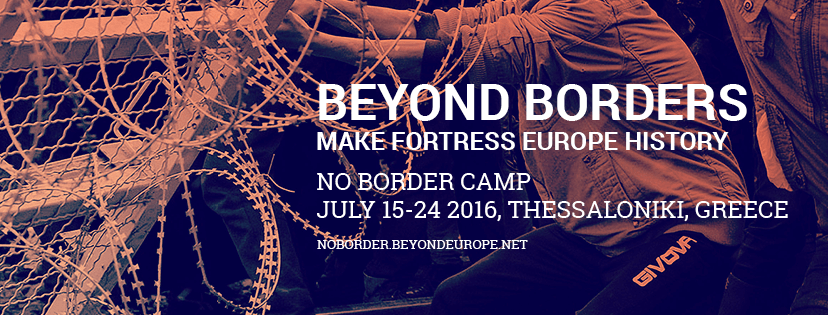
  • No Border Camp July 15-24th 2016 Thessaloniki (Greece)

    Defencing Festival and Actions on Croatian Slovenian border: june 24-26th 2016

    No Border Camp Thessaloniki July 15-24th 2016

    Programme / newspaper (pdf)

    Help to raise 10.000€ for NoBorder-Camp and self-organized support for refugees in Thessaloniki

    bannerBEnoborderFor the circulation of transnational struggles against state, nationalism, patriarchy and capital

    We want to move” (migrants’ slogan in the highway road between Athens-Thessaloniki)
    Don’t give me food, don’t give me water, open the borders” (migrants’ banner in the occupied railway line in Idomeni)
    Calling

    You can find this call in pdf here

    Today, with neoliberalism established across the planet, it is clear that capitalist relations are being intensified, together with nationalism and patriarchy. Fences and borders are being built not only in the physical space, but also across social relationships. However, the movements and transnational struggles of migrants are constantly producing new cracks in the system, new thresholds and pathways into an unexplored world.

    More specifically, transnational and global agreements further liberalize “free” markets and the lifting of tariff restrictions further ensure property rights for the wealthy. At the same time the former social contract of the welfare state is breaking down and the neoliberal state is claiming the role of manager-partner of companies, keeping for itself solely the army and the police in order to retain some of its administrative and legislative power. Gender oppression, racism and fascism are being remobilized for the control of populations.

    However, social struggles in the form of riots, rebellions, campaigns and movements both before and during the process of this recent “crisis”, seriously challenge all this. Prime examples are the riots in the French banlieues in November and December 2005, the Oaxaca Commune in 2006, the riots in December 2008 in Greece, the magnificently widespread Arab Spring in 2011, the Indignados Citizens Movements in Spain in 2011, the London riots in 2011, the “Occupy” movement in the USA in 2011 and 2012, the uprising at the Gezi park in Istanbul in June 2013, the Brazilian Spring in 2013, the uprisings in Bosnia and other Balkan States during 2013-2014.

    The response of neoliberalism to the recent structural crisis, one that is interpreted by some as a crisis of over-accumulation, by others as a result of civil disobedience, or as the long expected explosion of “abstract labor” in a fully monetarized economy, to extend and intensify its strategy of land-grabbing and pillage of resources, of means of production and of reproduction of whole societies.

    Austerity programs in the countries of the European South, war, religious intolerance and the intensification of gender oppression in the countries of the Arab Spring are part of the same strategy. Thus, whole populations are made to abandon their homes. These people, deprived of their natural and social space, migrate, cross borders, fences, barbed wire, rivers, seas, mines and police patrols. They also face exploitation by traffickers, they are detained in concentration camps and then they are forced to search for a job (usually in the black market, often unpaid) even under extremely dire conditions. Most end up unemployed and they form a kind of reserve workforce or are forced into prostitution, trafficking networks and organ smuggling.

    While more people need to move, more fences are being built. Fortress Europe rises from the ashes of its own crisis by using police procedures and policies of control, imprisonment, pushbacks, illegalization and penalization of the populations in motion. Police and military operations are intensified, N.A.T.O enters the picture, discriminations between immigrants and refugees are constructed and finally concentration camps, hot spots and pushback centers pivot the management of migrant people.

    Migrants moving from Africa and the Middle East towards Europe have challenged and fought against borders and national and supranational policies in practice. During the last months, hundreds of thousands of populations have crossed borders, and the movements for solidarity and emancipation are flourishing. The migrants’ movement with all its inventiveness and ingenuity proves that desires, social relationships and dreams cannot be imprisoned. Their power goes beyond borders and fences.

    It also shows that the motives for migration are mostly to be found in the complex intersections of gender, ethnic, cultural, religious or class discrimination and oppression. Populations in forced mobility develop survival strategies, activate subjective capabilities, coordinate social relationships with other moving people and simultaneously, they create social networks with those they leave behind.

    Therefore, we believe that we should understand but then go beyond the idea that perceives the state, capital, patriarchy and racism as totally dominant upon human subjects, and hence also immigrants as submissive victims in need only of charity, compassion and saving.

    In the last few months, immigrants and people in solidarity with them have met within and beyond the kaleidoscopic fields opened by the crisis. We believe that meetings and struggles should be encouraged, should acquire steady and lasting structures and reinvent the joy and the charm of companionship and sharing.

    For all these reasons, we think it’s crucial that we organize an international No Border Camp this summer in Thessaloniki.

    As for the choice of the specific city, Thessaloniki, it finds itself at the core of conflicts over the control and management of immigration and of the freedom of movement, due to its geographical position in northern Greece, bordering Albania, Rep. of Macedonia and Bulgaria, with many detention camps and pushback centers at its perimeter. In northern Greece as well as in the wider Balkan area, initiatives and solidarity networks have emerged during the last few months that can empower and be enhanced by the organization of a No Border Camp here. Finally, we think that the need for the coordination of various local political collectives and also its available movement infrastructures make Thessaloniki a suitable and reliable choice for the organization of a global and transnational No Border Camp.

    Based on the above framework, the present invitation is articulated as follows:

    a) practicalities of organization

    b) objectives

    c) working groups

    d) structure

    e) themes and topics of the gathering

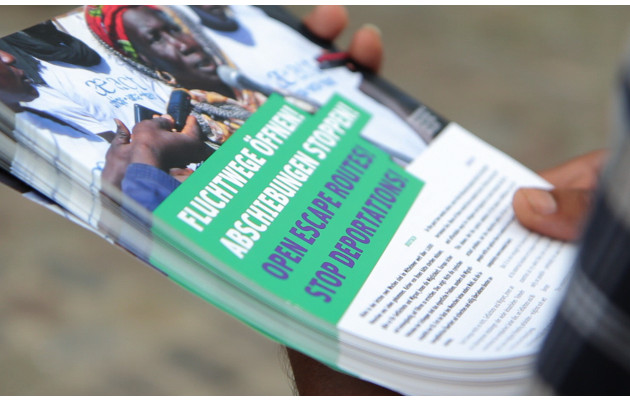
  • flyer Open Escape Routes! Stop Deportations!

    In the past two weeks alone, more than thousand people died in the Mediterranean Sea. None of them would have needed to die, if there were safe and affordable ways for refugees and migrants to reach Europe by ferry. This shows: Not the cynical methods of the human traffickers are the actual problem, but the migration policy of the EU. Because it leaves people with no option than to embark on the perilious passage on bad and completely overcrowded boats.

    flyer Open Escape Routes! Stop Deportations!143 kB

    flyerValletta

  • Politique de la UE en Afrique – Valletta 2015 – Interview avec Ousmane Diarra et Inna Touré

    Interview with Ousmane Diarra (Association Malienne des Expulsés / Bamako) and Inna Touré (Afrique Europe Interact-Mali) speak about the consequences of Valletta summit and about the current agenda of EU border politics in Africa

  • Lutte contre la migration africaine

    Le business migratoire
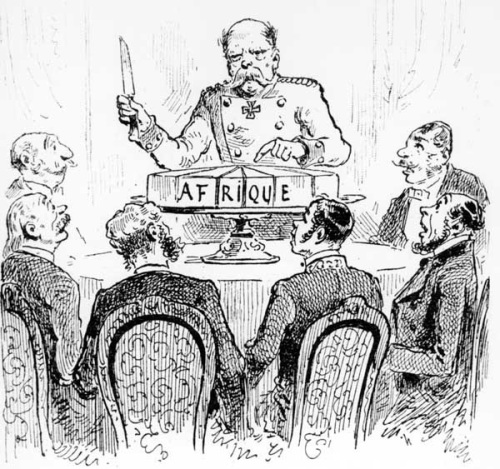
    Kongokonferenz 1884 / Franz.Karikatur - Congo Conference 1884/ French caricature -
    Par Samir ABI, Visons Solitaires (Togo)

    5 mai 2016

    C’est l’affaire qui rapporte le plus à l’heure actuelle : le business migratoire. Des réseaux mafieux en Italie aux passeurs libyens en passant par les sociétés de sécurité à Calais en France ou sous traitant dans différents pays d’Europe avec les opérations du FRONTEX, le système est bien huilé. Les Etats ne sont plus du reste dans ce nouveau business florissant. Après le chantage turc des 6 milliards d’euro c’est au tour du Niger de demander 1 milliard d’euro pour contribuer à lutter contre la migration clandestine[1]. Comme dans toute négociation internationale le poids du pays intervient dans la suite donnée à toute demande et la réponse de l’Union Européenne ne s’est pas faite attendre. Arguant des 20 milliards d’euro donnés annuellement aux 54 pays africains comme aide publique au développement et de la goutte des 1,8 milliards du fonds fiduciaire qui ne cesse de meubler le discours européen ces derniers mois. En réalité l’Europe continue un vieux jeu déjà expérimenté avec les pays du Maghreb et la Libye. Kadhafi, au dernier moment de sa gloire, lors du sommet Europe Afrique à Syrte en novembre 2010, s’était déjà servi des migrants comme instrument de chantage en se présentant comme le seul rempart au déferlement des subsahariens en Europe et en demandant 5 milliards d’euro pour les basses besognes[2]. La suite de l’histoire, tout le monde la connait. Le drame dans l’histoire est qu’on se refuse de nommer ce business auquel les Etats se livrent au dos des migrants de son vrai nom : Trafic d’être humain. En effet autant que les réseaux mafieux, les Etats s’adonnent à un honteux marchandage au détriment de lois internationales protégeant les droits humains à la mobilité et à l’asile. Marchander la liberté de mobilité des hommes n’est rien d’autre que du trafic même si on essai de le présenter comme la solution au drame en Méditerranée.

    Pour tout humaniste cette solution, qui met l’argent au dessus des libertés humaines, ne peut-être une solution viable. Même si ce discours peine à être entendu il reste toujours nécessaire de rappeler que la meilleure solution pour éviter des morts dans les mers aux frontières reste l’établissement d’une véritable politique de libre circulation. Si les migrants peuvent se payer leur voyage dans les déserts du Sahara comme au Mexique, ou pour joindre la Grèce c’est qu’ils peuvent se payer un séjour si on leur donne la possibilité de pouvoir se rendre librement dans un pays. Tous les espaces de libre circulation aussi bien en Afrique de l’Ouest, qu’en Europe ont démontré que l’ouverture des frontières n’est pas synonyme d’invasion mais multiplie les opportunités de développement pour les hommes comme pour les pays. Les Français sont autant en Belgique pour poursuivre leurs études que les Belges en Allemagne ou au Luxembourg à la recherche d’un emploi. Les nigérians parcourent aussi bien le corridor Lagos Abidjan que les ivoiriens. Depuis trente ans ces expériences de libre circulation même partielle sont là pour nous prouver que nous pouvons construire un monde autour de la libre mobilité. Le nouveau discours sécuritaire qui présente la fermeture des frontières comme un gage de lutte contre le terrorisme permet juste de cacher la responsabilité profonde des Etats européens dans l’augmentation de groupes extrémistes au sein des populations nées en Europe mais qu’ils n’ont pas su intégrer. Même problème en Afrique où le lot des terroristes se retrouve dans les groupes discriminés des touaregs et des peuhls. Cela nous ramène au vrai débat sur la sécurité sociale et l’inclusion comme seule gage de la sécurité pour tous. Malheureusement à l’heure de l’économisme et de la religion du tout marchand, il faut que cela paye pour que ce soit digne d’être défendu.

    Le paternalisme européen

    On le croyait révolu au nom d’un nouveau discours sur un partenariat égalitaire. Le voilà de retour. Telle est la belle leçon des dernières visites à répétition des ministres des affaires étrangères européens en Afrique. En moins de trois semaines, les pays du Sahel ont eu droit aux visites des ministres hollandais, français et allemand tous émissaires de Federica Mogherini, la chef de la diplomatie européenne, pour venir rappeler les engagements de La Valette aux Chefs d’Etat Africain. Passe encore le conseil des ministres Afrique Caraïbe Pacifique – Union Européenne tenu, dans la même période, à Dakar, avec ses beaux discours sur la migration et les Accords de Partenariat Economique au moment où les citoyens européens ne cessent de se mobiliser contre le Trans-Atlantic Free Trade Agreement (TAFTA).

    L’Europe unie met la pression sur l’Afrique et en particulier les pays sahéliens et distribue les médailles. Le Sénégal est ainsi qualifié de « Bon élève » par les ministres européens pour sa politique migratoire. Quand pense les citoyens sénégalais ? Eux qui dépendent tant de leur diaspora avec 1 milliard 614 millions de dollars (plus de 921 milliards de Francs Cfa)[3] reçu l’année passée de ses migrants. Si les politiques en Europe restent tributaires de l’opinion de leur citoyen pour leur politique migratoire telle n’est pas encore le cas en Afrique. Les politiques migratoires dans les pays africains comme bien d’autres politiques d’ailleurs sont faites par les dirigeants pour mériter le titre de « Bon élève » décerné par l’Europe sans que l’opinion du peuple et la voix de la société civile africaine ne soit prise en compte. Triste démocratie pourtant vendu par l’Europe comme gage de son partenariat égalitaire avec l’Afrique. Le Niger est prié de devenir un « Bon élève » en contrôlant des migrants moyennant les 50 milliards de Franc Cfa du fonds fiduciaire européen alors qu’elle reçoit depuis cinq ans en moyenne 70 milliards de Francs Cfa[4] par an de sa diaspora sans compter toute l’économie que crée le passage des migrants. Le calcul est vite fait. A moins qu’on cède au chantage et qu’on lui donne un milliards d’euro ou que l’on fasse chanter ses dirigeants pour des problèmes de gouvernance et de démocratie.

    La CEDEAO des peuples

    Et comme toujours les pays africains se refusent de le jouer solidaire et en y allant seul au risque de faire briser le cou par une Europe qui se mobilise en force. On l’a bien senti avec le Ministre Koenders et on l’a encore mieux compris avec la visite conjointe des ministres allemand et français, Frank-Walter Steinmeier et Jean-Marc Ayrault. La Communauté Economique Des Etats d’Afrique de l’Ouest (CEDEAO) semble jouer les observateurs face à ce ballet diplomatique incessant des acteurs européens dans les pays du Sahel préférant s’accrocher aux promesses d’argent à recevoir du fonds fiduciaire pour sécuriser les frontières. Le risque c’est de voir un peu plus la fragile union entre pays sahéliens et pays côtiers ouest africains se briser au jeu des intérêts. En effet la concurrence entre pays se développe pour pouvoir attirer le plus possible l’aide européenne au développement ou plutôt l’aide européenne contre la migration comme l’a rappelé Neven Mimica, le commissaire européen au développement, en marge de la réunion ACP-UE de Dakar[5].

    La société civile multiplie, sans succès, les appels pour une CEDEAO forte pour un dialogue politique réel entre l’Europe et l’Afrique pouvant aboutir à des accords de libre mobilité comme c’est le cas entre l’Europe et plusieurs pays d’Amérique latine. La CEDEAO des peuples telle que proclamée à toutes les rencontres des chefs d’Etat de cet espace reste un vœu qui demeure au niveau institutionnel et qui tarde par se matérialiser par des instruments réels d’interaction entre les peuples ouest africain et les institutions de la CEDEAO. En effet tant que le parlement de la CEDEAO ne sera pas élu directement par les citoyens de l’espace, tant que toutes les décisions se prendront entre chefs d’Etat sans des référendums nationaux pour les valider et qu’un contrôle citoyen ne sera pas effectif sur le fonctionnement des institutions communautaires, la voix des peuples ouest africains ne sera jamais entendue. Il nous reste donc l’ultime outil des peuples sans voix : la mobilisation.

    [1] http://www.actuniger.com/politique/11576-le-niger-a-besoin-d%E2%80%99un-milliard-d-euros-pour-contenir-les-flux-migratoires-ill%C3%A9gaux-vers-l-europe.html

    [2] http://www.slate.fr/lien/30993/khadafi-regler-immigration-europe-5-milliards-euros

    [3] World Bank remittances data april 2016

    [4] World Bank remittances data april 2016

    [5] http://www.euractiv.fr/section/aide-au-developpement/interview/mimica-emergency-trust-fund-for-africa-might-not-be-a-game-changer/

    cropped-248064_388962421139370_281603798_n1

  • overhandiging verklaring West-Afrikaanse NGO’s aan minister Koenders aangaande Valletta actieplan

    Op 8 april 2016 overhandigde All Included / Afrique-Europe Interact de Nederlandse minister van Buitenlandse Zaken Koenders (Nederland is eerste helft jaar van 2016 voorzitter van de Raad van de Europese Unie) de verklaring van de West-Afrikaanse civil society met betrekking tot het Vallette-actieplan.In Valletta / Malta werd in november 2015 door Europese en Afrikaanse regeringsleiders een actieplan opgesteld om de migratie in banen te leiden  (zie de open brief.van Afrique-Europe Interact hier)  Minister Koenders ging van 14 tot 17 april naar Mali, Ghana en Ivoorkust op verzoek van Hoog Vertegenwoordiger van de Europese Commissie Mogherini (Buitenlandse Zaken en Defensie) om afspraken te maken aangaande het actieplan.

    Tien organisaties uit zoveel West-Afrikaanse CEDEAO-landen keren zich in de verklaring tegen de druk van de Europese landen om de mobiliteit van de CEDEAO-onderdanen verder aan banden te leggen. De ondertekenaars wijjzen erop dat de diaspora een belangrijke (financiële) rol speelt in de ontwikkeling van de landen van herkomst. Zij zien bovendien de grondoorzaken van de irreguliere migratie in de beperkingen door Europese landen van bewegingsvrijheid van de afgelopen jaren waaronder het visabeleid. Migranten worden hiermee in de handen geworpen van smokkelaars.

    In de verklaring wordt ook de wijze waarop ongedocumenteerden worden teruggestuurd zwaar bekritiseerd. Mensen worden in zeer precaire situaties aan hun lot overgelaten zonder enige nazorg of waardigheid. Hier volgt de verklaring in engels en frans.

    [FR] ci-dessous

    DECLARATION FROM THE WEST-AFRICAN CIVIL SOCIETY AFTER THE MEETING ON THE IMPLEMENTATION OF THE LA VALLETTA ACTION PLAN BY THE ECOWAS MEMBER STATES.

    Accra, February 9th – 11th 2016.

    The West African civil society organisations present in Accra, Ghana, greet favourably the ECOWAS meeting on the implementation of the action plan adopted by the EU and African states at the La Valletta summit in Malta, on November 11th and 12th 2015.

    West African countries cannot remain indifferent to the ongoing drama happening off the European coasts, in the Sahara desert and in the Gulf of Guinea. Civil society is thus pleased with the strong involvement of the ECOWAS member states in finding solutions to this phenomenon.

    In the perspective of the La Valletta summit and in order to define an ECOWAS common stand, many meetings took place between heads of states and ministers between September 2015 and November 2015. The West African civil society is glad to have been included all along this process in the dialogue framework.

    However, its message towards the heads of states does not fully come across. Indeed, the crisis Europe faces with migrants’ arrival and the obstructions to freedom of movement within the Shengen Area should enable ECOWAS to present itself as a model of free movement area.

    84% of West African migrants live in another country from the ECOWAS. This one observation is sufficient to show that the migration stakes ECOWAS member states have to meet are relatively specific. On some points they can be far from the EU demands in terms of migration management.

    Our populations wish to reach a better mobility within their area. Their will goes against the temptation of movement control in the West African area foreshadowed in the La Valletta action plan.

    The five major points from the La Valletta action plan and the creation of an “orientation and professional training center” for migrants in Agadez, Niger, are worrying. Both of them lead civil society to fear the questioning of our historical freedom of movement in the West African area as ratified in ECOWAS protocols. Despite security risks due to more and more acts of terrorism (condemned by the civil society), civil society remains convinced that the appropriate answer to migration flow lies in migration policies respectful towards migrant workers’ rights and those from their families.

    The civil society therefore urges the ECOWAS member states to take into consideration their population’s right to free movement, both in the La Valletta action plan’s implementation and in the projects yet to be submitted to the 1.8 billion € fiduciary funds set by the EU.

    The civil society stresses again that the deep causes of irregular migration lie in restrictive migration policies developed by the EU over the last years. No solution to irregular migration should be found without a frank and honest dialogue between the EU and ECOWAS state members, and this, in order to offer to people (especially to the youths) mobility opportunities and visa exemptions such as obtained in some Latin American countries. Consensual mobility could prevent West African migrants to join people smuggler networks. It would also foster creativity and job generating production investments from young Africans after their migration experience.

    Faced with climate crisis, drought, coastal erosion and more and more natural catastrophes in the ECOWAS area, the civil society stresses the need to take into account resilience to climate change in all the projects yet to be submitted to the fiduciary funds. A dialogue should also be opened in the frame of the La Valletta action plan implementation in order to find solutions to the issue of internal refugees and displaced persons, who mainly find themselves in the ECOWAS area. Despite their lack of resources, states are now bearing the cost of this issue.

    The fight against human trafficking cannot be limited to cracking down on people smugglers. Regarding this topic and within the fiduciary funds frame, the civil society stresses the need to support projects helping to strengthen the legal frame and the victims’ protection.  It also invites the ECOWAS member-states to ratify all legal instruments relating to human trafficking, migrant trafficking and domestic work. The African civil society remains convinced that creating a safe channel for professional migration and university mobility inside and outside the ECOWAS area is a possible answer to fight human trafficking and migrant trafficking.

    The West African civil society wishes to point out its reluctance regarding the voluntary return mechanisms currently at work between European states and the ECOWAS member states. In order to protect the migrants’ dignity, the civil society likes to remind that returns shall take into account the risks of insecurity and precariousness faced by the person who comes back.  Given the importance of the diaspora members – regardless of their legal situation in the country where they live – for the development of ECOWAS Member States, each return should take place in a respectful way and in a concerted manner with the ECOWAS member-states including the necessary support for psychological monitoring and professional reintegration of the migrants in their origin country.

    According to the civil society, the diaspora has a big role to play in developing a win-win migration between ECOWAS member states and the EU. Therefore the civil society urges that projects developed for or by the Western African diaspora in Europe benefit from facilitated mechanisms to access funds from the fiduciary funds.

    In order to follow the implementation of the La Valletta action plan, the funding from the fiduciary funds and the West African migrants’ human rights, all the participants from civil society present in the Accra meeting have decided to create an Observatory of the West African Civil Society on the La Valletta Action Plan. This observatory will enable a better representativeness of civil society in the national and regional dialogues on migration.

    We call the ECOWAS commission and the technical and financial partners to support this initiative.

    Accra, Feb 11th 2016.


    ORGANISATIONS COUNTRY
    1 ONG UNION FAIT LA FORCE (UFF) BENIN
    2 ALERT MIGRATION BURKINA FASO
    3 MIGRATION POLICY AND ADVOCACY NETWORK (MiPAN) GHANA
    4 RESEAU AFRIQUE JEUNESSE DE GUINEE (RAJ-GUI) REPUBLIQUE DE GUINEE
    5 MOVIMENTO NACIONAL DA SOCIEDADE CIVIL PARA A PAZ , DEMOCRACIA E DESENVOLVIMENTO (MNSCPDD) GUINE-BISAU
    6 ECOWAS CIVIL SOCIETY LIBERIA
    7 ASSOCIATION MALIENNE DES EXPULSES MALI
    8 AMLGAMATED YOUTH MOVEMENT SIERRA LEONE
    9 ENDA DIAPOL SENEGAL
    10 VISIONS SOLIDAIRES TOGO


    Contact persons :

    1. Samir ABI,  Visions Solidaires, TOGO, email : samirvstg@gmail.com
    2. Eric PEASAH, Migration Policy and Advocacy Network, GHANA, email : epeasah@yahoo.com


    [FR]

    DECLARATION DE LA SOCIETE CIVILE OUEST AFRICAINE A L’ISSUE DE LA REUNION SUR LA MISE EN ŒUVRE DU PLAN D’ACTION DE LA VALETTE PAR LES ETATS MEMBRES DE LA CEDEAO

    Accra, 9 au 11 février 2016

    Les organisations de la société civile ouest africaine présentes à Accra au Ghana saluent la réunion de la CEDEAO sur la mise en œuvre du plan d’action adopté par l’Union Européenne et les Etats Africains au sommet de la Valette à Malte, les 11 et 12 novembre 2015.

    Le drame, qui continue au large des côtes européennes, dans le désert du Sahara et dans le Golfe de Guinée, ne serait laisser les pays ouest africains indifférents. Ainsi la société civile ouest africaine  se réjouit de voir la forte implication des Etats membres de la CEDEAO pour trouver des solutions à ce phénomène. La perspective du sommet de la Valette a permis, de septembre 2015 à novembre 2015, de nombreuses réunions au niveau des Chefs d’ Etat et au niveau ministériel pour définir une position commune de la CEDEAO. La société civile ouest africaine se réjouit que tout au long de ce processus elle ait été associée dans les cadres de dialogue mis en place à cet effet. Cependant son message à l’endroit des Chefs d’Etats peine encore à se faire entendre.

    En effet la crise de l’Europe face à l’arrivée des migrants et les obstructions qui naissent dans la libre circulation au niveau de l’espace Schengen doivent permettre de faire émerger la CEDEAO comme un modèle d’espace de libre circulation. 84% des migrants ouest africains vivent dans un autre pays de l’espace CEDEAO. Ce constat à lui seul démontre que les enjeux de la migration à laquelle doivent répondre les Etats membres de la CEDEAO sont assez spécifiques et peuvent être en certains points éloignés des demandes de l’Union Européenne en matière de gestion migratoire. La volonté de nos populations d’aller vers une meilleure mobilité dans leur espace se heurte à la tentation du contrôle de la mobilité dans l’espace ouest africain tel que le laisse présager le plan d’action de la Valette.

    Les cinq points majeurs du plan d’action de la Valette et la création annoncée d’un centre d’accueil, de formation professionnelle et d’orientation des migrants à Agadez au Niger, laisse craindre à la société civile une remise en cause de libre circulation historique de nos peuples dans l’espace ouest africain entérinée par les protocoles de la CEDEAO. Malgré les risques sécuritaires liés à la multiplication des actes terroristes, que la société civile condamne, elle reste persuadée que la réponse adéquate à l’afflux migratoire se trouve dans des politiques migratoires respectueuses des droits des travailleurs migrants et des membres de leur famille.

    La société civile invite donc les Etats membres de la CEDEAO à prendre en compte la nécessité du respect du droit à la libre circulation de leur population dans le suivi du plan d’action de la Valette et dans les projets à soumettre au fonds fiduciaire de 1,8 milliards d’euro mise en place par l’Union Européenne.

    La société civile rappelle que les causes profondes de la migration irrégulière se retrouvent dans les politiques migratoires restrictives développées par l’Union Européennes ces dernières années. Une solution à la migration irrégulière ne saurait être trouvée sans un cadre de dialogue franc et sincère entre l’Union Européenne et les Etats membres de la CEDEAO pour offrir aux populations, et en particulier les jeunes, des opportunités de mobilité et d’exemption de visa tel que obtenu par certains pays d’Amérique Latine. Une mobilité consensuelle pourrait permettre d’éviter que les migrants ouest africains aillent alimenter les réseaux de passeurs, et favorisera la créativité et des investissements productifs créateurs d’emploi, des jeunes africains après leur expérience migratoire.

    Face à la crise climatique, la sécheresse, l’érosion côtière et les catastrophes naturelles qui se multiplient dans l’espace CEDEAO, la société civile insiste sur la nécessité de prendre en compte dans les projets qui seront soumis au fonds fiduciaire la résilience face au changement climatique. Un dialogue doit également s’ouvrir dans le cadre du suivi du plan d’action de la Valette pour trouver des solutions au problème des réfugiés et déplacés internes qui se retrouvent majoritairement dans l’espace CEDEAO et dont le coût est supporté par les Etats malgré leur manque de ressource.

    La lutte contre la traite des personnes et le trafic des migrants ne serait juste se limiter à une guerre contre les passeurs. A ce sujet, la société civile rappelle la nécessité dans le cadre du fonds fiduciaire de soutenir les projets allant dans le sens du renforcement du cadre juridique et de la protection des victimes de traite et de trafic. Elle invite les Etats membres de la CEDEAO à ratifier l’ensemble des instruments juridiques sur la traite des personnes, le trafic des migrants et le travail domestique. La société civile africaine reste persuadée qu’une réponse possible pour éviter la traite des personnes et le trafic des migrants, serait la création de filière sécurisée de migration professionnelle et de mobilité universitaire à l’intérieur et hors de l’espace CEDEAO.

    La société civile ouest africaine tient à exprimer ses réserves sur les mécanismes de retours volontaires actuellement en œuvre entre les Etats européens et les Etats membres de la CEDEAO. Elle tient à rappeler que dans l’intérêt de la dignité des migrants tout retour doit se faire en tenant compte du risque de précarité et d’insécurité dans lequel pourrait se retrouver la personne retournée. Au vu de l’importance des membres de la diaspora, quelque soit leur situation légale dans les pays d’accueil, pour le financement du développement des Etats membres de la CEDEAO, tout retour doit être mené dans le respect et dans la concertation avec les Etats membres de la CEDEAO avec une nécessaire prise en charge du suivi psychologique et de la réinsertion professionnelle du migrant dans les pays d’origine.

    La diaspora a, de l’avis de la société civile, un grand rôle a joué pour développer une migration « gagnant gagnant » entre les Etats membres de la CEDEAO et l’Union Européenne. La société civile invite donc à des mécanismes facilités d’accès au financement du fonds fiduciaire des projets développés par ou à l’endroit des diasporas ouest africaines en Europe.

    Afin de suivre la mise en œuvre du plan d’action de la Valette, des financements qui seront accordés par le fonds fiduciaire et le respect des droits humains des migrants ouest africains, l’ensemble des acteurs de la société civile présente à la réunion d’Accra ont convenu de constituer un Observatoire de la Société Civile Ouest Africaine sur le Plan d’Action de la Valette. Cet observatoire permettra une meilleure représentativité de la société civile dans les cadres de dialogue régionaux et nationaux sur la migration.

    Nous appelons la Commission de la CEDEAO et les partenaires techniques et financiers à soutenir cette initiative.

                                                                                                  Fait à Accra le 11 février 2016

    ORGANISATIONS PAYS
    1 ONG UNION FAIT LA FORCE (UFF) BENIN
    2 ALERT MIGRATION BURKINA FASO
    3 MIGRATION POLICY AND ADVOCACY NETWORK (MiPAN) GHANA
    4 RESEAU AFRIQUE JEUNESSE DE GUINEE (RAJ-GUI) REPUBLIQUE DE GUINEE
    5 MOVIMENTO NACIONAL DA SOCIEDADE CIVIL PARA A PAZ , DEMOCRACIA E DESENVOLVIMENTO (MNSCPDD) GUINE-BISAU
    6 ECOWAS CIVIL SOCIETY LIBERIA
    7 ASSOCIATION MALIENNE DES EXPULSES MALI
    8 AMLGAMATED YOUTH MOVEMENT SIERRA LEONE
    9 ENDA DIAPOL SENEGAL
    10 VISIONS SOLIDAIRES TOGO


    Personnes de contact :

    1. Samir ABI,  Visions Solidaires, TOGO, Tél : (+ 228) 90 79 44 12 email : samirvstg@gmail.com
    2. Eric PEASAH, Migration Policy and Advocacy Network, GHANA, Tél : (+233) 242 170 827 email : epeasah@yahoo.com
     

  • 1 jaar Watch the Med Alarmphone: ‘Moving on’

    Watch the Med Alarmphone is actief sinds 11 Oktober 2014. Sindsdien zijn we in teams 24/7 bereikbaar voor migranten in nood op de Middellandse Zee. Inmiddels zijn we gegroeid tot een transnationale groep met 120 mensen uit tientallen landen. We zijn onafhankelijk, kritisch en activistisch, en volgen de dubbelzinnige praktijken van de kustwachten en Frontex op de voet. In het eerste jaar zijn we betrokken geweest bij meer dan 1200 alarm situaties. Over dit eerste jaar is nu de brochure ‘Moving on’ verschenen met daarin onze ervaringen en evaluaties. Het was een cruciaal jaar in de geschiedenis van migratie, met veel repressie en indrukwekkend doorzettingsvermogen van vele mensen die ondanks alle barricades die opgeworpen werden door bleven gaan met het opeisen van hun rechten. Door niet meer naar politici, grenswachten en politie te luisteren en door te blijven gaan, vaak lopend, totdat een gewenste bestemming is bereikt.

    De Alarmtelefoon is na het eerste jaar helaas niet onnodig geworden. Januari 2016 was een extreem dodelijke maand voor migranten op de Egeische Zee en ook de eerste week van februari liegt er niet om. De Watch the Med Alarmphone teams worden dagelijks geconfronteerd met omgeslagen boten en verdrinkingsdood. Zeker 257 migranten zijn in januari verdronken tijdens de gevaarlijke tocht tussen Turkije en Griekenland en zeker 26 mensen zijn dood gegaan op hun weg van Libië naar Italië. Migratie over de Middellandse zee houdt ook in de wintermaanden, uit bittere noodzaak. In januari hebben 60.000 mensen Griekenland bereikt via de Middellandse Zee. Dit is vergelijkbaar met de aantallen in de zomer (juli 2015: 55.000).  De wintermaanden zijn echter veel gevaarlijker, vanwege de weersomstandigheden: de sterke wind en de kou maken de reis veel riskanter. Maar aanhoudende oorlog en conflicten, slechte omstandigheden in de regio, en spierballentaal van de Europese Unie over het verder optrekken van de EU grenzen, maken dat mensen toch in grote getale hun levens wagen.

    Het politieke beleid en de lobby gaat van kwaad tot erger. Afgelopen weekend was er veel aandacht voor de Turks-Syrische grens, waar duizenden Syriers gevlucht uit een gebombardeerd Aleppo wachtten op veiligheid. De Europese Unie roept Turkije op de grenzen open te stellen voor vluchtelingen. Maar de EU onderhandelt ondertussen al maanden met Turkije om mensen tegen te houden vanuit Turkije naar Europa door te reizen. Daarbovenop worden plannen gesmeed om mensen die aankomen in de EU direct terug te sturen naar Turkije als veilig derde land en dus mensen hun recht op het vragen van asiel in een EU staat te ontnemen.
    Dat er al meer dan 3 miljoen vluchtelingen in erbarmelijke omstandigheden verblijven in Turkije en dat Turkije het niet zo nauw neemt met de mensenrechten, wordt voor het gemak ook even vergeten.

    Waar zijn we in de EU zo bang voor? Wordt het niet eens tijd om onze rijkdom en welvaart te delen met de mensen die er de dupe van zijn geworden? Wij vinden van wel. Maar in plaats daarvan zien we een toenemende repressie tegen migranten en vrijwillige hulpverleners. Migranten worden in dystopische situaties aan hun lot overgelaten: op de reis naar de kust van Libië, Marokko en Turkije, in het water, op de Griekse eilanden en aan de Macedonische grens. Het is ongekend en staat in het grootst mogelijke contrast met de welvaart die we in Europa als burgers met een Europees paspoort genieten.
    De nieuwste tactieken van Fort Europa richten zich op de solidaire burgerinitiatieven op de Griekse eilanden. Deze zijn nu punt van aandacht geworden: ze worden gecontroleerd en gecriminaliseerd in de hoop ze aan banden te leggen.

    Politici spreken al sinds de zomer over een vluchtelingencrisis. Watch the Med Alarmphone is ervan overtuigd dat migratie niet te beheersen is. Het enige dat beleidsmakers in de hand kunnen hebben is hoeveel mensen er tijdens hun reis omkomen. Wat dat betreft zou het interessant zijn om te bedenken wat er zou gebeuren als Samsom’s voorgestelde veerboten de andere kant op zouden varen, en juist mensen naar Europa zou brengen. Gewoon een ticket kopen en niemand meer die zijn leven hoeft te wagen.

    De brochure is online te bekijken:
    http://alarmphone.org/wp-content/uploads/sites/25/2016/01/AP-1year-Doku-Screen-04-DS.pdf

    Samenvattingen van alarmsituaties en hun afloop zijn te vinden op:
    http://www.watchthemed.net/

    http://alarmphone.org/en/2016/01/31/weekly-reports-january-2016-one-of-the-deadliest-months-ever-in-the-aegean-sea/?post_type_release_type=post

  • herdenking slachtpartij Ceuta 2016

    rapport sur Ceuta et Melilla (migreurop, GADEM, Cimade) dec. 2015

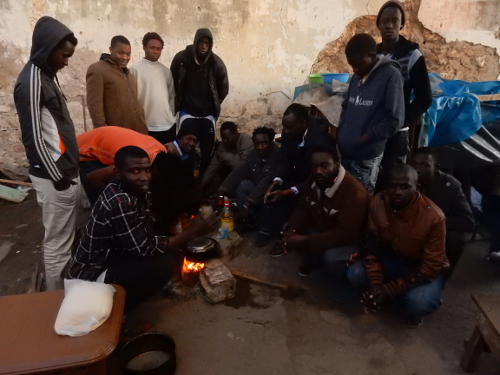
    Begin februari 2016 brachten twee mensen van All Included een bezoek aan Rabat/Marokko. Mede namens Afrique-Europe Interact namen wij deel aan de herdenking van de dood van 15 migranten in februari 2014, bezochten we een opvanghuis voor vrouwelijke migranten, een getto (illegaal kamp) van een vijftigtal migranten onder een brug in Rabat en diverse foyers (woongemeenschappen) waar migranten hun kansen afwachten om naar Europa te gaan.

    Guardia-del-Ceuta-que-dels_ARAIMA20150212_0033_5

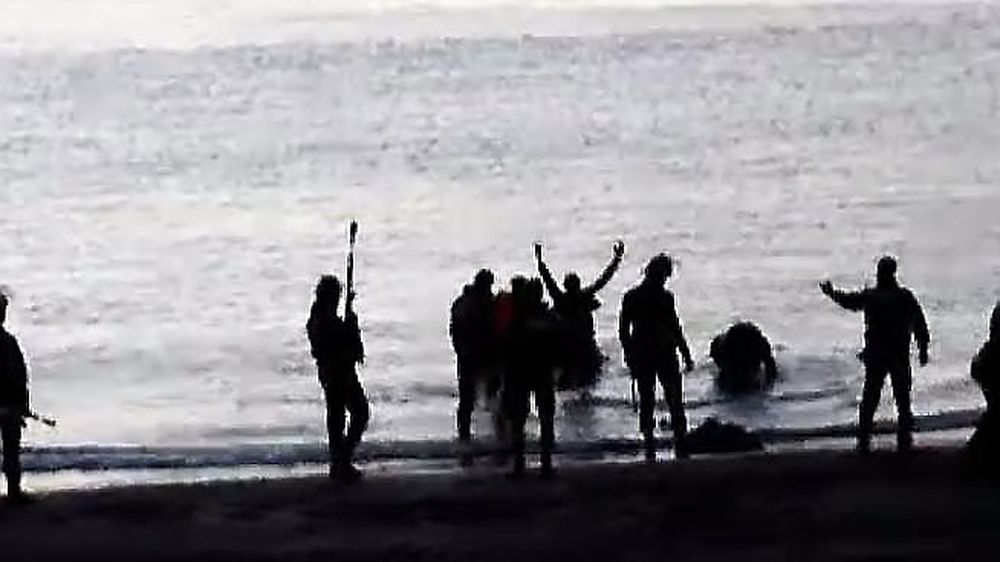
    6 februari 2014. Vijftien migranten die probeerden vanaf Marokko zwemmend het strand van Tarajal in de Spaanse enclave Ceuta te bereiken vonden de dood. Met gebruik van rubber- en andere anti-oproerpolitie kogels werd door de Spaanse grensbewakers van de Guardia Civil echter niet voorkomen dat een groep aan land kwam. Een Spaanse rechter vond dat er geen strafbaar feit gepleegd was met het gebruik van deze middelen. Tevens was de onmiddellijke uitzetting naar Marokko van de 23 migranten die wel levend de kust bereikten niet strafbaar.

    sit-in2016b

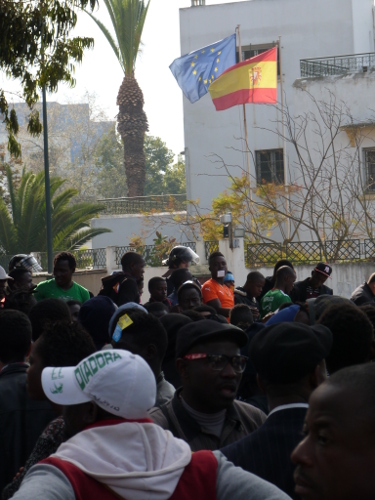
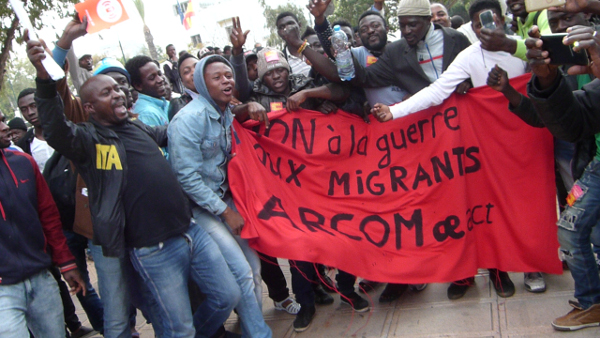
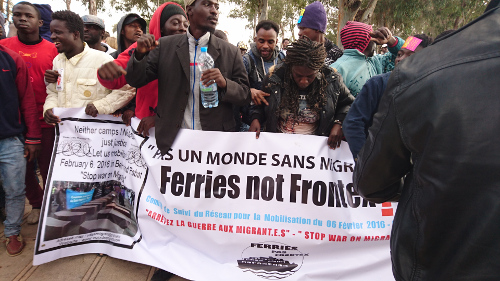
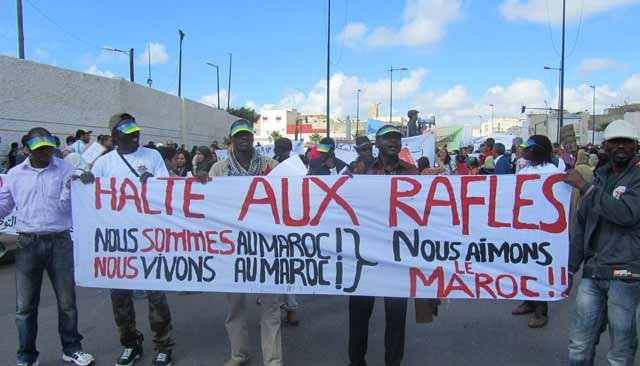
    Een kleine vijfhonderd migranten kwamen op 5 februari 2016 bijeen voor de Spaanse consulaat aan de avenue An Nasr in Rabat om te protesteren tegen de gewelddadigheden gepleegd tegen de migranten die pogen Europa te bereiken. Een geluidswagen werd door ingrijpen van de politie verboden maar de sit-in zelf werd toegestaan. Een rij oproerpolitie hield ons nauwlettend in de gaten. Het aantal migranten die uit diverse steden in het land kwamen was groter dan verwacht. Tijdens de voorbereidingen werd op een bepaald moment opgeroepen niet meer naar Rabat te komen bij gebrek aan financiën. De emotie die bij de bijeenkomst vooraf en tijdens de sit-in losbarstte was werkelijk uitzinnig. In het dagelijks leven is het nadrukkelijk uiten van de aanwezigheid van sub-Sahara migranten ongepast. De woede over de minachting voor deze migranten in Marokko (en Europa) bleek groot. Daar is  dan ook alle reden voor. Onlangs zijn alle sub-Sahara migranten langs de kust in Noord-Marokko opgepakt en naar de grote steden uitgezet. Dit ging gepaard met veel geweld en grove schending van mensenrechten.

    commemoration06022016Rabat2

    Het afgelopen jaar hebben ons de kracht van de migratiebeweging getoond. Migranten laten zich niet afschrikken door de Europese grensbewaking. Zoekend naar de meeste kans op binnenkomst in Europa wordt met veel druk toegang verschaft tot het Schengengebied. Migranten maken hierbij gebruik van hun recht tot het zoeken naar een menswaardig perspectief. Veelal gaat het om een verlichting van de diepe armoede, corruptie en onderdrukking; werk in Europa betekent een aanzienlijke bijdrage aan het gezinsinkomen. Door een dichtgetimmerd visumsysteem sinds eind jaren 1980 die hele landen uitsluit van een legale binnenkomst worden mensen verplicht gebruik te maken van irreguliere kanalen, de mensensmokkel.

    sit-in2016aFrontex, agentschap voor Europese grensbewaking, is een militair wapen in de oorlog tegen de migratie. Het beschikt over een arsenaal aan militair materieel en personeel uit alle landen van de Europese Unie en van het Schengengebied. Hiermee wordt middels Rabits (Rapid Border Intervention Teams) zoals onlangs in Griekenland direct ingegrepen daar waar grote groepen migranten plots Europa binnenkomen. Frontex Risico-analyses worden gemaakt om deze flexibiliteit voor te zijn. En zo worden migranten gedwongen gevaarlijkere routes te nemen met alle doden ten gevolge. Maar van enige bijdrage aan de oplossing van het probleem van het vraagstuk is geen sprake. Armoede, corruptie en onderdrukking worden niet aangepakt. Sterker nog, de corrupte staten waar migranten voor vluchten worden gesteund door de Europese staten en Unie. Deze steun is nodig om te komen tot de externalisatie van de grensbewaking. Daar het bewaken van de Middellandse Zee en de landgrenzen van de steeds groter wordende unie nauwelijks te behappen is wordt een buffer buiten de Europese grenzen gevormd. In deze transatielanden dient migratie aangepakt voordat  de grens van Europa wordt bereikt. Dat hiermee ook vluchtelingen de kans op asiel ontnomen wordt is meer dan ‘colletaral damage’. Er wordt immers ook voor deze groep geen alternatief geboden voor hun noden en rechten.
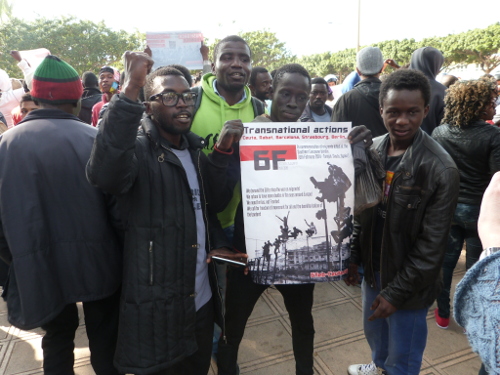
    Middels de foto-expositie “Europe closes our borders – Frontex and the externalization of European border control” krijgt de externalisatie in West-Afrika een gezicht. Het vertelt het verhaal van de grensbewaking aan de kust van Senegal en Mauritanië die de rol van waakhond voor de Europese Unie spelen in ruil voor een financiële en materiële vergoeding. Detentiecentra, grensposten en uitzettingen naar landen van herkomst worden hier betaald door landen van de Europese Unie. De titel “L’Europe ferme nos frontières” is afkomstig van het Senegalees Dagblad Le Soleil van de dag na de ondertekening van de terugname-overeenkomst tussen Spanje en Senegal in 2006. Hiermee wordt Europa afgeschermd van de vluchtelingen uit West-Afrikaanse landen van oorlog, armoede, droogte en corruptie: Ivoorkust, Liberia, Guinee, Togo, Mali.

    commemoration06022016Rabat4Net als Turkije die nu bijzondere aandacht van de EU krijgt mag Marokko een speciale positie genieten. Het land is zich aan het ontwikkelen van een emigratieland (‘gastarbeiders’) via transitland naar ontvangstland. Het leven van de Sub-Sahara migrant in Marokko is sterk beschreven door Emmanuel Mbolela in zijn boek “Mijn reis van Congo naar Europa. Tussen verzet, vlucht en ballingschap”. Emmanuel, Congolese activist en vluchteling, vertelt hierin over zijn verzet in Congo, zijn tocht van twee jaar via de woestijn en zijn verblijf in Marokko van vier jaar als illegaal, als sans-papiers. Binnenkort wordt dit manifest in het Nederlands uitgegeven door uitgeverij Van Gennep.
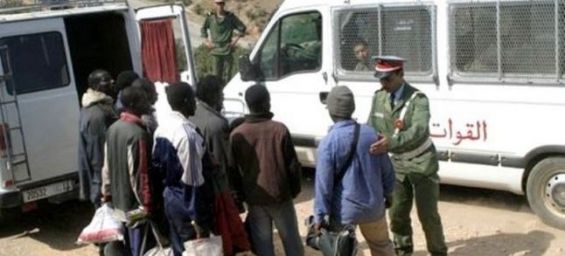
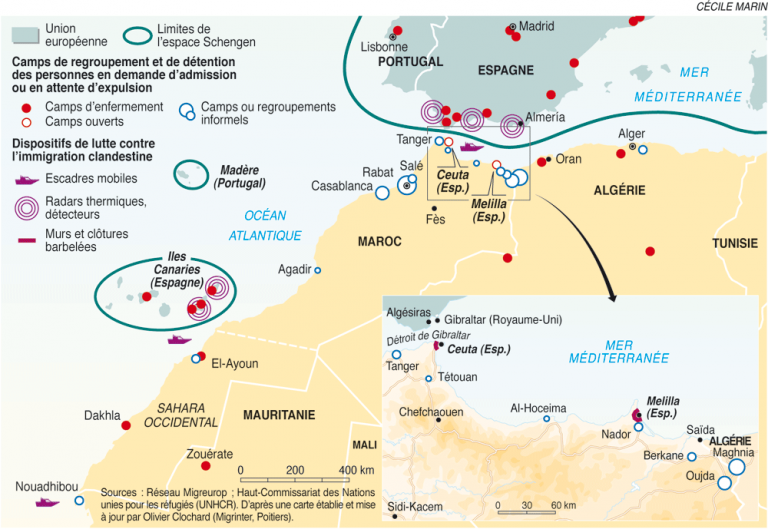
    Laatste ontwikkeling in Marokko is het schoonvegen van de kust langs de Middellandse Zee: alle kampen in de bossen bij de Spaanse enclave Ceuta en Melilla zijn platgebrand en iedereen is gearresteerd en naar steden richting zuiden gebracht. Hiermee wordt de overtocht per boot en land heel moeilijk gemaakt. De kracht van de migratie is echter blijvend sterk. Gevolg van dit alles is een toename van de oversteek naar de Canarische Eilanden en een trek naar Libië.

    De doorvoerstad Tanger in de buurt van Ceuta is altijd gevaarlijk terrein geweest voor sub-Sahara migranten, maar de situatie is geëscaleerd sinds 2015. Vooral tijdens de ramadan 2015 heeft de onderdrukking door de autoriteiten en gewelddadige aanvallen door de lokale bevolking een alarmerende dimensie bereikt. In juni 2015 werd de migrantenpopulatie van de Boukhalef wijk onderworpen aan grootschalige deportaties. Een jonge sub-Sahara migrant stierf toen hij van een dak viel op de vlucht voor de politie. In oktober breidde de politiekorpsen hun actieradius op de hele stad van Tanger en de omliggende bossen. Die migranten werden slachtoffer van arrestatie (zij ondergingen lange identificatieprocessen incl. foto’s en vingerafdrukken) en van deportaties naar Tiznit, meer dan 1000 km ten zuiden richting Mauritanië. Anderen werden (tijdelijk) gevangengezet in geïmproviseerde detentiecentra in het binnenland, in Fez, Marrakech, Casablanca, Rabat en Taroudant. Vaak werd het sub-Sahara migranten niet toegestaan ​​de bus naar het noorden te nemen. Deze behandeling moedigde meer en meer migranten aan om op weg te gaan naar het door oorlog geteisterde Libië, om zo te proberen Italië te bereiken.

    36417e6dff6cbea50ad50fb7448cca1c_thumb_565

    Gevallen zijn gemeld dat migranten in Tanger gearresteerd vervolgens werden overgebracht naar de haven Tanger Med op 50 km afstand. De algemene aanname is dat dit soort acties werden uitgevoerd met het oog op een verhoging van het aantal mensen dat op zee onderschept werd, en aldus de efficiëntie aantoonde van de Marokkaanse grenscontroles. Sinds de EU-Marokko overeenkomsten (actieplan) uit 2013 ontvangt het Koninkrijk Marokko 150 miljoen euro om de politieke en economische betrekkingen, maar ook de grenscontrole te intensiveren.

    Razzia’s tegen migranten kampen in de bossen demonstreren een ander niveau van escalatie. In de bossen worden de voorlopige onderkomens, tenten en persoonlijke bezittingen regelmatig in brand gestoken. Tijdens die operaties is het gebruikelijk dat er gewonden en zelfs doden vallen. Getroffenen ervaren de politie operaties als echte klopjachten, zoals het geval van de tragische dood in november 2015 van twee Kameroeners in het bos zeven kilometers van Ceuta. Ze werden door de militaire politie in een grot in de rotsen gedreven en vergast door traangas. Acht migranten die de politie informeerden nadat zij de lichamen vonden werden gearresteerd en naar het zuiden van Marokko gedeporteerd.
    foyerGuineeenRabat
    mm
    blesse_Ceuta_Rabat
    mm
    ghetto_SousPontRabat
    mm
    ghettoSousPontRabat
    mm

    mineurs 3klein

    mm

    Rafles-Maroc

    mm

    migreurop-768x529

    mm

    safehouseRabat1

    mm

  • Déclaration de la Société Civile d’Afrique de l’Ouest sur le Plan d’action Valletta

    [FR] ci-dessous

    DECLARATION FROM THE WEST-AFRICAN CIVIL SOCIETY AFTER THE MEETING ON THE IMPLEMENTATION OF THE LA VALLETTA ACTION PLAN BY THE ECOWAS MEMBER STATES.

    Accra, February 9th – 11th 2016.

    The West African civil society organisations present in Accra, Ghana, greet favourably the ECOWAS meeting on the implementation of the action plan adopted by the EU and African states at the La Valletta summit in Malta, on November 11th and 12th 2015.

    West African countries cannot remain indifferent to the ongoing drama happening off the European coasts, in the Sahara desert and in the Gulf of Guinea. Civil society is thus pleased with the strong involvement of the ECOWAS member states in finding solutions to this phenomenon.

    In the perspective of the La Valletta summit and in order to define an ECOWAS common stand, many meetings took place between heads of states and ministers between September 2015 and November 2015. The West African civil society is glad to have been included all along this process in the dialogue framework.

    However, its message towards the heads of states does not fully come across. Indeed, the crisis Europe faces with migrants’ arrival and the obstructions to freedom of movement within the Shengen Area should enable ECOWAS to present itself as a model of free movement area.

    84% of West African migrants live in another country from the ECOWAS. This one observation is sufficient to show that the migration stakes ECOWAS member states have to meet are relatively specific. On some points they can be far from the EU demands in terms of migration management.

    Our populations wish to reach a better mobility within their area. Their will goes against the temptation of movement control in the West African area foreshadowed in the La Valletta action plan.

    The five major points from the La Valletta action plan and the creation of an “orientation and professional training center” for migrants in Agadez, Niger, are worrying. Both of them lead civil society to fear the questioning of our historical freedom of movement in the West African area as ratified in ECOWAS protocols. Despite security risks due to more and more acts of terrorism (condemned by the civil society), civil society remains convinced that the appropriate answer to migration flow lies in migration policies respectful towards migrant workers’ rights and those from their families.

    The civil society therefore urges the ECOWAS member states to take into consideration their population’s right to free movement, both in the La Valletta action plan’s implementation and in the projects yet to be submitted to the 1.8 billion € fiduciary funds set by the EU.

    The civil society stresses again that the deep causes of irregular migration lie in restrictive migration policies developed by the EU over the last years. No solution to irregular migration should be found without a frank and honest dialogue between the EU and ECOWAS state members, and this, in order to offer to people (especially to the youths) mobility opportunities and visa exemptions such as obtained in some Latin American countries. Consensual mobility could prevent West African migrants to join people smuggler networks. It would also foster creativity and job generating production investments from young Africans after their migration experience.

    Faced with climate crisis, drought, coastal erosion and more and more natural catastrophes in the ECOWAS area, the civil society stresses the need to take into account resilience to climate change in all the projects yet to be submitted to the fiduciary funds. A dialogue should also be opened in the frame of the La Valletta action plan implementation in order to find solutions to the issue of internal refugees and displaced persons, who mainly find themselves in the ECOWAS area. Despite their lack of resources, states are now bearing the cost of this issue.

    The fight against human trafficking cannot be limited to cracking down on people smugglers. Regarding this topic and within the fiduciary funds frame, the civil society stresses the need to support projects helping to strengthen the legal frame and the victims’ protection. It also invites the ECOWAS member-states to ratify all legal instruments relating to human trafficking, migrant trafficking and domestic work. The African civil society remains convinced that creating a safe channel for professional migration and university mobility inside and outside the ECOWAS area is a possible answer to fight human trafficking and migrant trafficking.

    The West African civil society wishes to point out its reluctance regarding the voluntary return mechanisms currently at work between European states and the ECOWAS member states. In order to protect the migrants’ dignity, the civil society likes to remind that returns shall take into account the risks of insecurity and precariousness faced by the person who comes back. Given the importance of the diaspora members – regardless of their legal situation in the country where they live – for the development of ECOWAS Member States, each return should take place in a respectful way and in a concerted manner with the ECOWAS member-states including the necessary support for psychological monitoring and professional reintegration of the migrants in their origin country.

    According to the civil society, the diaspora has a big role to play in developing a win-win migration between ECOWAS member states and the EU. Therefore the civil society urges that projects developed for or by the Western African diaspora in Europe benefit from facilitated mechanisms to access funds from the fiduciary funds.

    In order to follow the implementation of the La Valletta action plan, the funding from the fiduciary funds and the West African migrants’ human rights, all the participants from civil society present in the Accra meeting have decided to create an Observatory of the West African Civil Society on the La Valletta Action Plan. This observatory will enable a better representativeness of civil society in the national and regional dialogues on migration.

    We call the ECOWAS commission and the technical and financial partners to support this initiative.

    Accra, Feb 11th 2016.


    ORGANISATIONS COUNTRY
    1 ONG UNION FAIT LA FORCE (UFF) BENIN
    2 ALERT MIGRATION BURKINA FASO
    3 MIGRATION POLICY AND ADVOCACY NETWORK (MiPAN) GHANA
    4 RESEAU AFRIQUE JEUNESSE DE GUINEE (RAJ-GUI) REPUBLIQUE DE GUINEE
    5 MOVIMENTO NACIONAL DA SOCIEDADE CIVIL PARA A PAZ , DEMOCRACIA E DESENVOLVIMENTO (MNSCPDD) GUINE-BISAU
    6 ECOWAS CIVIL SOCIETY LIBERIA
    7 ASSOCIATION MALIENNE DES EXPULSES MALI
    8 AMLGAMATED YOUTH MOVEMENT SIERRA LEONE
    9 ENDA DIAPOL SENEGAL
    10 VISIONS SOLIDAIRES TOGO


    Contact persons :

    1. Samir ABI, Visions Solidaires, TOGO, email : samirvstg@gmail.com
    2. Eric PEASAH, Migration Policy and Advocacy Network, GHANA, email : epeasah@yahoo.com


    [FR]

    DECLARATION DE LA SOCIETE CIVILE OUEST AFRICAINE A L’ISSUE DE LA REUNION SUR LA MISE EN ŒUVRE DU PLAN D’ACTION DE LA VALETTE PAR LES ETATS MEMBRES DE LA CEDEAO

    Accra, 9 au 11 février 2016

    Les organisations de la société civile ouest africaine présentes à Accra au Ghana saluent la réunion de la CEDEAO sur la mise en œuvre du plan d’action adopté par l’Union Européenne et les Etats Africains au sommet de la Valette à Malte, les 11 et 12 novembre 2015.

    Le drame, qui continue au large des côtes européennes, dans le désert du Sahara et dans le Golfe de Guinée, ne serait laisser les pays ouest africains indifférents. Ainsi la société civile ouest africaine se réjouit de voir la forte implication des Etats membres de la CEDEAO pour trouver des solutions à ce phénomène. La perspective du sommet de la Valette a permis, de septembre 2015 à novembre 2015, de nombreuses réunions au niveau des Chefs d’ Etat et au niveau ministériel pour définir une position commune de la CEDEAO. La société civile ouest africaine se réjouit que tout au long de ce processus elle ait été associée dans les cadres de dialogue mis en place à cet effet. Cependant son message à l’endroit des Chefs d’Etats peine encore à se faire entendre.

    En effet la crise de l’Europe face à l’arrivée des migrants et les obstructions qui naissent dans la libre circulation au niveau de l’espace Schengen doivent permettre de faire émerger la CEDEAO comme un modèle d’espace de libre circulation. 84% des migrants ouest africains vivent dans un autre pays de l’espace CEDEAO. Ce constat à lui seul démontre que les enjeux de la migration à laquelle doivent répondre les Etats membres de la CEDEAO sont assez spécifiques et peuvent être en certains points éloignés des demandes de l’Union Européenne en matière de gestion migratoire. La volonté de nos populations d’aller vers une meilleure mobilité dans leur espace se heurte à la tentation du contrôle de la mobilité dans l’espace ouest africain tel que le laisse présager le plan d’action de la Valette.

    Les cinq points majeurs du plan d’action de la Valette et la création annoncée d’un centre d’accueil, de formation professionnelle et d’orientation des migrants à Agadez au Niger, laisse craindre à la société civile une remise en cause de libre circulation historique de nos peuples dans l’espace ouest africain entérinée par les protocoles de la CEDEAO. Malgré les risques sécuritaires liés à la multiplication des actes terroristes, que la société civile condamne, elle reste persuadée que la réponse adéquate à l’afflux migratoire se trouve dans des politiques migratoires respectueuses des droits des travailleurs migrants et des membres de leur famille.

    La société civile invite donc les Etats membres de la CEDEAO à prendre en compte la nécessité du respect du droit à la libre circulation de leur population dans le suivi du plan d’action de la Valette et dans les projets à soumettre au fonds fiduciaire de 1,8 milliards d’euro mise en place par l’Union Européenne.

    La société civile rappelle que les causes profondes de la migration irrégulière se retrouvent dans les politiques migratoires restrictives développées par l’Union Européennes ces dernières années. Une solution à la migration irrégulière ne saurait être trouvée sans un cadre de dialogue franc et sincère entre l’Union Européenne et les Etats membres de la CEDEAO pour offrir aux populations, et en particulier les jeunes, des opportunités de mobilité et d’exemption de visa tel que obtenu par certains pays d’Amérique Latine. Une mobilité consensuelle pourrait permettre d’éviter que les migrants ouest africains aillent alimenter les réseaux de passeurs, et favorisera la créativité et des investissements productifs créateurs d’emploi, des jeunes africains après leur expérience migratoire.

    Face à la crise climatique, la sécheresse, l’érosion côtière et les catastrophes naturelles qui se multiplient dans l’espace CEDEAO, la société civile insiste sur la nécessité de prendre en compte dans les projets qui seront soumis au fonds fiduciaire la résilience face au changement climatique. Un dialogue doit également s’ouvrir dans le cadre du suivi du plan d’action de la Valette pour trouver des solutions au problème des réfugiés et déplacés internes qui se retrouvent majoritairement dans l’espace CEDEAO et dont le coût est supporté par les Etats malgré leur manque de ressource.

    La lutte contre la traite des personnes et le trafic des migrants ne serait juste se limiter à une guerre contre les passeurs. A ce sujet, la société civile rappelle la nécessité dans le cadre du fonds fiduciaire de soutenir les projets allant dans le sens du renforcement du cadre juridique et de la protection des victimes de traite et de trafic. Elle invite les Etats membres de la CEDEAO à ratifier l’ensemble des instruments juridiques sur la traite des personnes, le trafic des migrants et le travail domestique. La société civile africaine reste persuadée qu’une réponse possible pour éviter la traite des personnes et le trafic des migrants, serait la création de filière sécurisée de migration professionnelle et de mobilité universitaire à l’intérieur et hors de l’espace CEDEAO.

    La société civile ouest africaine tient à exprimer ses réserves sur les mécanismes de retours volontaires actuellement en œuvre entre les Etats européens et les Etats membres de la CEDEAO. Elle tient à rappeler que dans l’intérêt de la dignité des migrants tout retour doit se faire en tenant compte du risque de précarité et d’insécurité dans lequel pourrait se retrouver la personne retournée. Au vu de l’importance des membres de la diaspora, quelque soit leur situation légale dans les pays d’accueil, pour le financement du développement des Etats membres de la CEDEAO, tout retour doit être mené dans le respect et dans la concertation avec les Etats membres de la CEDEAO avec une nécessaire prise en charge du suivi psychologique et de la réinsertion professionnelle du migrant dans les pays d’origine.

    La diaspora a, de l’avis de la société civile, un grand rôle a joué pour développer une migration « gagnant gagnant » entre les Etats membres de la CEDEAO et l’Union Européenne. La société civile invite donc à des mécanismes facilités d’accès au financement du fonds fiduciaire des projets développés par ou à l’endroit des diasporas ouest africaines en Europe.

    Afin de suivre la mise en œuvre du plan d’action de la Valette, des financements qui seront accordés par le fonds fiduciaire et le respect des droits humains des migrants ouest africains, l’ensemble des acteurs de la société civile présente à la réunion d’Accra ont convenu de constituer un Observatoire de la Société Civile Ouest Africaine sur le Plan d’Action de la Valette. Cet observatoire permettra une meilleure représentativité de la société civile dans les cadres de dialogue régionaux et nationaux sur la migration.

    Nous appelons la Commission de la CEDEAO et les partenaires techniques et financiers à soutenir cette initiative.

    Fait à Accra le 11 février 2016

    ORGANISATIONS PAYS
    1 ONG UNION FAIT LA FORCE (UFF) BENIN
    2 ALERT MIGRATION BURKINA FASO
    3 MIGRATION POLICY AND ADVOCACY NETWORK (MiPAN) GHANA
    4 RESEAU AFRIQUE JEUNESSE DE GUINEE (RAJ-GUI) REPUBLIQUE DE GUINEE
    5 MOVIMENTO NACIONAL DA SOCIEDADE CIVIL PARA A PAZ , DEMOCRACIA E DESENVOLVIMENTO (MNSCPDD) GUINE-BISAU
    6 ECOWAS CIVIL SOCIETY LIBERIA
    7 ASSOCIATION MALIENNE DES EXPULSES MALI
    8 AMLGAMATED YOUTH MOVEMENT SIERRA LEONE
    9 ENDA DIAPOL SENEGAL
    10 VISIONS SOLIDAIRES TOGO


    Personnes de contact :

    1. Samir ABI, Visions Solidaires, TOGO, Tél : (+ 228) 90 79 44 12 email : samirvstg@gmail.com
    2. Eric PEASAH, Migration Policy and Advocacy Network, GHANA, Tél : (+233) 242 170 827 email : epeasah@yahoo.com