Category: campaign against Frontex

  • Open letter concerning the African-European Summit on Migration in Valletta, Malta, November 2015

    Afrique-Europe Interact

    [FR ci-dessous]

    9th November 2015 | African-European summit on migration: Open letter to the african governments

    On the occasion of the African-European summit on migration in Valetta, Malta (11th – 12th November 2015) Afrique-Europe-Interact has published an open letter which is mainly adressed to the african governments.

    Your honorable ambassadors,
    Dear media representatives,
    Dear ladies and gentlemen,

    this letter is addressed to the ambassadors of those African countries who will be present at the African-European Summit on Migration in Valletta. Moreover, we want to address the European public and thus European political institutions. As transnational network with member groups from a number of African and European states, we fear that in Valletta the European Union will yet again attempt to ruthlessly push through its interests – not least of all by relying on its simple economic supremacy. This not only becomes visible through the drafts of the final declaration, which have so far come to light, but also through the corresponding plan of action. More so, as is heard from inside the negotiations, the EU is following an extremely uncompromising course. A high-ranking representative of the African Union reported to the media service “Afroonline”, that already in the pre-negotiations no substantial dialogue has come about: “What we came to see from the EU is a monologue which aims to force their agenda onto us.”

    In this respect we would like to call upon the African governments not to agree to any solutions in Valletta which run against the interests of the African population – of which also refugees and migrants are a part, who are on their way to Europe or who are already there. More precisely: African countries should reject the European claim, that the primary aim of the summit in Valletta is to diminish irregular migration, including the readiness to accept or sign comprehensive deportation treaties with the European Union. Accordingly any attempt to tie payments of development aid to the implementation of measures of migration policies (the so called “more-for-more-principle”) has to be rejected. Rather a political course is to be striven for, which respects the fundamental rights of migrants and refugees – particularly in transit states such as Libya, Tunisia, Algeria and Morocco, in connection with a sustainable development strategy which is based on an economic upturn for the broad population in Africa.

    What are the precise plans for Valletta? Four thousand participants, among them heads of state from 35 African states and 28 European countries, are expected at the African-European Summit. This summit is not only planned to be follow-up to the Migration and Mobility Summit in Brussels in April 2014. Also, the previous results of the Rabat Process as well as the Khartoum Process are to be summarized. Both processes are primarily concerned with the control of migration, dictatorial regimes such as Eritrea or Sudan being also part of the negotiations in the Khartoum Process since 2014. Officially five negotiation topics are set up for Valletta, according to the German government: Fighting the causes for flight, legal migration and mobility, international protection and political asylum, combatting human trafficking and human smuggling as well as progresses concerning repatriation and readmission.

    Strikingly enough, the European Union signalizes no willingness whatsoever to turn away from its brutally interest-driven political course, which time and again produces the causes for flight that are supposedly sought to be “combatted”. One example of this is the recent demand put forth by the EU, that African states should ratify the highly controversial EPA-Freetrade Agreement (“Economic Partnership Agreements”) by 2017. Despite the fact that this will intensify cut-throat competition amongst African producers, these treaties plan the elimination of costums barriers for 80% of European products. Needless to say, that the state budgets of many African countries urgently require customs revenues. Similar pattern shows in many other areas, too: driving out local agrarian produce by pushing cheap export goods from the EU to the African market, by pushing the sale of African land to international investors (read: landgrabbing) or the mere fact that Africa looses up to 20 Billion Euro revenues per year through legal and illegal tax trickery by international corporations, to name but a few. In the face of this situation we want to appeal to you, the governments of Africa, to dare to nail your colours to the mast and to only agree to decisions which in fact sustainably improve the situation of your citizens:

    • Say No! to any form of politics aiming to seal off borders at the periphery of the EU, which forces refugees and migrants – women and men alike – to dangerous land and sea routes and No! to the increasingly brutal militaristic measures, aiming to hinder people from entering the EU (as for example the operation EUNFVOR at the Libyan coast). Thousands of dead African people are a terrible catastrophe for the involved families, friends and neighbourhoods. The ongoing externalization and hence elimination of refugee protection has to be met with decisive resistance. Huge refugee camps, as planned e.g. in Niger, cannot solve the problem – also because Niger counts as the poorest economy of the world. Instead what is to be expected are catastrophic conditions, as can be witnessed right now in the so-called “hotspots” on Lampedusa, the Greek island of Lesbos or the Serbian border. In this context we also want to appeal to the North-African countries, to refrain from their role as border police for the EU. The terrible scenes at the fences of Melilla and Ceuta or deportations to desert zones trample on the idea of transafrican solidarity. And the same was valid for the dramatic experiences with the camp Choucha at the border between Tunisia and Lybia as well (2011-2014).
    • Say No! to any form of forced repatriation from Northern Africa or Europe – do not sign any readmission agreement or contracts concerning the acknowledgement of EU-transitpasses (“laisser passer”). The real donors are the female and male migrants, who despite their often very precarious existence, transfer more money to Africa than the whole development aid of industrial countries comprises. The currently offered prospect of doubling the number of legitimate visas – amongst others to African students – is a joke and does not present a real solution for the actual needs of African migrants in terms of adequate education and work conditions.
    • Say No! to the multimedia campaigns which the EU wants to carry out in a number of African countries to prevent people from leaving. Neither the dangerous passages, nor racism or the deprivation of rights which influence the situation of migrants and refugees in Europe are an arbitrary fate. More than anything they are the imperatively condemnable result of deliberate policies set out to harass, wear down and exploit people. Relating to this issue, the red card needs to be shown to the cynical, yes racist, differentiation which is currently made between “well-educated” and hence welcomed civil war refugees from Syria and not welcomed “poverty refugees”.
    • Say No! to the ratification of the EPA-Freetrade Agreement and to all other economic measures enforced by the EU such as privatization in case of debts or tax exemption for international investors. In relation to this, the 1.8 billion Euro Emergency Aid Trust Fund is to be rejected as mere sham. Contrary to the official line, which claims that with this ridiculously tiny trust it is aimed to stabilize the situation in the Tchad region, at the Horn of Africa and in North Africa, it is planned to combat irregular migration with yet more measures based on security policies.
    • Say No! to all conducts which entail corruption, collusion and nepotism as well as bad governance, with which African governments themselves add to the aggravation of the permanent crisis in Africa. In this sense it is up to African institutions such as the AU or the ECOWAS to put pressure on autocratic and violent regimes such as Eritrea, Sudan or Burundi as their politics have already driven hundreds of thousands of people to flee.

    Lastly we would like to appeal to you, the African governments represented in Valletta, to accompany this multi-facetted NO! with a powerful YES!: A Yes, that on one hand aims to reach solidarity and fair settlement of interests between Africa and Europe (systematically taking into account the historical European responsibility for the long-term consequences of slavery, colonialism and climate change) and the realization of free movement as a steadfast human right on the other. It can not be emphasized enough, that it is not possible to control or stop migration and mobility! Instead it should be highlighted that the only effective alternative to sealing borders and deportation consists of unhindered and/or circular migration as it has always been culturally deeply rooted in all regions of Africa for decades and centuries.

    Kind regards,
    Afrique-Europe-Interact

    P.S.: On the occasion of the summit in Valletta, the Malian section of Afrique-Europe-Interact will hold a press conference on Tuesday, 10th November 2015 in Bamako

    [FR]

    09.11.2015 | Sommet afro-européen: Lettre ouvere aux gouvernements africains

    À l’occasion du sommet afro-européen sur la migration à La Valette, Malte (11.11.2015-12.11.2015) Afrique-Europe-Interact a écrit la lettre ouverte suivante.

    Chères ambassadrices, chers ambassadeurs,
    chers représentants et chères représentantes de médias,
    mesdames et messieurs,

    cette lettre est adressée aux ambassadeurs, ambassadrices et consuls qui ont une représentation diplomatique en Allemagne. Elle concerne aussi les pays africains qui seront présents au  « Sommet de La Valette sur les migrations ». Toutefois, nous voulons également l’adresser aux opinions publiques européennes afin donc d’interpeller la politique européenne. Parce que nous, en tant que réseau transnational avec des membres dans différents pays africains et européens, nous craignons que l’Union européenne par le biais du sommet de La Valette, essaie d’imposer encore une fois ses propres intérêts. Notamment en usant de leur supériorité économique pure. Cette crainte est fondée non seulement par les conceptions connues jusqu’à présent pour une déclaration finale, mais aussi basée sur les analyses du plan d’action de l“UE correspondant qui l’accompagne. Du côté des cercles de négociations on peut s’attendre à ce que l’UE soit extrêmement intransigeante. Un haut représentant de l’Union Africaine a d’ailleurs informé le service de média “afroline”, qu’il n’y avait jusqu’ici aucun dialogue véritable dans les entretiens préliminaires : “Ce que nous voyons de la part de l’UE, c’est un monologue, qui vise à nous imposer leur ordre du jour.” à -t-il déclaré.

    Dans cet ordre d’idées, nous voulons en appeler aux chefs de gouvernements africains au rejet à La Valette de toutes les solutions qui seront dirigées contre les intérêts des populations africaines – parmi lesquelle d’ailleurs les réfugiés et les migrant-e-s qui sont sur les chemins vers l’Europe ou qui sont déjà arrivés en Europe. Plus précisément : les pays africains devraient apporter une réponse négative au mot d’ordre européenne dont l’objectif principal à La Valette est de discuter sur “comment freiner “ la migration illégale et de faire signer les accords de réadmission. En conséquence, est à rejeter toute tentative qui oriente les flux d’aide au développement vers la mise en œuvre des mesures migratoires (le soi-disant principe du “plus pour plus”). Par ailleurs, est souhaitable une politique qui non seulement respecte les droits fondamentaux des migrants et des réfugiés, en particulier dans les pays de transit en Libye, Tunisie, Algérie et Maroc, mais qui doit également être connectée à une stratégie de développement à long terme basée sur une reprise économique en faveur de la vaste majorité des populations d’Afrique.

    Qu’est ce qui est exactement prévu à La Valette?

    Au sommet afro-européenne, 4.000 participants sont attendus, y compris les chefs d’État de 35 pays africains et de 28 pays européens. Le sommet doit se rallier non seulement au sommet sur la migration et la mobilité qui a eu lieu en avril 2014 à Bruxelle, mais en plus, il devra servir à relayer les résultats récents du processus de Raba entamé en 2006 en intégrant le processus de Khartoum en vigueur depuis 2014. Les deux processus sont consacrés en grande partie au contrôle des migrations, mais dans celui de Khartoum figure aussi les négociations avec des régimes dictatoriaux tels que l’Érythrée ou le Soudan. Officiellement, cinq sujets d’action devraient être discutés à La Valette: La lutte contre les causes de la fuite, la migration légale et la mobilité, la protection internationale et l’asile, la lutte contre le trafic d’êtres humains, et les progrès en matière de retour et de réadmission.

    Il est frappant de constater cependant, que l’Union Européenne n’a signalé aucune volonté d’abandonner sa politique qui crée à travers l’orientation sur ses propres intérêts, des causes de la fuite qui sont toujours officiellement “combattues”. Par exemple, l’UE a récemment demandé que les accords de libre-échange de l’APE (“accords de partenariat économique”), controversés depuis des années, doivent être “ nécessairement” ratifiés par les pays africains en 2017. Ceux-ci en echo demandent une élimination des barrières tarifaires pour 80% de tous les produits de l’UE bien que cela ne ferait qu’accroitre la concurrence acharnée pour les producteurs africains. Sans mentionner le fait que pour de nombreux pays en Afrique, les recettes douanières constituent une part importante des recettes de l´Etat. La situation est similaire dans d’autres domaines socio- économique, par exemple dans l’élimination des produits agricoles Africains face aux exportations bon marchés subventionnées par l’UE en Afrique et les operations de spoliations des sols africains aux investisseurs internationaux (mot-clé: l’accaparement des terres) ou dans le fait que l’Afrique perde chaque année jusqu’à 20 milliards d’euros à cause de manigances fiscales légales et illégales utilisées par les sociétés internationales. Compte tenu de cette situation, nous voulons faire appel à vous, chers gouvernements africains, afin que vous annonciez la couleur au sommet de La Valette et approuviez seulement les décisions qui seront en fait de nature à améliorer durablement la situation de vos citoyens:

        • Dites Non ! À toute forme de politique raciste aux frontières extérieures de l’UE qui pousse délibérément les réfugiés et les migrant-e-s sur les routes terrestres et maritimes dangereuses. Non à ces politiques du cloisonnement qui essaient d’empêcher leur arrivée en Europe, en usant des méthodes militaires de plus en plus brutales (comme dans l’opération EUNAFVOR avant la côte libyenne). Chaque année des milliers de décès d’Africains sont une tragédie terrible pour les familles, les ami-e-s et l’image des pays africains. La poursuite de l’externalisation et donc le rejet de la protection des réfugiés par l’UE doit être fermement repoussé. Les camps d’accueil gigantesques qui sont prévus au Niger, ne peuvent pas résoudre le problème. Car ils augurent des conditions catastrophiques à craindre, comme c’est actuellement le cas dans les soi-disant “Hotspots” à Lampedusa, sur l’île grecque de Lesbos et sur la frontière serbe – en outre, le Niger est l’un des pays le plus pauvre dans le monde en termes économiques. Dans le même contexte, nous souhaitons également faire appel aux pays d’Afrique du Nord afin qu´ils abandonnent leur rôle gendarme en faveur de l’Union européenne. Les scènes terribles aux clôtures de Ceuta et Melilla ou les déportations dans le désert foulent l’idée de la solidarité intra-africaine aux pieds. Il en fut de même pour l’expérience dramatique du camp “Choucha” aujourd’hui fermé à la frontière tuniso-libyenne (2011-2014).
        • Dites Non ! À toute forme d’expulsion forcée d’Afrique du Nord ou d’Europe – ne signez pas des accords de réadmission ou la reconnaissance d’un laissez-passer européen. Il faut noter que les donateurs véritables sont les migrant-e-s qui envoient malgré leur situation parfois extrêmement précaire, plus d’argent à l’Afrique que l’aide totale au développement qu’accordent les pays riches industrialisés. Le doublement promis de la délivrance de visas, entre autres aux étudiant-e-s africain-e-s, est ridicule et n’est pas une réponse aux besoins réels de formation et travail des migrant-e-s africain-e-s.
        • Dites Non ! Aux campagnes de dissuasion médiatique que l’Union européenne veut effectuer dans plusieurs pays africains. Parce que non seulement les points de passage sont dangereux, mais également la situation en Europe marquée par la privation de droits et le racisme n’est pas un destin inévitable. Au contraire, elle est le résultat de la politique gouvernementale de tracasserie, de démoralisation ciblée et de l’exploitation économique ce qui doit également être critiqué haut et fort. Dans ce contexte, un carton rouge doit être donné à la distinction cynique ou même raciste entre les réfugiés bien éduqués et donc souhaités de la guerre civile de Syrie et les réfugiés de la pauvreté et donc non-souhaités de l’Afrique.
        • Dites NON ! À la ratification des accords de libre-échange de l’EPA et à toutes les autres mesures économiques, forcées par l’UE, comme les privatisations à cause de la dette ou des exonérations fiscales pour les investisseurs internationaux. Dans ce contexte, les fonds d’urgence de l’UE de 1,8 milliard d’euros, mis en place à l’occasion du sommet de La Valette, devraient être rejetés comme un simple trompe-l’œil. Parce qu’avec ces fonds minuscules, il n’est pas planifié – comme officiellement affirmé – de stabiliser la situation dans la région du Sahel, dans la région du lac Tchad, dans la Corne de l’Afrique et en Afrique du Nord (ce qui ne serait pas possible avec ce montant). Il s’agit plutôt à ce sommet, de combattre la migration irrégulière par des mesures de sécurité.
        • Dites NON! À la corruption, au clientélisme et la mauvaise gouvernance, à cause desquelles les gouvernements africains contribuent eux-mêmes au renforcement des crises permanentes en Afrique. Dans ce sens, les institutions africaines telles que l’Union africaine ou la CEDEAO doivent exercer aussi une pression ciblée sur les régimes autocratiques et violents comme en Erythrée, au Soudan ou au Burundi, où la politique a déjà provoqué la fuite des centaines de milliers de personnes.

    Enfin, nous voudrions faire appel aux gouvernements africains représentés à La Vallette de connecter ces multiples Non! à un fort Oui: un Oui, qui vise d’une part la solidarité et le juste équilibre des intérêts entre l’Afrique et l’Europe (sous la considération systématique de la responsabilité historique de l’Europe pour les conséquences à long-termes de l’esclavage, du colonialisme et du changement climatique), d’autre part la réalisation de la liberté de circulation en tant que droits de l’homme inviolable et inaliénable. Il serait donc bienvenu d’insister sur l’incapacité de contrôler ou même arrêter la migration et la mobilité. Il convient de souligner pour terminer que la seule alternative au cloisonnement ou à l’expulsion, c’est la libre circulation, comme elle est culturellement enracinée dans toutes les régions d’Afrique depuis des décennies, et même pendant des siècles.

    Cordialement,

    Afrique-Europe-Interact

    P.S. A l’occasion du sommet de La Vallette la section malienne d’Afrique-Europe-Interact va, le mardi 10.11.2015, faire à une conférence de presse à Bamako.

  • WTM Alarmphone verklaring 1 jarig bestaan

    http://alarmphone.org/en/2015/10/12/anniversary-statement/
    (also in other languages available on the website)

    [english underneath]

    12.10.2015

    ‘Hoewel wij geconfronteerd worden met veel wanhoop, worden we ook eindeloos geïnspireerd door de kracht en moed om de zee te overwinnen en op zoek te gaan naar een nieuwe thuisplek in Europa’.

    De grote sociale en politieke strijd die vluchtelingen en migranten leveren voor vrijheid van beweging wordt afgelopen paar maanden sterker, harder en meer zichtbaar. Een van de gevaarlijkste delen van de reis naar Europa is de oversteek per boot, waar migranten vaak als vee op elkaar gedrukt worden. Veiligere landroutes om Europa binnen te komen worden door Europese regeringsleiders afgesloten door legale- of fysieke middelen als grensmuren.

    De Alarm Telefoon staat sinds april roodgloeiend. We worden iedere dag gebeld door mensen in nood op zee, of hun bezorgde families of vrienden. Ons doel is ervoor zorgen dat hun noodkreet gehoord wordt en hier meteen een reddingsactie aan gekoppeld wordt. In het centrum en het westen van de Middellandse zee, alsmede in de Egeïsche zee, zijn wij betrokken bij honderden noodsituaties en hebben hier ernstige mensenrechtenschendingen gedocumenteerd.

    Op 11 oktober 2015 is de Alarm Telefoon één jaar oud. Wij hebben deze datum bewust gekozen, aangezien op deze datum een schip is gezonken met als gevolg meer dan 200 doden. De slechte staat van het schip was bekend, maar de Maltese en Italiaanse autoriteiten waren niet bereid om snel in actie te komen voor 400 mensen in nood op zee. Destijds vroegen wij ons af wat er gebeurd zou zijn met de mensen op dit zinkende schip, als er een onafhankelijke tweede telefoonlijn had bestaan. Een telefoonlijn waaraan een burger team gekoppeld was, die direct klaarstonden om alarm te slaan en druk uit te oefenen op de autoriteiten om een reddingsmissie te starten. Een jaar later hebben wij de Alarm Telefoon opgezet: een meldpunt voor mensen in nood, die de maritieme grens proberen over te steken.

    Wij konden niet langer toekijken hoe steeds meer wreedheden zich voor onze ogen afspeelden en wilden niet beperkt blijven tot het achteraf veroordelen van de verantwoordelijke autoriteiten. Wij ondernemen actie, in de meest dodelijke grenszone van de wereld en zetten een telefoonlijn op die 24-uur per dag beschikbaar is. Deze lijn wordt gerund door een internationaal netwerk van activisten en migranten groepen aan beide kanten van de Middellandse zee. Hoewel het voor ons niet mogelijk is om fysiek aanwezig te zijn met een reddingschip, bieden we advies en slaan alarm wanneer mensen in nood niet geholpen- of zelfs terug geduwd worden door de Europese grenswachters.

    In het afgelopen jaar is ons netwerk van activisten gegroeid tot meer dan 100 mensen in verschillende steden en landen. We worden gesteund door verschillende migrantgroepen, individuele leden en mensenrechtenactivisten en -organisaties. Ook werken we samen met deze organisaties en groepen, om migranten en vluchtelingen te steunen in hun reis door- en buiten Europa. Wij hebben ontzettend veel geleerd van dit proces met jullie. Zeker onze jonge Syrische vrienden zijn van onschatbare waarde. Zij ondersteunen iedere nacht weer reizigers die de Middellandse zee oversteken en informeren ons wanneer er zich problemen voordoen.

    Toen we de Alarm Telefoon oprichtten, hadden wij de huidige migratie crisis van 2015 niet voorzien. De situatie aan de grenzen van Europa is onhandelbaar. Meer dan een half miljoen mensen gaat de Europese watergrens over, volgens tellingen tot eind september. Hiervan zijn meer dan 3000 mensen vermist, verdronken en gestorven.

    Binnen één week, medio april, zijn meer dan 1200 mensen gestorven in schipwrakken aan de kust van Libië in de Middellandse zee. Deze doden zijn directe gevolgen van Europa’s gebrek aan motivatie om een adequaat, grootschalig reddingsplan op te stellen voor personen die de watergrens proberen over te steken. Als reactie op dit drama heeft de Europese Unie geen maatregelen genomen om toekomstige overstekers te helpen, maar heeft haar afschrikbeleid verder uitgebreid. Er is een anti-smokkelaar campagne campagne; EUNAFOR Med. gelanceerd en het budget voor Europa’s grensbewaking operatie; Triton, uitgevoerd door de organisatie Frontex, is verdriedubbeld. Diverse door burgers gestuurde schepen, zoals die van Artsen zonder Grenzen, MOAS en Sea-Watch, voeren om dit gat in hulpverlening te vullen zelf reddingsoperaties uit op zee. Zij hebben al duizenden levens gered.

    De Egeïsche zeeroute is momenteel de meest gebruikte route naar Europa. In de zomermaanden zijn steeds meer mensen verdronken op dit traject. Ondanks te korte afstand tussen Turkije en Griekenland over zee, kan de reis levensgevaarlijk zijn door de flinke stromingen en windstoten. Om hier nog een schepje bovenop te doen, hebben wij verschillende keren meegemaakt hoe gemaskerde grensbewakers boten met vluchtelingen aanvielen, bedreigden, hun motor stolen en zelfs in sommige gevallen de boten lek stoken. Toch komen er nog steeds dagelijks duizenden vluchtelingen aan op kleine Griekse eilandjes en nog nooit verliep de reis naar Europa zo snel.

    De minst gebruikte zeeroute richting Europa loopt via Marokko naar Spanje. Ook hier worden duizenden doden gerapporteerd. De Marokkaanse marine onderbreekt de reis van veel bootvluchtelingen door ze op gewelddadige wijze terug te brengen naar de plek die ze probeerden te ontvluchtten.

    Wij hebben honderden mensen in nood op zee geholpen. Wij lokaliseren schepen met behulp van GPS data. Wij krijgen informatie over de situatie van de boot en verlenen psychologische hulp. Tegelijkertijd slaan wij alarm bij de reddingsorganisatie en oefenden druk uit op de verantwoordelijke autoriteit om dit zo snel mogelijk te regelen. Hoewel we vaak met de hopeloosheid van de bootvluchtelingen geconfronteerd worden, worden we ook enorm geïnspireerd door de motivatie en kracht van deze mensen om de zee te trotseren en alsnog in Europa op zoek te gaan naar een nieuw thuis.

    In afgelopen zomer is de migratie naar Europa niet afgenomen. De huidige migratiecrisis gaat nu al de geschiedenisboeken in als de grootste crisis aan de grenzen van Europa, door de honderdduizenden mensen die hier nu een veilige haven proberen te vinden. Terwijl Europa’s afschrikbeleid de reis naar Europa tot een levensgevaarlijke onderneming maakt, maken deze mensen simpelweg gebruik van hun recht op vrije mobiliteit. Zij blijven grens na grens overgaan op zoek naar een veilige haven. Hoewel verschillende Europese landen hun grenzen hebben versterkt middels extra regels, hekken, muren en grensbewaking; blijven er nieuwe wegen naar Europa ontstaan. Duizenden Europeanen heten de Europeanen in wording welkom. Zij strijden in solidariteit met de vluchtelingen en migranten voor een veilige grensovergang, goede opvang in Europa en basisrechten tegen deportatie en discriminatie.

    De Alarm Telefoon is nu een jaar oud en wij hadden gehoopt te kunnen zeggen dat onze werkzaamheden niet langer meer nodig waren, omdat er genoeg veilige wegen naar Europa leidden. Helaas is dit niet het geval en dit doel lijkt niet in de nabije toekomst gerealiseerd te kunnen worden. In een tijd waarin Europese grensbewaking verscherpt, beloven wij door te strijden. Wij zijn een beweging die staat voor mondiale gelijkheid. Met dit gedachtengoed, vragen wij om ‘Ferries, not Frontex’  (veerboten in plaats van Frontex). Wij vragen om vrijheid van beweging voor iedereen, een veilige weg naar Europa en een warm welkom voor de mensen die hier aankomen.

    contact & information:
    wtm-alarm-phone@antira.info

    Wij willen iedereen bedanken die meegewerkt heeft aan de Alarm Telefoon, op politiek en sociaal gebied, met hun handtekeningen en donaties. De volgende personen willen wij persoonlijk bedanken:

    > De honderden bootvluchtelingen die ons gebeld hebben: jullie vertrouwen en moed heeft ons kracht gegeven. Jullie doorzettingsvermogen motiveert ons om hiermee door te gaan.

    > Vader Mussie Zerai; het netwerk van Syrische activisten: Nawal Soufi en haar hele team; het Macedonische collectief en anderen die soortgelijke taken als wij uitvoeren. Jullie inspireren ons met jullie kennis en toewijding.

    > De moedige vissers die al honderden mensen hebben gered in de Turkse en Griekse wateren; onze vrienden van Sea-Watch; de bemanning van Artsen zonder Grenzen en MOAS.

    > Alle bemanning van cargo schepen die direct reageerden op onze SOS oproepen en geholpen heeft, zelfs zonder training en kennis van reddingsoperaties.

    > Alle kustwachten die betrokken waren bij reddingsoperaties aan land en op zee. Jullie hebben alles gegeven om migranten en vluchtelingen te redden en zijn, in tegenstelling tot sommige van jullie collega’s, bezig met het redden van vluchtelingen in plaats van geweld aanjagen jegens deze mensen.

    Ook willen wij onze vrienden bedanken, die hun ervaringen hebben gedeeld over hun zeetocht naar Europa. Jullie verhalen hebben een beter inzicht in de situatie op zee gecreëerd. Als laatste willen we de mensen bedanken die een steun en toeverlaat vormen voor onze teamleden. Jullie zijn een luisterend oor en een rots in de branding. Wij steken iedereen die staat voor de vrijheid van mobiliteit een hart onder de riem toe.

    Tot slot zijn donaties voor dit project altijd welkom.

    Forschungsgesellschaft Flucht & Migration
    Sparkasse der Stadt Berlin
    IBAN: DE68 10050000 0610024264
    BIC: BELADEBEXXX
    Catchword: WatchTheMed-AP

    Contact information: wtm-alarm-phone(at)antira.info


    [GB]
    “While we are confronted with a lot of despair, we have also been inspired uncountable times by the willingness to overcome the sea and to move on to desired places throughout Europe”.

    They grew stronger, louder and more visible every day in the past months: the incredible social and political struggles of refugees and migrants for the freedom of movement. To overcome the Mediterranean Sea in small and overcrowded boats is one of the most dangerous aspects of these migration journeys towards the European Union as safe and legal pathways are closed down and fenced off by its governments.

    Especially since April this year, our Alarm Phone is called every day by people in distress at sea, or by their families, communities and friends. We try to ensure that their calls are being heard and that rescue operations are quickly being launched. In the Central and Western Mediterranean Sea as well as in the Aegean Sea, we have been engaged in hundreds of distress situations and have also documented grave human rights violations.

    On the 11 of october 2015, the Alarm Phone turned one year old. We consciously chose that date last year to launch our project as it was the anniversary of a shipwreck that had caused the death of more than 200 people. The vessel’s precarious situation had been known, but the Maltese and Italian authorities were unwilling to rapidly respond to the distress of more than 400 people in the Central Mediterranean Sea. A year later we began to operate the so-called Alarm Phone, a hotline for people in distress at sea when trying to cross maritime borders. Back then we asked: What would have happened if the people could have directed a second call to an independent phone-hotline through which a team of civil society members could raise alarm and put immediate pressure on authorities to rescue?

    We did not want to stand by any longer as more and more atrocities were unfolding before our eyes and we did not want to merely condemn responsible authorities in the aftermath of mass deaths. We decided to directly intervene in the most deadly borderzone of the world and created a phone line that is available 24/7 and run by a transnational network of activist and migrant groups, located in various settings on both sides of the Mediterranean Sea. While we are not able to physically intervene, with no rescue vessels at our disposal, we offer advice and raise alarm when people in immediate distress are not promptly rescued or even attacked and pushed-back by European border authorities.

    In the past year, our network of activists has grown and we are now more than 100 people situated in various cities and countries. We gained the support of many migrant communities, individual members of civil society, as well as human rights activists and organisations. We now also cooperate with various activist collectives that support people on the move throughout and beyond Europe. We want to thank all of them, because we have learned so much in the process of engaging with you. We want to particularly thank our young Syrian friends who bravely support travellers on boats every night and inform us in cases of distress.

    When we launched the Alarm Phone, we could not have imagined how dramatic the situation along Europe’s maritime borders would become in 2015, with more than half a million people able to cross them by the end of September and with, once again, more than 3000 people disappearing, drowning, and dying.

    Within one single week in April, more than 1200 people died in shipwrecks in the Central Mediterranean Sea, off the coast of Libya. These deaths were the direct consequence of Europe’s unwillingness to create an adequate and large-scale rescue operation at sea. In the aftermath, the EU did not introduce measures to prevent the dying but extended its policies of deterrence by launching a military ‘anti-smuggler’ campaign called Eunavfor Med and by tripling the budget for the operation Triton of Europe’s border control agency Frontex. Various civilian humanitarian rescue vessels, such as those of MSF, MOAS and Sea-Watch, have tried to fill the void and have rescued thousands of lives.

    In the summer months, more and more people drowned also in the Aegean Sea which has become the most frequented sea route into Europe. While the stretches between Turkey and Greece are short, the sea, its currents and strong winds turn journeys from time to time into incredibly dangerous endeavours. And, to make matters worse, we have witnessed several times how masked border units attacked refugee vessels, threatened their passengers, stole there engines and at times punctured their boats. Nevertheless, thousands continue to arrive daily on the small Greek islands and never was their movement towards their destination as fast as it is today.

    The least frequented sea route currently is the one between Morocco and Spain but also there dozens of deaths were recorded. More often than not, the Moroccan Navy forcibly intercepted travellers on precarious vessels and returned them to the place they seek to escape.

    In hundreds of distress situations we assisted people in urgent need. We were often able to locate their vessels through GPS data, obtain information about their emergency situation and give psychological assistance, to then alarm the responsible rescue services and make pressure so that they would intervene as quickly as possible. While we are confronted with a lot of despair and human suffering in moments of distress at sea which is not easy to deal with for our shift teams, we have also been inspired uncountable times by the willingness to struggle on, to overcome the sea, and then move to desired places throughout Europe.

    This summer of migration has still not come to an end but what we have witnessed in the past months is truly historic already. The movement of hundreds of thousands of people provoked the biggest crisis of the European border regime up to date. While Europe’s policies of deterrence seek to turn journeys into struggles over life and death, these people simply enacted their freedom of movement by disobediently crossing one border after the other. While countries tried to resurrect their borders, positioned police and military forces along them, and built higher razor-wired fences, they failed to block these human mobilities. These travellers are Europe’s newest members and they will change and transform Europe forever. Thousands of European citizens have welcomed them and struggled in solidarity with them, for safe passage and arrival, for rights and accommodation, and against repression and deportation.

    The Alarm Phone is now one year old and we wish we could say that our work is no longer needed as there now are safe ways of entry for those who are escaping for various reasons. While this is not in sight in the near future and the border regime seeks to find new ways to violently exclude people on the move, we promise to struggle on. We understand ourselves as a movement for global justice and informed by this perspective we call for ‘Ferries not Frontex’, the freedom of movement for all, safe pathways into Europe and a welcoming culture for those who newly arrive.

    contact & information:
    wtm-alarm-phone@antira.info

    We would like to thank all those who supported the Alarm Phone during the past year politically and socially, with their signatures and donations. We would like to thank in particular:

    – All the hundreds of refugees on boats who called us: your confidence and courage were gifts to us. It is your determination that animates us and allows us to struggle on.
    – Father Mussie Zerai; all the networks of Syrian activists; Nawal Soufi and her whole team; the Macedonian collective and all others who do a similar job like us and inspired us with your knowledge and commitment.
    – All the brave fisherman who saved hundreds of people in distress in Turkish and Greek waters; our friends from Sea-Watch; the crews of Médecins Sans Frontières and MOAS.
    – All the crews of cargo vessels who did not hesitate to quickly react to SOS calls and helped, even if they were not equipped or trained to conduct rescue operations.
    – All those coastguard members in rescue operation centres and those who went out to sea and gave their best to rescue migrants and refugees in distress and who, unlike some of their colleagues, were not involved in violent and inhumane practices, including non-rescue, push backs, attacks and interceptions.

    We also thank all our friends who shared their own experiences of crossing the sea on boats with us: Exchanging with you gave us a much better understanding of the whole situation. And all of the uncountable friends who listen to our shift-team members when they need someone to speak to. All of you who struggle every day for the freedom of movement.

    Last but not least, we are always happy to receive donations for our project.

    Forschungsgesellschaft Flucht & Migration
    Sparkasse der Stadt Berlin
    IBAN: DE68 10050000 0610024264
    BIC: BELADEBEXXX
    Catchword: WatchTheMed-AP

    Contact information: wtm-alarm-phone(at)antira.info

  • Ferries not Frontex! 10 points to really end the deaths of migrants at sea

    http://www.watchthemed.net/media/uploads/page/12/Ferries%20not%20Frontex.pdf

    On April 20, the Joint Foreign and Home Affairs Council of the EU released a ten-point action plan outlining their response to the recent deaths of migrants in the Mediterranean Sea. Many other proposals have also been made over the last few days. We are activists who have been involved in the struggles against the European border regime for several years and who have been in touch on a daily basis with hundreds of people who have crossed the Mediterranean through Watch The Med and the Alarm Phone project.Faced with the hypocrisy of the “solutions” that have been proposed so far, we feel compelled to undermine their falsity and attempt to open up an alternative space for reflection and action.

    1. We are shocked and angered at the recent tragedies that have claimed at least 1200 lives in the Mediterranean Sea in the last week. We are shocked, although not surprised, by the unprecedented number of deaths in merely a few days. We are angered because we know that without a radical change these are just the first of many more deaths to come in 2015.

    2. We are also angered because we know that what is proposed to us as a “solution” to this unbearable situation only amounts to more of the same: violence and death. The EU has called for the reinforcement of Frontex’ Triton mission. Frontex is a migration deterrence agency andTriton has been created with the clear mandate to protect borders, not to save lives.

    3. However, even if saving lives was to be its core task, as it was the case for the military-humanitarian operation Mare Nostrum in 2014, it is clear that this would not bring dying at sea to an end. Those who suggest a European Mare Nostrum should be reminded that even during its mission, the most grandiose rescue operation in the Mediterranean to date, more than 3.400 people died. Is this figure acceptable to the European public?

    4. Others have called for an international military operation in Libya, a naval blockade or the further enlisting of African countries for the policing of their own land borders. The history of the last 20 years in the Mediterranean shows that stepping up the militarization of migration routes is only cause to more death. Each and every time a route into Europe has been blocked by new surveillance technologies and increasing policing, migrants have not stopped arriving. They have simply been forced to take longer and more dangerous routes. The recent deaths in the Central and Eastern Mediterranean are the result of the militarization of the Gibraltar Strait, of the Canary Islands, of the land border between Greece and Turkey, and of several land borders in the Sahara. The “successes” of Frontex mean death to thousands of people.

    5. International organisations as well politicians from across the whole political spectrum have denounced smugglers as the main cause of death in the Mediterranean Sea. Several prominent politicians have compared the smuggling of migrants to the transatlantic slave trade. There seems no limit to hypocrisy: those who uphold the slave regime condemning the slave traders! We know very well that smugglers operating in the context of the Libyan civil war are often ruthless criminals. But we also know that the only reason why migrants have to resort to them is the European border regime. Smuggling networks would be history in no time if those who now die at sea could instead reach Europe legally. The visa regime that prevents them from doing so was introduced only 25 years ago.

    6. Those who have called, once again, for the creation of asylum processing centres in Northern Africa should be reminded of two examples that are the most accurate examples of what these centres would actually mean. First, the Tunisian Choucha camp managed by the UNHCR, which abandoned those who sought refuge there from the Libyan conflict. Even those who were recognized as needing international protections were left behind in the Tunisian desert, often without any other choice than trying to cross the sea. Second, the creation by Australia of offshore processing centres on remote “prison-islands”, which is now hailed by many as a role model for Europe, only shows how hideous the forceful confinement of asylum seekers can be. These “solutions” serve only to displace the violence of the European border regime away from the eyes of Western publics.

    7. Faced with this situation, what is to be done? Comrades and friends with whom we have shared common struggles in the past years have been calling for freedom of movement as the only viable response to this situation. We too make this demand ours, as it is the only one that has managed to open up a space of political imagination in an otherwise suffocating debate. Only unconditional legal access to the EU can end the death of migrants at sea. And yet we think that a general call for the freedom of movement is not enough in the current context. We want to consider the freedom of movement not as a distant utopia but as a practice – enacted by migrants on a daily basis often at the cost of their lives – that should guide our political struggles here and now.

    8. These are the reasons why we call for the institution of a humanitarian ferry, that should travel to Libya and evacuate as many people as possible. These people should be brought to Europe and granted unconditional protection in Europe, without undergoing an asylum process which has lost its original purpose to protect and has de facto become yet another tool of exclusion.

    9. Is the idea of a ferry unrealistic? In 2011, at the height of the Libyan civil war, humanitarian ferries evacuated thousands of stranded migrants from Misrata to Bengasi, overcoming obstacles such as shelling, constant fire and sea mines. This shows that even in the current volatile situation of Libya, considering such an action is possible. Moreover, ferries would certainly be immensely cheaper than the prospect of a massive rescue mission at sea and of any military solution.

    10. The only reality we know is that any solution short of this will continue to lead to more deaths at sea. We know that no process of externalisation of asylum procedures and border control, no amount of compliance with the legal obligations to rescue, no increase in surveillance and militarization will stop the mass dying at sea. In the immediate terms, all we need is legal access and ferries. Will the EU and international agencies be ready to take these steps, or will civil society have to do it for them?

    The Alarm Phone

    wtm-alarm-phone@antira.info

    http://www.watchthemed.net/index.php/page/index/12

    Op 19 april bracht Watch the Med persbericht “De EU doodt vluchtelingen:
    geen Frontex maar Veerboten!” uit:
    http://www.allincluded.nl/posts/de-eu-doodt-vluchtelingen-geen-frontex-maar-veerboten/

    5401964524_bfacef4443_o

  • De EU doodt vluchtelingen: geen Frontex maar Veerboten!

    logo_WTM1 jaar Watch the Med Alarmphone: ‘Moving on’

    Ferries not Frontex! 10 points to really end the deaths of migrants at sea & video (Watch The Med – Alarmphone)

    Experts: Vluchtelingenplan EU lost niets op (Henk van Houtem, Save the Children & Den Haag Centrum voor Strategische Studies)

    logo_WTMFive false assumptions driving EU migration policy

    Push Back Frontex! Against a new dimension of left-to-die-policy at sea

    Migrants’ Files: The Money Trail en De Miljardeneconomie achter Fort Europa (juni 2015, Groene Amsterdammer)

    Persbericht Watch The Med
    19 april 2015

    De EU doodt vluchtelingen: geen Frontex maar Veerboten!
    http://watchthemed.net/reports/view/110

    Gisteren nacht zijn tenminste 650 bootvluchtelingen ongeveer 73 zeemijlen noordelijk van de Libische kust op weg naar Italië verdronken. Ze zaten aan boord van een 30 meter lange kotter, die omsloeg toen het vrachtschip King Jacob naderde om hulp te bieden. Er zijn maar 28 overlevenden.

    Het is de grootste vluchteling-scheepsramp in de recente geschiedenis van de Middellandse Zee. De EU is met haar besluit van 27 augustus 2014 om de reddingsoperaties op de Middellandse Zee te beperken, verantwoordelijk voor deze massale dood.

    De EU heeft de middelen en de mogelijkheden om vluchtelingen op de Middellandse Zee te redden. Maar ze laat de mensen verdrinken.

    In de afgelopen weken werden wij van Alarm-telefoon Watch the Med directe getuigen, als vluchtelingen op boten streden om te overleven en familieleden zich om hen zorgen maakten. Wij werden ook getuige hoe de kustwachten van Italië en Malta, net als steeds meer bemensingen van commerciële schepen, inspanningen verrichtten om te redden, maar vaak het sterven niet konden verhinderen omdat ze niet goed genoeg toegerust waren. De achtergrond hiervan zijn de politieke besluiten van de Europese Unie.

    Fort Europa heeft de afgelopen 25 jaar tot tienduizenden doden in de Middellandse Zee gevoerd.

    Verantwoordelijk zijn:

    De politici en politie die met het Schengen-regime besloten hebben tot de de allesomvattende visa-dwang en de georganiseerde klopjacht op vluchtelingen en migranten zonder visum,

    De politici, politiebeamtes en militairen die de laatste 10 jaar met Frontex de grensbewaking boven de mensenrechten hebben gesteld en sinds de Arabische lente de zee tussen Libië en Italië in een zee-hogebeveiligingsszone hebben veranderd,

    De toppolitici van de EU die op 27 augustus 2014 in Brussel besloten tot het einde van de Italiaanse Mare Nostrum operatie en het inkrimpen van het reddingsprogramma op de Middellandse Zee en besloten tot de afschermingsoperatie Triton-Frontex voor de Italiaanse kusten!

    Zij dragen de verantwoordelijkheid voor de duizenden doden van de afgelopen maanden in het zeegebied tussen Libië en Italië

    Er moet een einde aan het sterven komen!

    Wij eisen een met onmiddellijke ingang in te stellen directe veerbootverbinding voor vluchtelingen uit Tripoli en andere plekken in Noord Afrika naar Europa.

    Wij eisen veilige en legale wegen om toevluchtsoorden te bereiken, zonder dodelijke risico’s te hoeven lopen.

    Wij roepen iedereen op, ongeacht de confessionele en politieke overtuiging, om onmiddellijk directe acties te ondernemen tegen de moorddadige politiek van de EU.

    Watch the Med Alarm Phone http://www.watchthemed.net/

    info@watchthemed.net

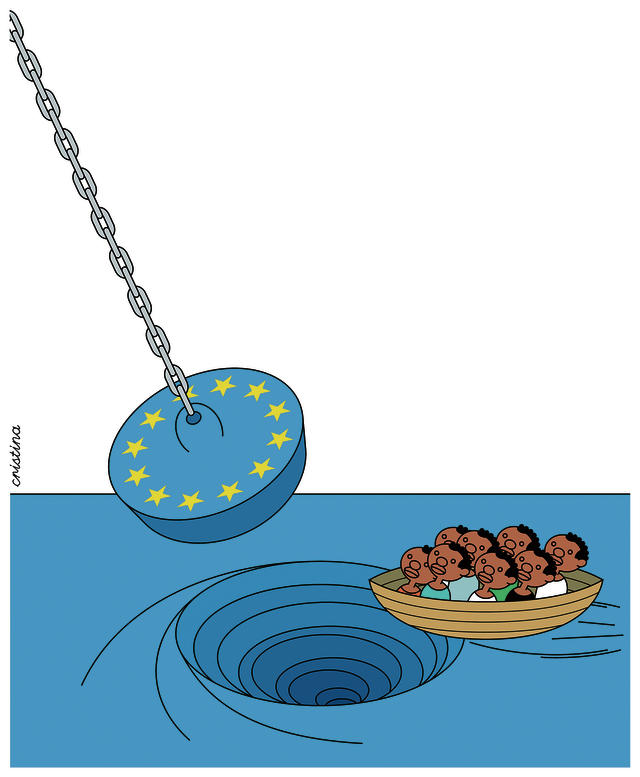
    Illustratie_Christina_Sampaio

  • Push Back Frontex! Against a new dimension of left-to-die-policy at sea

    Push Back Frontex!
    Against a new dimension of left-to-die-policy at sea

    13 febr. 2015
     
    In a letter from the 9th of December 2014, Klaus Rösler, director of Operations Division of Frontex, called upon the Italian Ministry of Interior, the navy and the coastguards to stop the current practice of rescuing boat-people in distress at sea. After the termination of the Italian navy operation Mare Nostrum which rescued the lives of more than 120.000 people, and at the beginning of the Frontex operation Triton, Rösler attacked the authorities in Rome for assigning vessels to move “into zones outside the operational area of Triton” in order to assist vessels in distress. This “would not correspond to the operational plan” and not every SOS-call needed to be acted upon, Rösler continued. As one of the directors of Frontex, he points to the responsibility of the Libyan coastguards which, as is known, do not exist for many months anymore due to renewed war-like conflicts. In other words: Klaus Rösler has unambiguously appealed from a top position of the EU border agency to let many refugees and migrants die in situations of distress at sea.
     
    Frontex was founded exactly 10 years ago. Already since its first operations at sea in 2006, the agency stands for an aggressive politics of deterrence. In order to polish its tarnished reputation, Frontex purported in the past years to observe refugee conventions, human rights and the law of the sea. This now, once again, proves to be a merely cosmetic measure, a dishonest image campaign for an agency that, since 2005, acts as the driving force of the EU border regime. Besides the operations along the sea- and land-borders, Frontex is a significant part of the training and technical armament of border police forces, the externalisation of borders through cooperation with third countries, the creation of and the participation in the border surveillance system EUROSUR, the border control operation Mos Maiorum, as well as brutally executed charter-deportations.
     
    In the current crisis in the central Mediterranean Sea, Frontex wants to enforce that the 25 vessels and 9 airplanes of operation Triton would be employed only within the 30-mile-zone off the Italian coast. The explicit aim of Triton is the reduction of arrivals at European coasts and the deterrence of boat-refugees. Over the last months, WatchTheMed’s* recently launched alarm phone for migrants has supported the rescue of several boats that were located precisely in the zone that Frontex demands to abandon. The hotline-teams have been in direct contact with boatpeople who would no longer be alive if Frontex’s left-to-die policy would have been applied. The situation necessitates a determined response of civil societies and all social movements: Let us stop these inhumane policies, let us defend the rights of refugees and migrants!
     
    Moreover, it is sheer mockery that Frontex, in January 2015, accused people smugglers of a “new dimension of cruelty” when several crews of so-called ‘ghost ships’ abandoned the vessels to avert criminalisation. Without doubt, there are unscrupulous profiteers of the lucrative trade of escape via the Mediterranean Sea. However, it is clear that the business with illegalised entry and the thousandfold death at sea are products of the EU border regime. Both could become history by tomorrow if refugees and migrants were able to simply buy ferry- and plane-tickets and travel as safely and cheaply as tourists. 

    As long as the freedom of movement for all is not a reality, deaths at sea can only be prevented if all people in distress are rapidly rescued everywhere, also off the coast of Libya! We demand the immediate withdrawal of the murderous Frontex order. We aim for an Euro-Mediterranean space that is not characterised by a deadly border regime but by solidarity and the right for protection and freedom of movement.

    * http://www.watchthemed.net

    First signatures:
    Networks Afrique-Europe-Interact, Borderline Europe, Welcome to Europe, FFM, Berlin; All Included Amsterdam, Flüchtlingsrat (Refugee Council) Hamburg, Stiftung (foundation) :do

    More signatures? Send to info@allincluded.nl

  • Watch the Med Alarm Phone

    For Boatpeople in Distress at Sea and in Cases of Pushback

    Campaign “Ferries not Frontex” towards an open Mediterranean space! (march 2016)

    WTM Alarmphone verklaring 1 jarig bestaan (12 okt. 2015)

    In solidarity with migrants at sea! The Alarm Phone 3 years on with dutch press release

    Moving On – 1 Year Alarm Phone Brochure and the many remarkable experiences made by Alarm Phone members in the project’s first year of existence (23 jan. 2016) with dutch press release

    News, Reports & Investigations

    THIS NUMBER IS NOT A RESCUE NUMBER!
    But an ALARM NUMBER to support rescue operations!

    What to do if you are in distress at sea or getting pushed back:
    1. Call first the coast guards and tell them about your situation of distress
    2. Then call the Alarm Phone
    3. Note that we cannot rescue, we do not have boats or helicopters
    4. We will make sure that your distress call is noted and acted upon
    5. If you are not promptly rescued by the coast guards we will inform the public media and politicians to put pressure on the rescue services.

    —————————————————————————————————

    Alarm Phone Nr.:  + 334 86 51 71 61

    —————————————————————————————————

    We know coastguards act quite differently. There are areas where they do their job well and rescue promptly. But refugees also report that they get pushed back by coast guards or are treated violently. When a distress call is received, we will call the coast guards ourselves, and follow up on their response, making known to them that we are informed and ‘watching’ them. We want to support you in protecting your lives and your right of freedom of movement.

    FAQ (10 questions posed to the WTM alarm phone project),

    Safety at Sea / Instructions for a Distress Call.

    Transnational Monitoring against the deadly injustice at sea! (how Watch the Med works) and

    Risks,Rights &Safety at Sea (informations for people considering to cross the sea).

    For a push back operation, see “They want to see us drown” – Survivors of a push back operation in the Aegean Sea report 16.11.2014 / Chios/Greece-Cesme/Turkey

    For the deadly delays in rescue operations, see the exemplary case from the 11th of October 2013 when more than 200 boat people drowned: Shipwreck 11th of October 2013.

    For general information about the situation in certain european countries for refugees – see: w2eu.info / welcome to europe

    Moet een kapitein een bootje met migranten in nood redden? (Vrije Universiteit Amsterdam)


    [Press Release, 8th of October 2014] *Watch The Med Alarm Phone against Left-to-die cases at Sea* »Our project is no solution, but an emergency intervention«

    Call for Watch The Med Alarm Phone” for Boatpeople

    (signatures below!)

    11th of October 2013: Refugees from a sinking boat called again and again Italian coastguards via satellite phone in order to be rescued, but their SOS signals were not taken seriously. The boat carried more than 400 people and was shot at in the night before by a Libyan vessel. Despite the Italian and soon later the Maltese authorities having been warned of the imminent distress of the passengers, rescue efforts were delayed for several hours and patrol vessels arrived one hour after the boat had sunk. More than 200 people died, only 212 people were saved.

    What would have happened if the boatpeople could have directed a second call to an independent phone-hotline through which a team of civil society members could raise alarm and put immediate pressure on authorities to rescue?

    One year after the tragedy from Lampedusa on the 3rd of October
    and after the left-to-die case mentioned above, the situation is no less dramatic. Although the Italian military operation “mare nostrum” led to the rescue of about 100.000 refugees and migrants within the last 11 months, only in the central Mediterranean area more than 1300 boatpeople became new victims of the border-regime. In the beginning of 2014 we witnessed more death at the external borders of EU: on the 20th of January 12 refugees died when their vessel sunk while being towed at high speed by a vessel of the Greek Coast Guard aiming to push it back towards the Turkish coast.
    And on the 6th of February the Spanish border guards shot with plastic-bullets at swimming migrants who tried to enter the Spanish enclave of Ceuta. More than 14 people died as a result.

    These cases are not isolated
    , but rather the most obvious amongst many similarly deadly violations perpetrated against migrants at sea throughout the Mediterranean. Would these deaths have occurred had civil society been informed and had exercised its pressure and influence before rather than after the incidents?
    We can no longer bear to remain helpless as tragedies repeat themselves. We want to do more than condemning these violations after the incidents. We believe that an alternative alarm network established by the civil society on both sides of the Mediterranean Sea could make a difference.

    We neither possess any rescue-teams, nor can we offer direct protection. We are aware of our limited capabilities and of the provisional and precarious character of our initiative. But we want to immediately raise alarm when refugees and migrants get into situations of distress at sea and are not rescued promptly. We want to document in real-time and scandalize immediately when boatpeople become victims of push-back operations or are sent back to countries such as Libya, where migrant rights are repeatedly violated. We want to intervene with political pressure and public mobilisation against the daily injustices at the external borders of the EU.

    We know that such pressure can be effective because it has been exercised already for several years by a few individuals who, through family and solidarity ties, have received phone calls from migrants at sea, alerted authorities and made sure that rescue operations had been carried out. We want to broaden and strengthen this network and reinforce its political role in support of migrant rights and the freedom of movement.
    Thus we aim to establish – in close cooperation with the monitoring project Watch The Med – an alternative alarm-phone running 24/7 as of the 10th of October 2014. It will be managed by human rights activists from both sides of the Mediterranean and offer a multilingual team. We will advise all persons in distress at sea to first alert the officially responsible rescue teams. But we will also call the coast guards ourselves, and follow up on their responses, making known to them that we are informed and “watching” them. If they fail to respond, we will gather all imaginable political and public pressure to force them to do so.
    We will alarm captains of commercial boats close by as well as international journalists, requesting the support of politically active religious leaders of all confessions as well as support of famous supporters. We will use the critical net-community for just-in-time-campaigns and call everybody to contribute with the creation of further forms of intervention.

    The left-to-die cases at sea, the human right violations of the EU border agency Frontex and coast guards in all areas of the Mediterranean Sea have to be stopped immediately. We need a civil society network on both sides of the Mediterranean Sea which can enforce political pressure for the lives and the rights of boatpeople, and we want to be part of it.

    Such an alternative alarm network would be a first but an urgently required step on the path toward a Euro-Mediterranean area that is not characterised by a deadly border regime but by solidarity and the right for protection and the freedom of movement.

    An Initiative of: Welcome to Europe  |  Afrique Europe Interact  |  borderline-europe  |  Noborders Marocco  |  Forschungsgesellschaft Flucht und Migration  |  Voix des Migrantes

    Signatures for the call:

    Madjiguene Cisse, former Sans-Papier-Movement in Paris, Dakar | Étienne Balibar, Philosopher, Paris | Elfriede Jelinek, Author & Nobel Literature Prize Winner, Vienna | Fr. Mussie Zerai, Habeshia Agency, Rome | Mohanad Jammo, Physician & Survivor of 11.10.13 Shipwreck, Aleppo/Bad Bergzabern | Fabrizio Gatti, Journalist, Rome | Jean Ziegler, former U.N., Special Rapporteur on the Right to Food, Geneva  |  Emmanuel Mbolela, author of ‘Mein Weg vom Kongo nach Europa’, Amsterdam  |  Boats4People  |  Imed Soltani, La Terre pour Tous, Tunis | José Palazon, Pro.De.In, Melilla | Mikel Araguas, Andalucia Acoge | Conseil des Migrants Subsahariens au Maroc | Petja Dimitrova, Artist, Academy of Fine Arts Vienna | Antonio Negri, Philosopher, Paris | Nina Kusturica, Filmmaker, Vienna | Network of Social Support to Refugees and Migrants, Athens | Gabriele del Grande, Journalist, Milano | Jesuit Refugee Service Schweiz | Stiftung:do, Hamburg | Ousmane Diarra, AME (Association Malienne des Expulsés), Bamako |  Stefan Schmidt, Captain of Cap Anamur 2004, Refugee-Commissioner of Schleswig-Holstein, Lübeck | FTDES (Forum Tunisien pour les Droits Économiques et Sociaux), Tunis | ODS, Sevilla | Karl Kopp, Director of European Affairs PRO ASYL and ECRE, Frankfurt | Amadou Mbow, AMDH (Association Mauritanienne des Droits de l’Homme), Nouakchott | Fulvio Vassallo Paleologo, L‘Altro Diritto, Sicilia |  Elias Bierdel, 2002-2004 Leiter der Cap Anamur, Austria | Martin Glasenapp, Medico International, Frankfurt | Patrice Boukar Zinahad, A.R.A.CE.M (Association des Refoulés d’Afrique Centrale au Mali), Bamako | KEERFA – Movement Against Racism & Fascist Threat, Athens | ATMF, France | ARCI, Italy | Ferenc Kőszeg, Honorary Chairman of the Hungarian Helsinki-Committee, Budapest | Borderline Sicilia Onlus | Sandro Mezzadra, Border and Migration Researcher, Bologna | Osaren Igbinoba, The Voice Refugee Forum, Jena | Solidarité sans Frontières, Switzerland | Village all together, Mytilini | Association Les voix libres, Strasbourg | Article 13, Tunis | Daniel Moundzego, ARSF (Association des Refugees Sans Frontieres), Douala | Ilias Panchard, Co-Präsident Junge Grüne Schweiz, Lausanne | All Included, Amsterdam | MigSzol – Migrant Solidarity Group of Hungary | Humanistische Union, Germany | Barbed Wire Britain | Balthasar Glättli, Fraktionspräsident Grüne, Schweiz  |  Orcun Ulusoy, Researcher, The Hague | Maria Bacchi, Comitato Scientifico Fondazione Langer, Bolzano & Associazione Mantova Solidale | Chabaka, Tanger  |  Antiracist Initiative of Thessaloniki |  Gergishu Yohannes, Initiative gegen Tod im Mittelmeer 2009 e.V. Bonn  |  Karl Heinz Roth, Social Historian & Physician, Hamburg  |  Michael Genner, Asyl in Not, Vienna  |  Conseil des Migrants France  |  CADTM Europe  |  Africa con voz propia  |  APDHA, Spain  |  The Refugee Councils, Germany  |  David Fedele, Filmmaker, Sydney  |  Franck Düvell, Researcher, COMPAS, Oxford  |  ALECMA (Association Lumiére sur l`Emigration Clandestine au Maghreb)  |  Rete Antirazzista Catanese  |  Comitato NoMuos/NoSigonella, Catania  |  Paolo Cutitta, Migration researcher, Amsterdam  |  Federica Sossi, Università di Bergamo  |  Hélène Yamta, La Voix des Femmes Migrantes, Rabat  |  Sabine Hess, Leiterin des Labors für kritische Migrations- und Grenzregimeforschung, Göttingen  |  Campaign to Close Campsfield  |  Luciana Zarini, retired teacher, Palermo  |  Maria Rosa Ragonese, teacher, Palermo  |  Association Horizons Migrants; bordermonitoring.eu  |  Wolf Dieter Narr and Dirk Vogelskamp, Commitee for Basic Rights and Democracy, Berlin/Cologne  |  Ahmed Jlassi, Filmmaker and University teacher, Tunis  |  Atmf (Association des Travailleurs Maghrébins de France). section Bas-Rhin  |  U.D.E.ES, l’union des étudiants de Strasbourg  |  CCFD-terre solidaire Strasbourg  |  Hatem Gheribi, Tunisien, Strasbourg  |  Mehdi Mohamed Amadir, Moroccan, Strasbourg  |  Omar Naman, Syrian refugee, Strasbourg  |  ATTAC Liège  |  Initiativkreis MenschenWürdig, Leipzig  |  Prof. Sabine Broeck, Research Group Black Knowledges, Universität Bremen  |  glokal e.V., Berlin  |  Lampedusa-Bündnis Göttingen  |  Integrationsrat Göttingen  |   Imam-Jonas Dogesch, Network of Migrants Organisations in Mecklenburg­-Vorpommern  |  Fouad HASSAM  |  Peter Birke, SOFI, Göttingen  |  Barbara Cárdenas and Willi van Oyen, Left Party, Hessen  |  Action-Alliance against Deportation, Rhine-Main  |  no one is illegal, Hanau  |  Lampedusa in Hanau  |  no one is illegal, Cologne  |  NoLager Bremen  |  transact  |  Netzwerk Kritische Migrations- und Grenzregimeforschung  |  European Civic Forum  |  Peter Marhold, Helping Hands, Vienna  |  Ulrich Brand, Institutsleiter und Professor für Internationale Politik an der Universität Wien  |  Network for the Political and Social Rights, Athens  |  Augenauf Bern  |  Bleiberecht Bern  |  Sans-Papiers-Anlaufstelle Zürich SPAZ  |  Johannes Bühler, Autor des Buches “Am Fusse der Festung”, Fribourg  |  Salvatore Pittà, Journalist und Aktivist, Bern  |  Pauline Milani, Präsidentin SOSF, Lausanne  |  Myriam Schwab-Ngamije, CSP Vaud, Lausanne  |  MediNetz Bremen  |  Die Linke Bremen  |  Recherche International e.V., Köln  |  Charlotte Wiedemann, Journalistin, Berlin  |  Wohnungsbaugenossenschaft WiSe e.G.  |  Stadtkommune Alla Hopp, Bremen  |  Tobias Linnemann, Diplompädagoge, Bremen  |  Bruno Kraft, Diplompädagoge, Bremen  |  Luca Bräuer, Schüler, Bremen | Veith Weers, Bremen |  Barbara Funck, Studentin, Bremen |  Cornelius Hertz, Galerist, Bremen |  Sarah Lempp, Journalistin |  Ted Gaier, Goldene Zitronen  |  SOAS Detainee Support (SDS), London  |  Cetta Mainwaring, Assistant Professor, University of Waterloo  |  Right to Remain, London  |  kein mensch ist illegal, Hamburg  | Association pour la Défense des Emigrés Maliens (ADEM), Bamako  |  Association Retour Travail Dignité (ARTD), Bamako  | Association des Migrants Repatriés de Libye et de la Cote d’Ivoire (AMRLEC), Bamako  |  Association des Femmes et Enfants Repatriés et Migrants de la Cote d’Ivoire (AFERMACI), Bamako  |  Association des Jeunes Reoules de l’Espagne de la Commune Yanfolila (AJRECY), Yanfolila  |  Hellenic League for Human Rights, Athens  |  Solidarity Social Clinic (KIA), Thessaloniki  |  Yiorgos Tsiakalos, Professor Emeritus, Aristotle University of Thessaloniki  |  Spyros Marchetos, School of Political Sciences, Aristotle University of Thessaloniki  |  Jérôme Valluy, Université Panthéon-Sorbonne  |  Gilles Reckinger, Department of History and European Ethnology, Innsbruck  |  Alexander Pollak, SOS Mitmensch, Vienna  |  Anna Fuchs, Berlin  |  www.migrazine.at – Online-Magazin von Migrantinnen für alle  |  Medinetz Freiburg  |  Die ganze Bäckerei, Leipzig  |  Sieglinde Rosenberger, Department of Political Science, Head of the research group INEX ‘The Politics of Inclusion & Exclusion’, Vienna  |  Peter Herrmann, EURISPES, Rome  |  Stefan Thimmel, Rosa Luxemburg Stiftung, Berlin  |  Angelika Wahl, Frankfurt  |  Konstantinos Tsitselikis, Associate Professor, University of Macedonia, Thessaloniki  |  Athanasios Marvakis, Associate Professor, Aristotle University of Thessaloniki  |  Institute of Race Relations, London  |  Gurminder K. Bhambra, Professor of Sociology, University of Warwick  |  South Yorkshire Migration and Asylum Action Group  |  No One Is Illegal, England   |  L’Association Rencontre Méditerranéenne pour l’Immigration et le Développment (ARMID), Tanger  |  Spitou Mendy, SOC-SAT, Almería  |  Noborder, Frankfurt  |  Helga Dierichs, Munich  |  Matthias Plieninger, Hamburg  |  Ramona Lenz, Medico International, Frankfurt  |  Ivana Domazet, Refugee Council Brandenburg, Potsdam  |  Antirassistisches Netzwerk Sachsen-Anhalt  |  Arbeitskreis Antirassismus, Magdeburg  |  Anne Bathily, Brussels  |  f.lo.p.s, autonomous feminist women-lesbian group, Bremen  |  no-racism.net, Vienna  |  acompa, assistance group for refugees, Bremen  |  Christian Peacemaker Teams, Mediterranean  |  Kommune Niederkaufungen  |  Natalia Paszkiewicz, Anthropologist, London  |  Alexander Stoff, Vienna  |  Hannelore Stoff, Vienna  |  Susanne Heim, Berlin  |  Youth without Borders, Germany  |  Afghans United Association, Athens  |  Österreichische Lagergemeinschaft Ravensbrück & Freunde, Vienna  |  Nadine Kegele, Author, Vienna  |  Dr. James Brassett, University of Warwick  |  Alev Korun, Abgeordnete zum Österreichischen Nationalrat, Vorsitzende des parlamentarischen Menschenrechtsausschusses  |  Thalia Tsalouhidou, Apothekerin, Solidarische Klinik, Athens  |  ausbrechen, Paderborn  |  David Loher, Social Anthropologist, Bern  |  Harald Bauder, Ryerson Centre for Immigration & Settlement (RCIS), Toronto  |  Andrea Ypsilanti, Institut Solidarische Moderne, Member of the Hessian parliament (SPD)  |  Bremer Friedensforum  |  Analyse & Kritik, newspaper for left debate, Hamburg  |  Resf13, Réseau Éducation Sans Frontières, France  |  Dietrich Gerstner, Kirchlicher Entwicklungsdienst – Menschenrechte und Migration, Hamburg  |  Tom Rodriguez-Perez, Football Beyond Borders, London  |  Yasmine Accardo, Activist, Naples  |  Flüchtlingsinitiative Bremen  | Heinz Nigg, Visual Anthropologist and Community Artist, Zurich  |  Athanasios Papaisiou, Teacher at the State Conservatory of Thessaloniki  |  Flüchtlingsrat Bremen  | SolidaritéS (mouvement anticapitaliste, féministe et écologiste),  Suisse  |  Ulla Jelpke, MdB, Innenpolitische Sprecherin der Fraktion DIE LINKE, Berlin  |  Frans Zoer, Visitors Group to migrant detention centre, Amsterdam  |  ASTU (Action citoyennes interculturelles), Strasbourg  |  FelS (Für eine linke Strömung), Berlin  |  Senol Akkilic, Integrations- und Jugendsprecher der Wiener Grünen im Rathaus  |  Kritnet Schweiz  |  Mattea Meyer, Kantonsrätin SP, Zürich  |  Salvatore die Concilio, SPAZ Vorstand und alt Gemeinderat SP, Zürich  |  Shedhalle, Zürich  |  Solidarités, Switzerland  |  Sarah Schillinger, Migrationsforscherin und Aktivistin, Basel  |  Ueli Mäder, Professor für Soziologie, Basel  |  Andrea Vogel, Ärztin, Bremen  |  Joachim Welsch, Osnabrück  |  Katerina Stavroula, journalist, Athens  |  Elias Perabo, Adopt a Revolution, Berlin  |  Dr Chris Rossdale, Royal Holloway, University of London  |  Center for Political Beauty, Berlin  |  Christiane Benner, Geschäftsführendes Vorstandsmitglied der IG Metall, Frankfurt  |  Vicki Squire, Associate Professor, University of Warwick  |  Solidaritätsnetz Sans-Papiers, Bern


    The Watch The Med Alarm Phone is a novel project which will be launched in October 2014 by activist networks and civil society actors in Europe and Northern Africa. It responds to the human rights violations and the unabated dying of migrants and refugees at sea, as well as the militarisation and externalisation of EU borders. 2014 is already the deadliest year ever recorded with at least 3000 people dying in their attempt to overcome Europe’s external borders. This year, the Italian navy launched the ‘Mare Nostrum’ operation, an ambivalent process that further extended Europe’s border surveillance and (potential) repression of migratory movements but that became also appropriated by about 130.000 migrants and refugees who made it to European shores. However, the Mare Nostrum operation is ending and replaced by ‘Frontex Plus’ and it seems certain that the new mission will not be as extensive as Mare Nostrum had been so that even more people will die in their attempts to cross the border.
    This alternative alarm network is the first and an urgently required step toward a Euro-Mediterranean area that is not characterised by a deadly border regime but by solidarity and the right for protection and the freedom of movement.

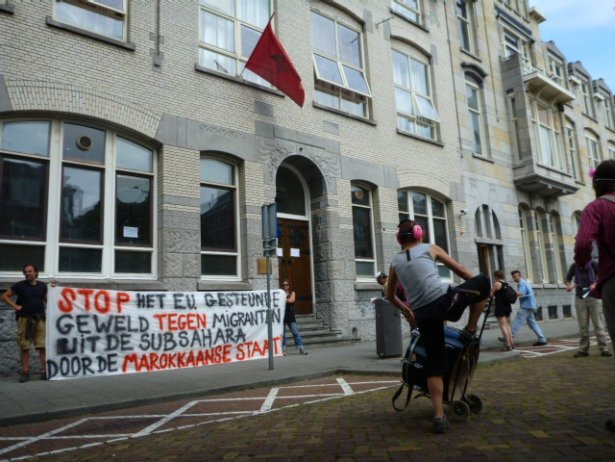
  • picketline spaans consulaat: opheldering over de doden aan de grenzen van Ceuta en Melilla!

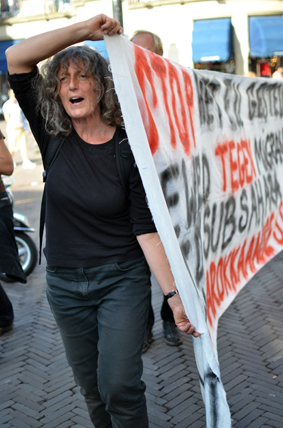
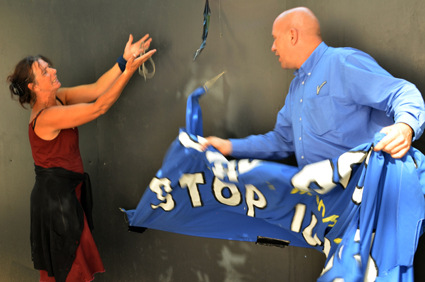
    25 februari 2014. Activisten van Afrique-Europe-Interact hebben actie gevoerd bij de ambassades van Marokko en Spanje in Berlijn ter nagedachtenis van de doden in Ceuta van 6 februari 2014. Op 27 februari werd in Amsterdam bij het Spaanse consulaat gedemonstreerd door We Are Here vluchtelingen en No Border activisten. Voor video’s zie:
    http://www.afrique-europe-interact.net/?article_id=1146&clang=2

    Oproep Picketline bij Spaanse Consulaat:
    Opheldering over de doden aan de grenzen van Ceuta en Melilla!
    Ter herdenking van de doden van Ceuta en Melilla en voor het stoppen van het moorden en opjagen van migranten aan de grenzen van Fort Europa, organiseren ‘We Are Here’ en het No Border Netwerk donderdag 27 februari 2014 vanaf 16.00 uur een picketline voor het Spaanse Consulaat aan de Frederiksplein 34 in Amsterdam. Vrije migratie en vestiging voor iedereen en overal!
    Met de heldere eis ‘Opheldering over de doden aan de grenzen van Ceuta en Melilla’ wordt de internationale gemeenschap opgeroepen, om in de laatste week van februari protestherdenkingen te organiseren voor Spaanse en Marokkaanse consulaten, ambassades en of andere overheidsinstellingen afkomstig uit die landen.
    Op 6 februari probeerden 400 migranten in een collectieve actie de zwaar beveiligde grens van de Spaanse enclave Ceuta in Marokko vanuit zee te overwinnen. Het betreft een van de twee directe buitengrenzen van de EU op Afrikaanse bodem. De Spaanse Guarda Civil beantwoordde deze poging om het grondgebied van de EU te bereiken door op mensen in het water te schieten met rubberen kogels en traangas. Marokkaanse agenten van de grenspolitie, ondersteund door lokale racisten, namen vanaf de wal deel aan de moorddadige klopjacht. Tenminste negen mensen verloren op die dag het leven, en ten minste 50 worden volgens de groep ‘Illegale mensen uit Sub Sahara in Marokko’ nog steeds vermist. Tientallen raakten gewond en werden illegaal gedeporteerd naar Marokko.
    De moorddadige klopjacht aan de buitengrenzen van de EU is het directe en door alle EU-lidstaten bewust gekozen gevolg van de uitgebreide militarisering en de externalisering van de buitengrenzen van de EU. Het is onderdeel van de oorlog van de EU-migratieregimes en haar bondgenoten tegen allen die zich het recht nemen op vrij verkeer tussen Afrika en Europa. De ruim 300 slachtoffers van de ramp bij Lamperdusa zijn nog niet begraven of een volgende ramp heeft alweer plaats gevonden. In dit geval laat de Marokkaanse overheid zich als een betrouwbare poortwachter van de EU inzetten. In de hoop op bevoorrechte economische en politieke betrekkingen met de Europese mogendheden creëert Marokko een soort voorgeborchte voor migranten bij de muren van Fort Europa.

    De internationale oproep van Interact (transnationaal netwerk) is in Nederland overgenomen door de migrantengroep ‘We Are Here’ en het No Border Netwerk Nederland. Het moet afgelopen zijn met de militarisering van het grensregime. De grenzen van Fort Europa worden steeds verder naar Afrika opgeschoven (externalisering van de EU grenzen). Dat de Marokkaanse staat moet stoppen taken te vervullen wat betreft EU grenscontroles.

    Ofwel: opening van alle Europese grenzen en in het bijzonder bij Ceuta en Melilla. Vrijheid van beweging en vestiging voor iedereen. En opheldering over de slachtpartij van afgelopen 6 februari.

    Zie ook:
    – a href=”https://no-border.nl/oproep-ter-herdenking-van-doden-ceuta-en-melilla-decentrale-acties-bij-spaanse-en-marokkaanse-instituties/#duits” target=”_blank”>https://no-border.nl/oproep-ter-herdenking-van-doden-ceuta-en-melilla-decentrale-acties-bij-spaanse-en-marokkaanse-instituties/#duits
    – http://www.afrique-europe-interact.net/?article_id=113&clang=0
    – http://www.deredactie.be/cm/vrtnieuws/videozone/nieuws/buitenland/1.1880828

  • Nederland doet actief mee aan immigrantenjacht

    Nederland doet actief mee aan immigrantenjacht

    All Included / Amsterdam, 2011

    Nederland neemt sinds 15 februari deel aan Frontex-operatie Hermes in het Middellandse Zeegebied tussen Noord-Afrika en Zuid-Italië. Sinds in januari de volksprotesten in Noord-Afrika oplaaiden, is er een grote toename van immigranten die de oversteek naar Europa wagen. Nadat Italië de hulp van de andere landen van de Europese Unie inriep, startte Europees grensagentschap Frontex Operatie Hermes 2011. Een Nederlands Dornier kustwachtvliegtuig patrouilleert nu vanuit het Italiaanse eiland Pantelleria, halverwege tussen Tunesië en Sicilië, op zoek naar bootvluchtelingen. Nederland levert eveneens een aantal grenswachters en technici. Deze staan onder Nederlands commando maar voeren instructies uit van Italië als ontvangend land van de Frontex-operatie.

    Mensenrechtenschendingen

    Italië staat echter voorop met het schenden van mensenrechten voor migranten. Al sinds 2009 stuurt Italië migranten in ‘push back’-operaties terug naar Libië. Migranten, asielzoekers incluis, worden zo simpelweg buiten de deur gehouden. Deze collectieve uitzettingen heeft Italië ook uitgevoerd binnen het kader van Frontex-operaties zoals operatie Nautilus. De ‘push back’-operaties worden geprezen om hun effectiviteit: de migratiebewegingen worden stopgezet.
    Italië eist nu van Tunesië  dat ze Italiaanse veiligheidstroepen aan de Tunesische kust mogen stationeren en dreigt met gedwongen repatriëring als de migratie niet gestopt wordt. “Wij zijn niet onderworpen aan chantage zoals met Libië deed met de olie. Tunesië is van ons afhankelijk, zeker in de toeristensector.” aldus de Italiaanse minister van Binnenlandse Zaken Roberto Maroni.
    Nederland heeft tot nu toe een enigszins huichelachtig beleid gevoerd: Frontex wel ondersteunen, maar geen vuile handen willen maken door zelf aan collectieve uitzettingen deel te nemen. Met haar deelname aan operatie Hermes dreigt Nederland nu direct medeverantwoordelijk te worden voor ‘push back’-operaties.

    Omgekomen migranten

    Aan de ‘push back’-operaties gingen diverse akkoorden tussen Europa en Libië vooraf, waarbij Italië, Frontex en de EU betrokken waren. Italië heeft diverse overeenkomsten en protocollen met Libië gesloten in de strijd tegen ‘terrorisme, georganiseerde misdaad en irreguliere migratie’. In 2003 voorzag Rome Tripoli van rubberboten, off-road voertuigen en systemen voor satellietnavigatie, en nam deel aan de financiering van deportatievluchten en de bouw van detentiecentra voor migranten. Tussen oktober 2004 en maart 2005 voerde Italië de eerste collectieve uitzettingen uit. Van deze eerste groep uitgezette migranten zouden er 106 in detentie zijn omgekomen.

    Nauwe samenwerking met Khadaffi

    De EU begon haar samenwerking met Khaddafi in 2004 en financierde grenscontroles tussen Libië en Niger. De Europese Commissie nodigde Khaddafi zelfs uit deel te nemen aan Frontexpatrouilles in het centrale deel van de Middellandse Zee. Volgens de toenmalige EU-commissaris Franco Frattini zou Frontex in het ideale geval toegestaan worden in de Libische territoriale wateren patrouilles uit te voeren en immigranten terug te sturen naar Libische havens. Om dit te bereiken leidde Frontex in juni 2007 een EU-missie in Libië over illegale immigratie. Hierbij werden detentiecentra voor migranten bezocht. Zo’n 60.000 migranten werden ten tijde van dit bezoek onder erbarmelijke omstandigheden gedetineerd.
    Men kwam overeen dat irreguliere migranten die in Libië aan het werk waren naar hun landen van herkomst konden worden uitgezet. Een maand later luidde Amnesty International de noodklok over massadeportaties van asielzoekers uit Libië. Tientallen waren gearresteerd nadat ze onderschept waren in de Middellandse zee door Libische schepen.

    Uiteindelijk sloot Libië niet met Frontex maar met Italië in 2007 een akkoord over het uitvoeren van gezamenlijke zeepatrouilles in Libische en internationale wateren, in de vorm van een Protocol van Samenwerking en een Vriendschapsverdrag. Hierbij schonk Italië de Libiërs vaartuigen voor een gemengde Italiaans en Libische bezetting. Van de EU kreeg Libië twee jaar later nog eens 20 miljoen euro ter bestrijding van illegale immigratie. Dit financieel stimuleren van Afrikaanse landen door Brussel en afzonderlijke EU-lidstaten om migranten preventief tegen te houden en terug te sturen wordt externalisatie van de EU-grensbewaking genoemd.

    ‘Push back’-operaties

    Hoe gaat een ‘push back’-operatie in zijn werk? Wanneer een kustwachtvliegtuig een vaartuig een vaartuig in het vizier krijgt dat  verdacht wordt van het vervoeren van migranten, gaat de Italiaanse marine of grensbewaking over tot interceptie. Dit betekent dat de migranten op  het Italiaanse vaartuig moeten stappen. Soms gaan ze over op een Libisch vaartuig waarbij Italiaanse grenswachters aan boord gaan. Vervolgens worden de migranten teruggestuurd naar Libië. Bekend is dat door UNHCR erkende vluchtelingen op deze wijze collectief zijn teruggestuurd. In enkele gevallen hebben in het verleden Frontex-vliegtuigen hierbij als waarnemers Italië naar de bootvluchtelingen geleid.
    Frontex kreeg in 2009 fikse kritiek van mensenrechtenorganisaties omdat de bootvluchtelingen niet de kans gekregen hadden om een asielaanvraag in te dienen. Iedereen moet volgens het internationaal recht de mogelijkheid krijgen om vervolging in eigen land te ontvluchten en asiel te zoeken in een ander land. Bovendien is Libië geen partij bij het Vluchtelingenverdrag en heeft het zelfs geen asielprocedures. Frontex schendt met deze aanpak het internationale vluchtelingenverdrag, het Schengenverdrag en het Europees Verdrag voor de Rechten van de Mens.

    Ook in West Afrika

    Dergelijke door Frontex ondersteunde ‘push back’-operaties vinden al langer plaats in West-Afrikaanse wateren. In Frontex-operatie Hera worden migrantenboten door Spaanse patrouilleboten al in Senegalese en Mauretaanse wateren onderschept en teruggestuurd naar deze landen met zeer slechte mensenrechtensituaties. ‘Een ontmoedigingsbeleid,’ noemt Frontex-directeur Ilkka Laitinen dat. ‘Een ernstige vorm van schending van mensenrechten’ noemden mensenrechtenorganisaties dat.

    Gil Arias-Fernández, plaatsvervangend directeur van Frontex, benadrukte bij aanvang van de Italiaanse push-back-operaties in 2009 dat alle vliegtuigen, boten en personeel van EU-lidstaten die betrokken zijn bij Frontex missies onder controle blijven van nationale regeringen. Wanneer patrouilles rapporten sturen naar de Italiaanse grensbewaking over migrantenbewegingen, dan is het feitelijk ‘niet Frontex die rapporteert’. Frontex is bovendien niet belast met het terugsturen van mensen naar Libië of West-Afrika. “Dat is de verantwoordelijkheid van Spanje en Italië”. Maar “het zou kunnen” dat Frontex een morele verantwoordelijk draagt, erkent Gil Arias. Statistieken van Frontex laten in 2009 een daling zien van 31% in het aantal migranten die Italië of Malta proberen te bereiken. Arias-Fernández zei dat de Italiaanse overeenkomst met Libië hiertoe had bijgedragen. Er is onder EU-lidstaten onenigheid over wie er  verantwoordelijk is voor de migranten die op zee worden opgepikt. “Als de situatie aanhoudt zouden sommige lidstaten problemen kunnen hebben met deelname [aan gezamenlijke Frontex-operaties] daar waar twijfels zijn over mensenrechten,” zei Arias-Fernández in 2009.

    Nederland houdt handen schoon?

    Nederland heeft afgelopen jaren twee voorwaarden gesteld aan haar deelname aan Frontex.
    De eerste eis is dat een Nederlands schip alleen in Europese territoriale wateren wordt ingezet. Zo wil Nederland voorkomen dat als een Nederlands  fregat bijvoorbeeld voor de kust van de Canarische Eilanden een schip met Senegalezen oppikt, Nederland verantwoordelijk is voor hun asielaanvraag.  Op een Nederlands schip geldt immers de Nederlandse rechtsspraak. “Het moet geen vooruitgeschoven asielpost worden”, aldus toenmalige staatsecretaris van Justitie Albayrak.
    Bij een Frontex-operatie kan worden afgesproken dat het Europese gastland – Italië in geval van Hermes-operatie – verantwoordelijk is voor het asielverzoek van een onderschepte of geredde migrant als deze aan boord van een schip van een EU-land wordt gehaald. Nederland heeft dit als voorwaarde gesteld voor haar deelname aan een Frontex-operatie.

    Zuid-Europese landen maken dergelijke bilaterale afspraken met corrupte regimes in Afrika – zoals Spanje met Mauretanië en Italië met Libië – omdat Noord-Europese landen nauwelijks asielzoekers overnemen uit Spanje, Italië en Malta. Ook Nederland weigert asiel te verlenen aan mensen die de gewelddadigheden in Noord-Afrika ontvluchten. Vluchtelingen moeten in de regio blijven en als ze Italië of Malta weten te bereiken, moeten deze landen ook maar de procedures en opvang verzorgen, zo is de redenering.

    Verantwoordelijkheid

    Nederland is echter ook direct verantwoordelijk doordat ze geld beschikbaar stelt aan Frontex voor de zeepatrouilles incl. de ‘push back’-operaties van de zuidelijke landen en grensbewaking in Afrika. Zo ontvangt Spanje financiële steun van de overige lidstaten voor patrouilles in de wateren van Senegal en Mauretanië.

    Zo werkt Nederland mee aan het buiten de deur houden van migranten en asielzoekers, terwijl de zuidelijke landen het vuile werk opknappen. Zonder problemen worden corrupte regimes gesteund zolang ze migranten tegenhouden. Terwijl in Afrika en het Midden-Oosten een inspirerende revolutie aan de gang is, probeert men in Europa uit alle macht alles bij het oude te houden door het eigen belang voorop te stellen. Van solidariteit met de onderdrukte bevolking in het Zuiden is vooralsnog geen sprake. Daarom zullen migranten blijven komen om armoede en corruptie te ontvluchten. En dat is hun goed recht.

    All Included 2011

  • Protest tegen arrestaties van Subsahara migranten in Marokko

    8 augustus 2013

    Vandaag protesteren wij vanuit het No Border Camp zowel bij de ambassade van Spanje en bij de vertegenwoordiging van de Europese Commissie in Den Haag. Wij eisen ter ondersteuning van het Beraad van Subsahara Migranten in Marokko dat de mensenrechten worden gerespecteerd. Wij eisen tevens dat Europa een einde maakt aan het externaliseren of exporteren van de Europese grensbewaking en het omkopen van de Marokkaanse staat om de rol van waakhond te vervullen.

    In de nacht van 23 op 24 juli 2013 heeft een groep Subsahara migranten gepoogd de hekken van Melilla over te steken. Melilla is een Spaanse enclave tegen Marokko aan aan de Middellandse Zee. De migranten hoopten in Europa een beter leven op te bouwen en geld naar huis te kunnen sturen. Zij werden echter allen zwaar mishandeld door zowel Spaanse als Marokkaanse bewakers. De volgende dag vonden er massale razzia’s plaats in steden in het Noorden van Marokko waarbij honderden subsahara migrante vrouwen, mannen en kinderen werden geslagen, gearresteerd en uitgezet naar de Marokkaans-Algerijns woestijngebied. Anderen zijn in het ziekenhuis van Nador waar twee zijn overleden en meerder met zware verwondingen liggen. De migranten vragen nu om hulp.
    090813_consulaatMarokko_Rotterdam1

    Sinds 2 augustus is er in Rotterdam een No Border Camp. Dit kamp is een actiekamp ter ondersteuning van migranten onder de leus ‘vrijheid van beweging’.

    Onderstaande Engelstalige brief wordt aangeboden aan de Spaanse ambassade en de Europese Commissie, en is ook verstuurd naar de Marokkaanse ambassade:

    Arrests of Sub-Saharan migrants in Morocco
    Dear Mr. Ambassador,

    with great concern I learned from Moroccan and international media, that Moroccan security forces executed various raids against Sub-Saharan migrants in the North of Morocco and in other cities like Mekhnés and Rabat. For example: on July 27th 140 migrants were detained close to the city of Nador and some days before, on July 24th, nearly 300 migrants were detained in the neighbourhood Boukhalef in Tanger.

    A group of unarmed migrants attempted to override the border fortifications to Melilla in the night of 23th to 24th of March and these desperate trys which are going on since years now were given as a reason for the actual police raids. During the raids hundreds of migrants – men, women and children – have been arrested, beaten and deported to the desert at the moroccan-algerian border. In Tanger a senegalese woman in presence of her two year old child was injured and humiliated by police forces and was deported half naked in a lorry to the border between Morocco and Algeria. Close to Nador a woman was forced to leave her seven months old child behind in the forest, another one had to leave one of her three year old twins behind. Those who managed to escape and to hide in the close by forests did not dare to go back into the cities for fear of new raids. Others are in hospitals in Nador, numerous severely injured and two dead persons are reported.

    To my opinion it is alarming, that Moroccan media are justifying these inhuman raids by claiming, that the migrants were responsible for armed attacks against the fences of Melilla as they should have used sticks. It is highly deceptive to call these sticks arms (if ever they have been used) and to call the desperate try to overcome the fences violence. The violence was clearly committed by the Moroccan security forces as the above mentioned examples show.
    And it has to be mentioned here too, that a big part of the responsibility for the violence is the deeply inhuman policy of the European Union, to externalise and militarise its border regime. Last but not least this policy is responsible for the death of some ten thousands of refugees and migrants from both Sub-Saharan Africa and the Maghreb on their way to Europe since 1993.

    Basically I would like to ask you, to advocate for an immediate stop of the ongoing raids, arrests and deportations to the moroccan-algerian border. It is also of great importance, that the responsible persons for the recent cases of death are brought to justice. Moreover all wounded migrants should have the possibility of medical treatment in hospitals without being in fear of being arrested.

    Finally I would like to point out, that I explicitly support all corresponding demands of Moroccan human rights organisations.

    Yours sincerely,
    0080813_EUvertegenwoodiging_DenHaag5_small
    0080813_EUvertegenwoodiging_DenHaag2_small